Virgin Galactic's Next-Gen Space Plane Just Flew for the First Time
The vehicle, named Apeiron, is built to fly far more often than its predecessor as the company works through a growing backlog of ticket holders.
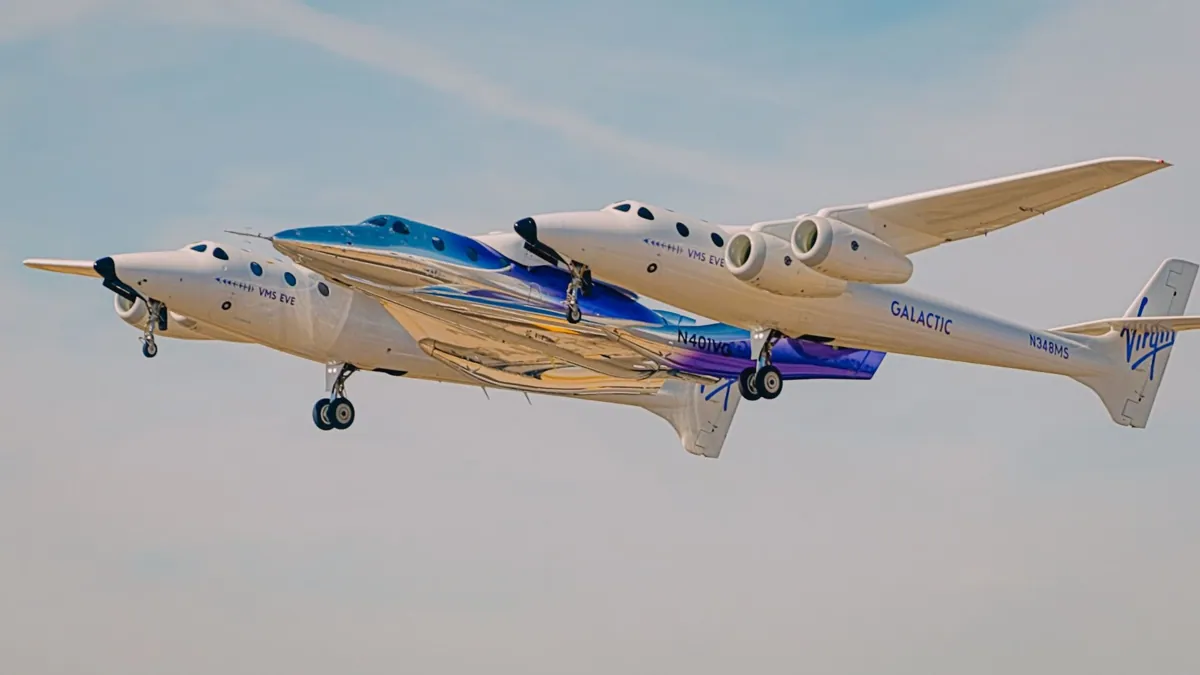
Virgin Galactic's next-generation space plane just left the ground for the first time, a milestone the company has been building toward for years as it tries to turn space tourism into something closer to a real business rather than a novelty.
The vehicle, named Apeiron, made its maiden flight on Thursday, October 28, carried beneath the wings of Virgin's mothership aircraft, VMS Eve. The trip wasn't a space launch itself. It was a ferry flight, moving Apeiron from Virgin's manufacturing facility in Mesa, Arizona, to Spaceport America in New Mexico, where the company actually flies its suborbital missions.
"Seeing the ship fly beneath Eve to Spaceport America was a moment years in the making," Virgin Galactic CEO Michael Colglazier said in a statement, adding: "To our team and our astronaut community: your Spaceship has arrived."
Apeiron, whose name comes from the Greek word for "boundless," is the first of what Virgin calls its "Delta-class" space planes. It will spend time at Spaceport America going through checks and tests before the company's planned start of commercial service in spring 2027.
How the flights will work
The basic flight profile will look familiar to anyone who followed Virgin Galactic's earlier missions. Eve carries the space plane up to roughly 45,000 feet before releasing it. From there, Apeiron ignites its own rocket motor and climbs the rest of the way into suborbital space, carrying six passengers and two pilots. Those passengers get a few minutes of weightlessness and a view of Earth's curvature against the black of space before Apeiron glides back down for a runway landing at the spaceport.
Virgin Galactic has run this playbook before. Its previous space plane, VSS Unity, flew seven commercial suborbital missions between June 2023 and June 2024. But Unity's run was brief, and that's precisely the problem the Delta-class is meant to solve.
Built for volume, not novelty
According to Virgin Galactic, the Delta-class ships are designed to fly twice a week and last for more than 500 missions over their operational lifetime. The company describes the new vehicles as supporting "the economics of a scaled commercial operation, with increased flight cadence and a cost profile unprecedented in the industry," per the statement.
That's a notably different pitch than the one built around Unity, which flew a handful of missions total. If Virgin Galactic can actually hit twice-weekly flights with a fleet of these vehicles, it starts to look less like a boutique experience for the ultra-wealthy and more like an actual recurring service, even if the price tag remains firmly out of reach for most people.
And a fleet is the plan. A second Delta-class ship is already under construction and is expected to enter service in mid-2027, Virgin Galactic says.
A deep backlog and rising prices
The company has real demand to work through. Nearly 700 ticket holders are currently waiting for their turn to fly, according to Virgin Galactic. The most recent batch of tickets, priced at $750,000 each, sold out completely. The next round is expected to cost $850,000 per seat, according to a report from LATTE Luxury News.
That backlog underscores why flight frequency matters so much here. A space plane that flies occasionally and carries six people at a time can only chip away so fast at a list of hundreds of paying customers. Getting Apeiron and its siblings into a twice-weekly rhythm would meaningfully speed up how quickly those ticket holders actually get their trip.
The field to itself, for now
Once Apeiron starts flying commercially, Virgin Galactic will effectively have the suborbital space tourism market to itself. Jeff Bezos' Blue Origin had been the other major player, flying paying customers on its New Shepard vehicle through 14 crewed suborbital missions between July 2021 and January 2026. But New Shepard is currently grounded while Blue Origin redirects its attention to helping NASA land Artemis astronauts on the moon.
That leaves Virgin Galactic as the only company currently positioned to offer this kind of trip, assuming Apeiron's testing campaign at Spaceport America goes smoothly over the next several months. The spring 2027 target for commercial service gives the company roughly a year and a half to run through the checks needed before it starts flying paying customers again. For a company whose last commercial space plane flew only seven missions, the real test isn't whether Apeiron can reach suborbital space. It's whether Virgin Galactic can finally make flying there a routine occurrence rather than a rare event.