SpaceX Test-Fires Starship Ahead of November Flight That Could Land Both Stages
Ship 42 completed back-to-back static fires this week, clearing a key hurdle before a Flight 15 launch that may attempt the company's first-ever catch of a returning Starship upper stage.
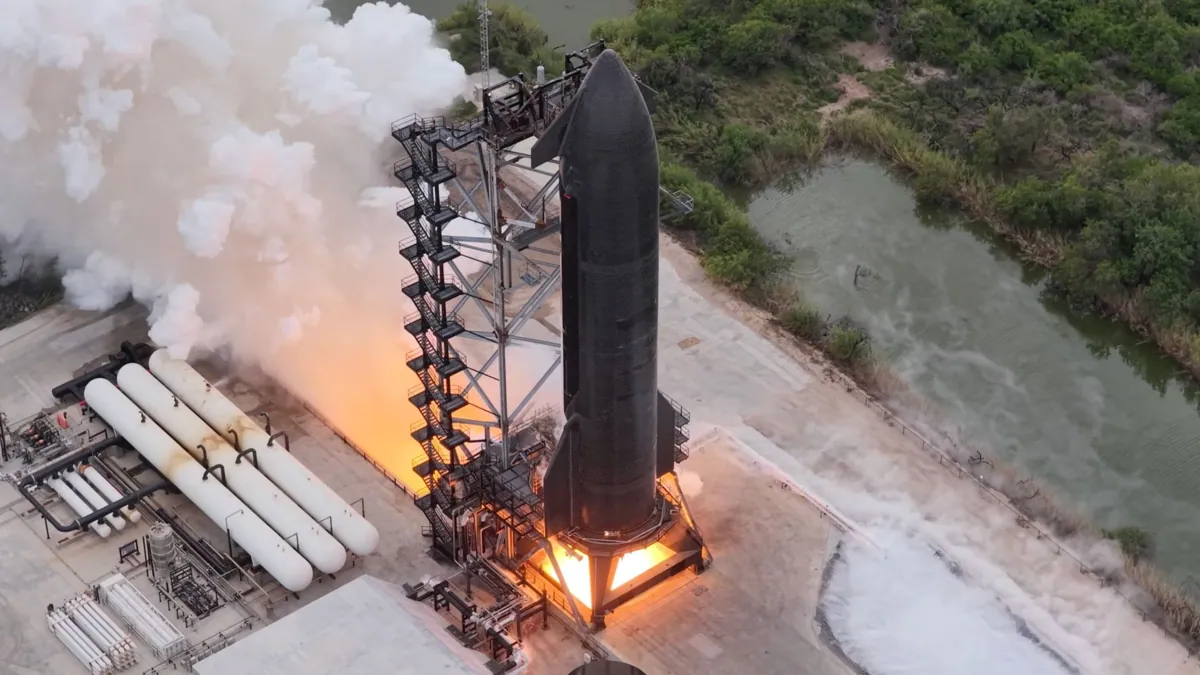
SpaceX ran Starship's upper stage through its paces this week, igniting its engines on the ground in a pair of tests that push the company closer to its next big Starship launch.
On Monday and Tuesday, SpaceX fired up Ship 42, the vehicle slated to serve as the upper stage for Starship's 15th flight test. According to a SpaceX post on X shared Wednesday, the vehicle "performed a full duration, six-engine static fire, and fired a single Raptor engine to simulate a deorbit burn." Static fires like these let engineers confirm an engine's performance while the rocket stays bolted to the ground, rather than risking a full liftoff with something still wrong.
The test comes shortly after SpaceX ran a similar check on Booster 22, the Super Heavy first stage that will fly alongside Ship 42 on Flight 15. That booster test involved all 33 of its engines firing at once. With both halves of the rocket now checked out, SpaceX appears on schedule for a flight CEO Elon Musk has said is targeted for sometime in November.
A flight built for a double catch
What makes Flight 15 worth circling on the calendar isn't just that it's happening. It's what SpaceX might try to pull off once it does.
Musk said last week that the company intends to attempt catching both the Super Heavy booster and the Ship upper stage during this flight, assuming regulators sign off. SpaceX has already landed Super Heavy three times using the giant mechanical arms, nicknamed "chopsticks," mounted on the launch tower at Starbase, its South Texas facility. But it has never tried to catch Ship. If Flight 15 pulls off both catches, it would mark the first time SpaceX has recovered the entire rocket in one mission.
That matters because catching both stages is the whole point of how Starship is supposed to work. SpaceX designed the rocket to be fully reusable, a sharp departure from the Falcon 9 and Falcon Heavy, whose upper stages are thrown away after every launch. Catching Ship and Super Heavy with the tower, rather than landing them the way Falcon boosters touch down on legs, is meant to cut the turnaround time between flights dramatically, which SpaceX says is key to flying Starship far more often than it does today.
Riding momentum from a historic flight
Flight 15 follows what was already a landmark mission for the program. On Sept. 28, Flight 14 sent Starship to orbit for the first time in the rocket's history. During that flight, Ship also deployed 26 of SpaceX's next-generation Starlink V3 satellites, marking the start of a new broadband constellation.
That constellation is a big part of why Starship's launch cadence matters so much going forward. Musk has said the Starlink V3 network could eventually grow to 100,000 satellites, and missions to build it out are expected to account for a large share of Starship flights in the coming years.
But Starlink isn't the only megaconstellation SpaceX has in mind for the rocket. The company has also floated plans for Starmind, a far larger orbital network that could eventually house up to one million AI data center satellites, according to SpaceX.
For now, the near-term story is simpler: two successful static fires, a rocket on schedule, and a November flight that could show, for the first time, what a fully reusable Starship actually looks like in practice.