The Air Force Just Tested Delivering Supplies by Rocket, and SpaceX's Secret Capsule Made It Home
A disk-shaped reentry vehicle called Starfall splashed down in the Pacific carrying medical gear, food and survival equipment, pushing the military's "Rocket Cargo" concept closer to reality.
The U.S. Air Force Research Laboratory just recovered a capsule from the Pacific Ocean that spent its trip to space packed with food rations, medical supplies and a desalinator, and the fact that it came back at all is the real headline here.
The capsule is called Starfall, and it belongs to SpaceX. It launched October 20 from Cape Canaveral Space Force Station aboard a Falcon 9 rocket as part of the company's Bandwagon-5 rideshare mission, carrying a set of AFRL-developed cargo pods. On October 26, AFRL confirmed on X that the pods had been recovered after splashdown, with SpaceX's support. The agency called it a point-to-point rocket cargo delivery test, military shorthand for an idea that sounds almost absurdly ambitious: skip ships, planes and trucks, and use rockets to drop supplies anywhere on Earth within a matter of hours.
"This was a critical achievement to demonstrate the potential of Rocket Cargo delivery for point-to-point rapid global mobility for the Future Force," said Adam Remaly, director of AFRL's Technology Transition Office, in an October 20 press release.
What was actually inside
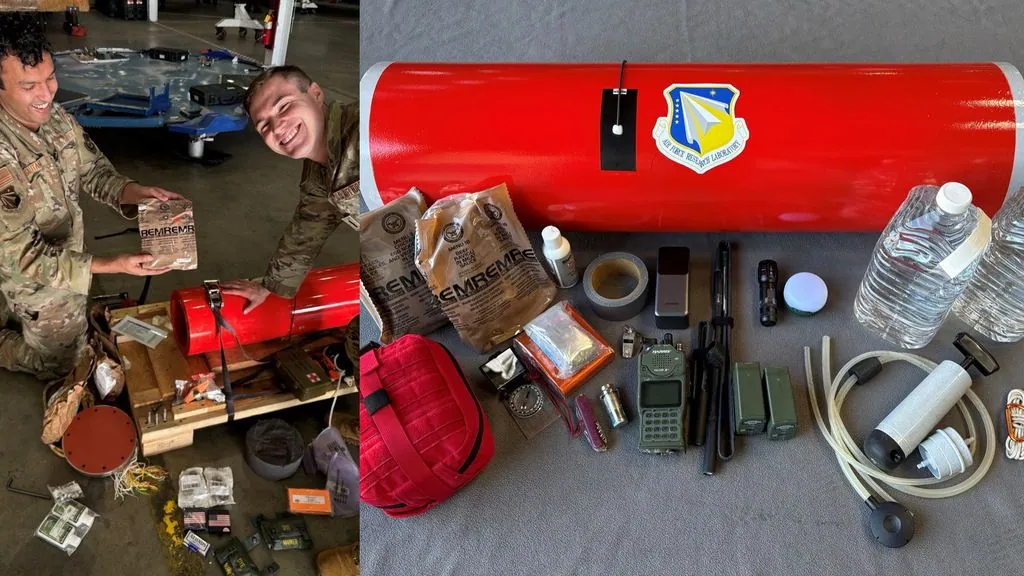
AFRL wasn't shy about the manifest. The cargo pods carried representative emergency supplies, the kind of gear that might matter most in a place conventional transport can't easily reach: medical equipment, food ration packs and other military kit. The agency also fit-checked a UNI-PAC III life raft inside Starfall, raising the possibility it could ride along on a future test.
Each pod was wired with sensors tracking temperature through launch, reentry and splashdown, along with the shock and vibration loads the cargo endured along the way. AFRL said researchers focused particular attention on electronics and survival gear, including a SATCOM-enabled tracker, batteries, a reverse osmosis desalinator and emergency medical equipment, according to the agency's release.
Photos AFRL posted alongside the announcement show personnel unpacking a recovered pod for inspection, the kind of mundane-looking moment that represents a genuinely new capability if it scales.
The vehicle itself
SpaceX has said almost nothing publicly about Starfall since the capsule quietly debuted on a Falcon 9 launch back in June. Most of what's known about it comes not from SpaceX but from a Federal Aviation Administration environmental assessment published earlier this year.
That document describes a disk-shaped vehicle roughly 10.2 feet across, often likened to an oversized hockey puck, capable of returning up to 2,200 pounds of cargo from orbit. It's built with a carbon fiber heat shield to survive reentry heat, compressed gas thrusters for attitude control on the way down, and a parachute system designed for precision landings rather than a wide splashdown zone.
That combination of size and payload capacity matters for understanding where Starfall fits into the Air Force's bigger ambitions. It's not the end goal. It's a testbed.
Why the military wants this at all
AFRL's Rocket Cargo initiative is aiming much higher than a couple thousand pounds per flight. The program's long-term vision involves delivering tens of tons of cargo in a single launch, well beyond what Starfall alone can carry. The data gathered from this mission feeds into that broader effort, giving AFRL real-world numbers on how cargo behaves under the stress of spaceflight rather than just simulations.
Starfall isn't the only vehicle the Air Force has had its eye on. SpaceX's Starship, still in development, was viewed as a likely candidate for cargo tests at Johnston Atoll, a remote Pacific site where the Air Force had proposed building landing pads specifically for this kind of mission. Those plans hit a wall in July 2025, when environmental concerns tied to the atoll's status as a bird sanctuary forced the Air Force to suspend them. The search for an alternative site hasn't produced a clear answer yet.
That makes the Starfall test more significant than a single successful splashdown might suggest. With the Starship pathway stalled, a smaller, already-flying capsule that can demonstrate the core concept, launch, survive reentry, land with precision and protect sensitive cargo, gives the Rocket Cargo program a way to keep generating data while the bigger piece of the puzzle sits in limbo.
Point-to-point rocket delivery has been talked about for years as a theoretical way to get supplies anywhere on the planet fast, bypassing the geography that slows down ships and aircraft. This mission is one of the first concrete steps toward proving it's more than a slide in a Pentagon briefing. AFRL now has real flight data, recovered hardware and a working relationship with SpaceX's newest reentry vehicle. The next question is how fast the capsule side of this can scale toward the tonnage the military actually wants, and where exactly those future landings will happen now that Johnston Atoll is off the table.