NASA Stacks Artemis III's Megarocket Ahead of Pad Testing
Technicians at Kennedy Space Center joined the core stage to its twin solid rocket boosters, a key step before the moon mission's crew can practice countdown procedures.
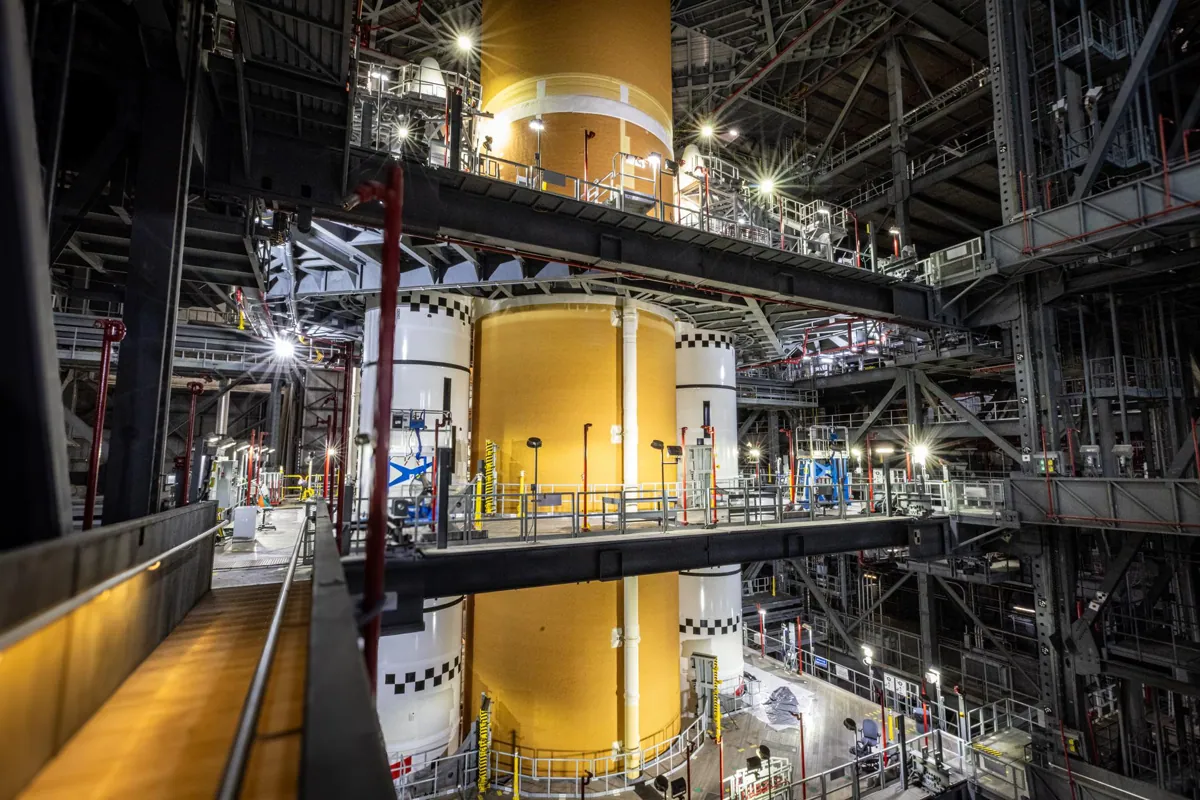
NASA has completed a major assembly milestone for Artemis III, joining the Space Launch System's core stage to its twin solid rocket boosters inside the Vehicle Assembly Building at Kennedy Space Center in Florida.
The work happened in stages over about a week. On October 22, technicians lifted the 212-foot core stage out of the building's transfer aisle. By October 23 it was horizontal and ready for positioning, and on October 25 crews integrated it with the two booster motor segments already standing in High Bay 3, according to NASA. The agency confirmed the full stack was complete as of October 28.
Getting there required a purpose-built tool: a one-of-a-kind lifting beam engineered specifically to hoist the core stage and set it onto the mobile launcher, the platform that will carry the rocket to the pad and support it through launch. That's the kind of unglamorous hardware detail that rarely makes headlines but matters enormously in practice — a rocket stage that size can't just be craned around like cargo.
What NASA calls the "short stack" configuration is now in place: core stage, both boosters, no upper elements yet. Next comes testing and checkouts on the assembled hardware. Once those clear, teams will roll the stack out to Launch Pad 39B for a tanking test, loading liquid hydrogen and liquid oxygen into the core stage to rehearse the actual countdown procedures and timelines the launch team will run on mission day. Fueling tests like this are where engineers catch problems with seals, sensors, and fueling hardware before they become launch-day scrubs — SLS and its predecessor programs have a long history of catching exactly these kinds of issues during similar wet dress rehearsals.
Artemis III is shaping up to be the most operationally complex Artemis mission flown so far. The flight will send NASA astronauts Randy Bresnik, Frank Rubio, and Andre Douglas, along with ESA astronaut Luca Parmitano, into space aboard the Orion capsule riding atop this SLS rocket. But the mission isn't just about getting Orion into orbit. According to NASA, the crew will use the flight to test rendezvous and docking between Orion and commercial spacecraft built by Blue Origin and SpaceX — a rehearsal for the lunar landing missions that follow.
That detail matters because it signals how NASA's moon architecture actually works: SLS and Orion get astronauts off Earth and into lunar space, but the final descent to the surface depends on separate commercial landers. Proving that Orion can reliably find, approach, and dock with those vehicles is a prerequisite for any future landing attempt, not a side exercise.
For now, the hardware milestone is the story. Stacking the core stage with its boosters is one of the last big physical assembly steps before the rocket starts moving toward the pad for real operational testing. The tanking test will be the next concrete signal of how close Artemis III is to a launch date — it's the point where NASA stops assembling and starts rehearsing.