YouTube Music Will Now Tell You When a Song Was Made by AI
The new labels disclose AI's role in a track's creation but stop short of blocking AI-generated songs from monetization, putting YouTube on a different path than stricter rivals like Deezer and TIDAL.
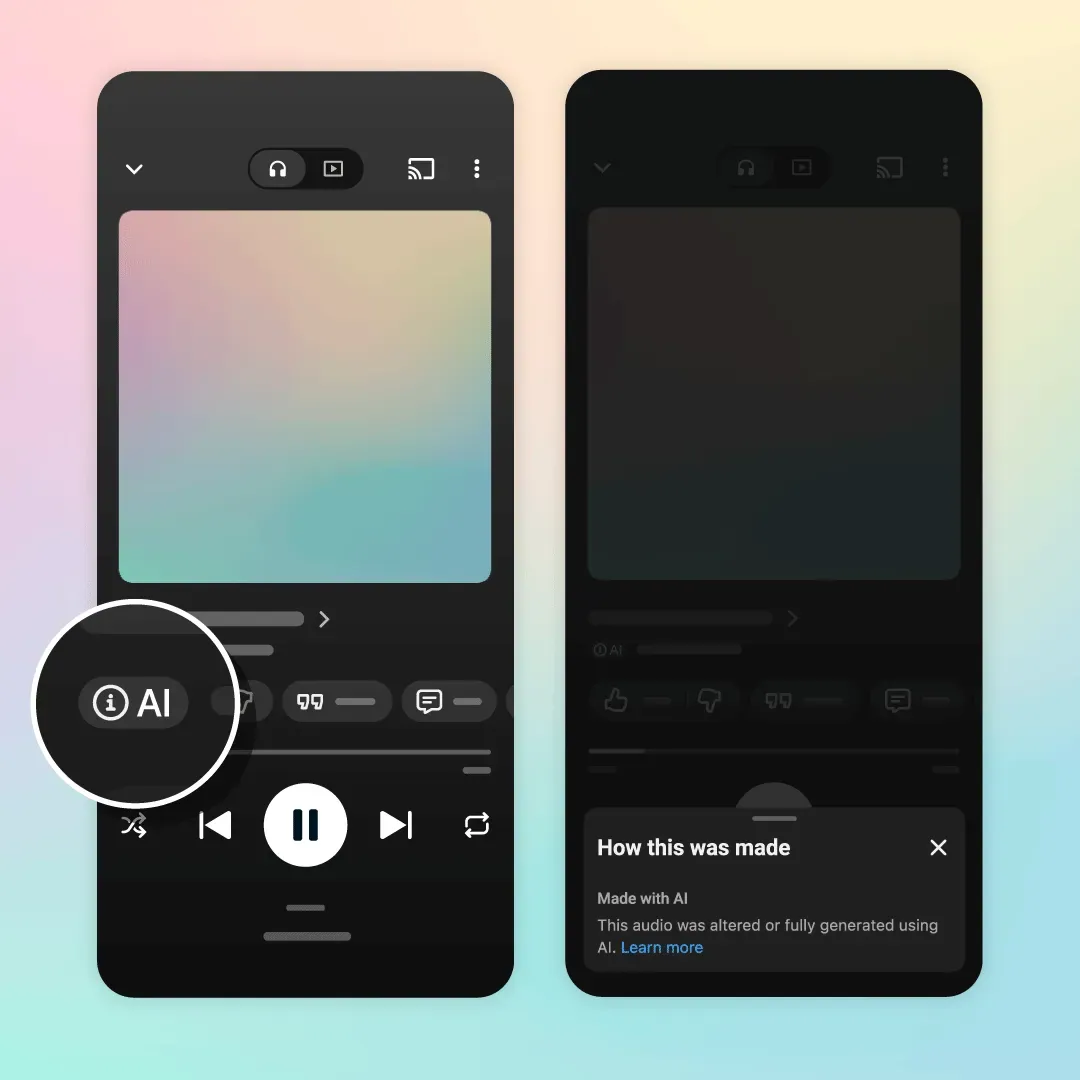
YouTube Music is rolling out a labeling system that tells listeners exactly how much artificial intelligence went into the song they're hearing, the company announced Wednesday. The labels flag AI involvement in both composition and vocals, and they'll show up not just in the music app but across the main YouTube app as well.
Here's how it works: a label appears on the player page, and tapping it surfaces more detail about what role AI actually played in making the track. Rather than a single blanket flag, YouTube is using three tiers. "Fully Gen AI" means the track was entirely machine-generated. "Partly Gen AI" covers songs where an artist used AI-generated elements but layered in their own live performance on top. And "No Gen AI" is exactly what it sounds like, though it's worth noting that standard production tools like Auto-Tune don't count as AI for these purposes and keep a track in that clean category.
To identify which songs get which label, YouTube says it's combining two approaches: working directly with its music partners, who can self-declare under one of the three designations, and running its own in-house detection tools to catch what isn't disclosed.
A crowded field of different approaches
YouTube isn't the first platform to tackle this, and the timing isn't a coincidence. AI-generated music has been pouring into streaming services at a pace that's forced nearly every major platform to pick a policy. Apple Music has said it will introduce its own "Made With AI" tags later this year as part of a broader AI Transparency Tags initiative. Spotify already labels AI-involved tracks and runs a music spam filter to catch low-effort AI content before it clutters recommendations.
Deezer has gone further than most. The platform reported in July that it was receiving nearly 90,000 fully AI-generated tracks every single day, a volume that pushed it toward a more aggressive stance: flagged AI tracks get excluded from algorithmic recommendations and editorial playlists, and the company withholds royalties from streams it determines are fraudulent. Deezer is also building a feature that would let listeners filter AI-generated music out of their experience entirely.
TIDAL has taken a similar route, labeling tracks it identifies as fully AI-generated, giving users the option to turn those recordings off, and cutting them out of royalty attribution altogether.
YouTube's approach reads as noticeably lighter touch by comparison. The company is explicit that AI involvement, even full AI generation, doesn't automatically make a track ineligible for monetization. The goal here is disclosure, not gatekeeping. Listeners get the information and can decide for themselves what they want to do with it, but nothing is being filtered, demonetized, or stripped from playlists simply for carrying an AI label.
That stance lines up with YouTube's broader relationship with AI music tools. The platform has been actively experimenting in this space itself, most notably with Dream Track, a feature that lets a select group of creators generate soundtracks using AI-recreated versions of participating artists' voices. A platform building its own AI voice-cloning tools was always going to land somewhere less restrictive than one trying to wall AI out entirely.
The split across the industry is becoming a real dividing line in how streaming services think about AI music: transparency-first platforms like YouTube and Spotify that label and let listeners decide, versus restriction-first platforms like Deezer and TIDAL that actively limit AI content's reach and payout. Neither approach has settled into an industry standard yet, and with AI-generated tracks arriving at tens of thousands per day on just one platform, that's a problem every major streaming service is going to keep having to answer.