TikTok Wants to Be Your Next Restaurant Finder, Not Just Where You Saw the Video
The company's new Must Eat guide turns 40 million posts and reviews into a searchable dining directory, putting it in direct competition with Yelp and Google Maps.
TikTok has spent years turning random bowls of pasta and extra-long cheese pulls into reasons people drive across town. Now it wants to own what happens after the video ends.
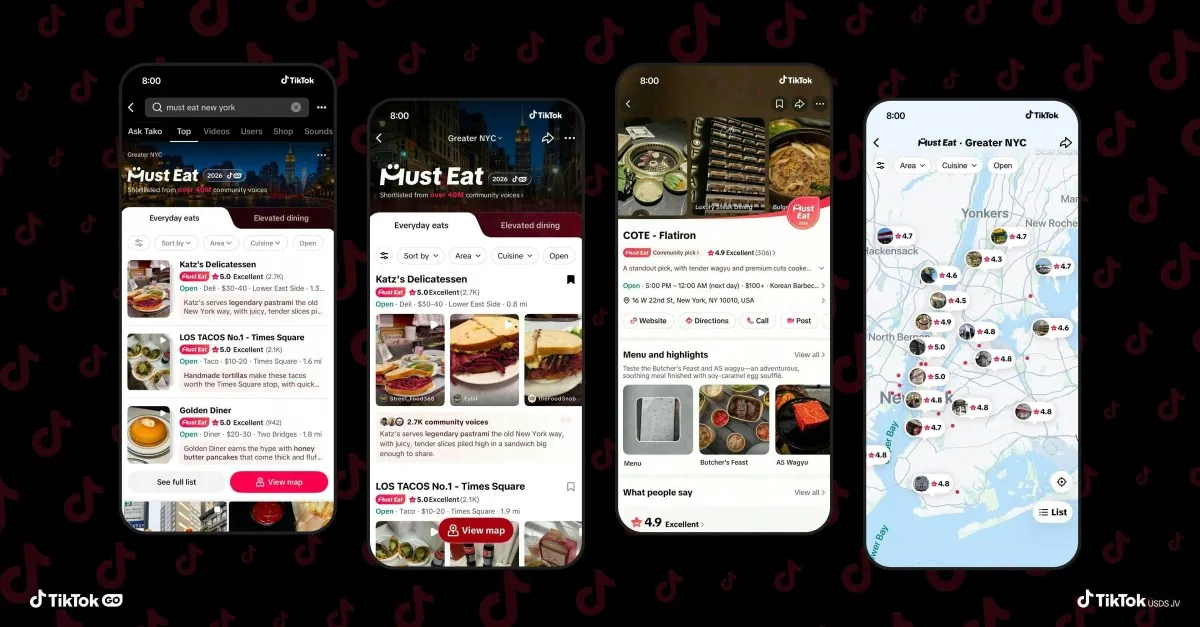
The company announced Must Eat this week, a new in-app section that turns TikTok's dining content into something closer to a restaurant directory. Built on 40 million posts, reviews, and comments about food on the platform, the feature lets users search for nearby restaurants, read crowdsourced reviews, book reservations, and call a business directly, all without leaving the app.
TikTok US CEO Adam Presser described it at a launch event as, in his words, "the compilation of all of the conversation that's happening on the TikTok platform across creators, restaurateurs, [and] individuals" who post or comment about local spots, according to The Verge. That framing matters: TikTok isn't claiming to generate new restaurant opinions so much as organize the ones already scattered across its comment sections and creator videos into something usable.
The feature launches first in New York City, Los Angeles, and the Bay Area, with New York listings including Golden Diner, known for pancakes that went viral, and notoriously tough-to-book spots like Semma and Via Carota. Must Eat splits recommendations into two tabs, "everyday eats" and "elevated dining," and lets users filter by rating, distance, cuisine, and whether a place is currently open. Each restaurant's page links back to the TikTok videos that feature it, and users can bookmark businesses to revisit later. TikTok says restaurants cannot pay for placement on the recommendation lists.
Positioned between Yelp and a curated guide
Must Eat sits in an odd middle ground. It has the open, crowdsourced structure of Yelp, where anyone can leave a review, but the curation and tabbed categories give it more of the feel of a publication like The Infatuation, which hand-picks and organizes its recommendations. That hybrid approach is TikTok's bet: that the sheer volume of dining content already on the app, paired with some editorial structure, can outcompete both models at once.
It's also not TikTok's first attempt to close the loop between watching a video and actually showing up somewhere. Earlier this year, the company rolled out TikTok Go, which let creators tag and link to hotels and attractions so viewers could book them directly. Must Eat extends that same idea, letting creators and commenters effectively map their recommendations onto real, bookable locations. The difference is scale and specificity: travel bookings are occasional, but restaurant decisions happen constantly, often on impulse, which is exactly the kind of decision TikTok's algorithm is built to influence.
Why restaurants are the natural next step
TikTok's move into dining isn't really a pivot. It's an acknowledgment of something that's already happened. Food content on the app has reshaped how a generation of home cooks and diners discover restaurants, and it's changed restaurants themselves. Menus have adapted to the camera: dramatic plating, oversized portions, and those cheese pulls exist partly because they perform well in a 15-second clip. Individual creators have built followings as de facto restaurant critics, each cultivating a recognizable voice or gimmick in a field that used to belong to newspaper reviewers and Yelp's star ratings.
TikTok's own numbers back up how far that influence has traveled. In its press release announcing Must Eat, the company said 27 million US diners visited a restaurant, cafe, or shop for the first time last year specifically because of something they saw on the platform. That's a significant chunk of real-world foot traffic being driven by an app that, until now, had no built-in way to actually complete the transaction. A viral video could put a restaurant on someone's radar, but finding it, checking if it was open, and getting a table still meant switching to Yelp, Google Maps, or a reservation app like Resy.
What TikTok is really chasing
By building Must Eat, TikTok is trying to capture that entire journey inside its own app, from discovery to decision to reservation. That's valuable territory. Yelp and Google Maps have long benefited from being the default stop when someone wants to know where to eat nearby, and TikTok is essentially arguing it already has better raw material for that job: millions of actual videos, reactions, and comments about specific dishes and experiences, rather than a star rating and a paragraph of text.
Whether that translates into people actually changing habits is the open question. Yelp and Google Maps have the advantage of being purpose-built search tools people reach for specifically when they're hungry and nearby. TikTok has the advantage of already being where a lot of that dining inspiration starts in the first place. Must Eat is a bet that closing the gap between the two, inside a single app, is enough to pull users away from the tools they'd otherwise open next.
For now, the test is limited to three major US markets. How TikTok expands it, and whether restaurants outside those cities start seeing real foot traffic tied to Must Eat specifically, will be the clearer signal of whether this becomes a serious rival to the apps that have owned restaurant discovery for over a decade.