Spotify Ditches CarPlay for Its Own Car App, Starting With Audi
The new app runs natively on Android Automotive, letting Spotify control every pixel instead of relying on Google's templates or a phone connection.
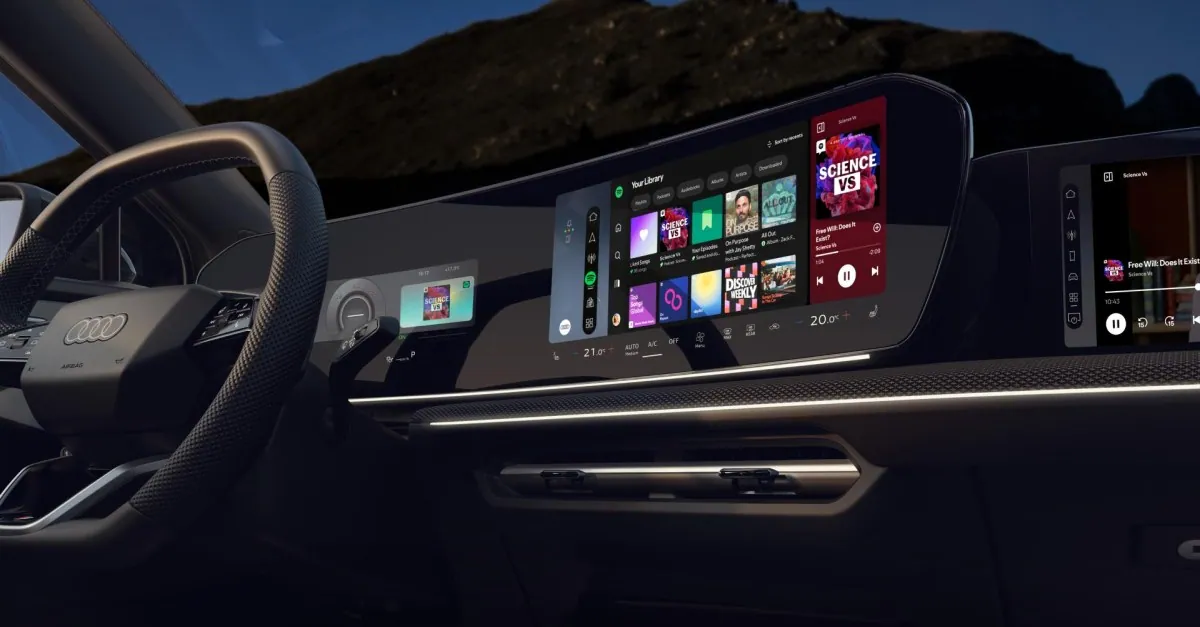
Spotify has built its first fully native car app, and it's betting that drivers are ready to stop plugging in their phones altogether.
The app launched Wednesday on select Audi models, including the electric A6 e-tron and Q6 e-tron and the gas-powered A5, Q5, and A6. Unlike Apple CarPlay or Android Auto, it doesn't mirror anything from a phone. It runs directly on the car's own infotainment hardware, built on Google's Android Automotive operating system, which means no Bluetooth pairing, no aux cable, and no tethering of any kind, according to the company.
That's a meaningful shift. Phone projection systems like CarPlay have become the default way most people listen to music in their cars, and for good reason: get in, phone connects automatically, your familiar interface shows up on the dash. Spotify isn't abandoning that setup. Jonathan Tarlton, the company's automotive business development lead, told The Verge Spotify remains "heavily invested" in phone projection. But the new app is clearly designed to give drivers a reason to use something else.
The technical distinction matters more than it might sound. Spotify's existing Android Automotive integration is what Tarlton calls "headless" — Spotify supplies the music catalog and playlist data, but Google's templates control how everything looks and behaves on screen. The new Audi app flips that. It's "headful," meaning Spotify designs and renders its own interface from the ground up.
"We're drawing all the pixels," Tarlton said. "We own the user experience. So we're not in a template or a framework. It's 100 percent Spotify."
Why Spotify cares this much about your car
The stakes here are bigger than they might first appear. According to Spotify, 34 percent of its monthly active users stream in their cars, and that number jumps to 77 percent among Premium subscribers. For a company whose business depends on daily listening habits, the car is one of the most important rooms in the house. If the experience is clunky, people notice.
And phone projection, for all its ubiquity, has real friction. Wireless CarPlay connections can be unreliable depending on the vehicle. Tarlton pointed to the simple annoyance of a "cold start in the morning" — waiting for a phone to connect, a screen to load, a Bluetooth handshake to complete, before you can hit play. A native app skips that sequence entirely because the software is already sitting on the car's hardware, ready to go the moment you start the engine.
The new app also unlocks features that aren't really possible through a projected phone screen. Passengers can scan a QR code displayed in the car to join a "Spotify Jam" session and queue up songs from their own phones without taking over the driver's screen. In vehicles equipped with a secondary passenger display, the person riding shotgun can browse music, read lyrics, or watch video content without interrupting whatever's playing for the driver. And when the car is parked or charging, visual content like lyrics and video podcasts shifts over to the central display so everyone in the car can see it.
Tarlton framed those features as something closer to a cultural fix than a technical one. He described a familiar scene: parents up front enjoying music together while kids in the back disappear into their own headphones. The new app, he said, is meant to pull everyone back into a shared experience. "I'm excited that we can bring joy to the cabin again," he said. "It's not just technology."
One app, not fifty
Spotify spent a little over a year building the new app, and the strategy behind its rollout is as notable as the app itself. Rather than building a custom version for every automaker, Spotify is focusing on cars running Android-based systems and distributing a standard Android Automotive APK through whatever app store a given manufacturer uses, whether that's the Google Play Store or something proprietary like Audi's own Application Store.
That approach is deliberate. "Our number one goal was to prevent fragmentation, not just for our sake, but for the sake of the whole industry," Tarlton said, adding that Spotify wants the car to be "an open and fair place for apps to play."
It's a practical calculation as much as a philosophical one. Building bespoke software for every carmaker's infotainment system would be slow and expensive. A single standardized package that multiple automakers can adopt is a far more scalable way to get native Spotify into more vehicles without reinventing the app each time.
Spotify insists this isn't an either-or proposition for drivers. Tarlton said the company wants to give people choice, whether they're locked into Apple's ecosystem through CarPlay or prefer Android on their phones. But the subtext is clear enough: Spotify would rather own the full experience in as many cars as possible than keep ceding the screen to Apple's and Google's phone-mirroring software. Audi is the starting point. Whether other automakers follow will determine how far this native push actually goes.