SpaceX Launches Robot-Armed Satellite Repair Drone Toward Deep Orbit
The Mission Robotic Vehicle will spend its life installing thruster "jetpacks" on aging satellites 22,000 miles above Earth — a first for the commercial space-servicing industry.
SpaceX launched a satellite-servicing mission today that looks less like a typical rocket flight and more like the opening chapter of an orbital repair business. A Falcon 9 lifted off from Cape Canaveral Space Force Station during a launch window that opened at 5:15 p.m. EDT, carrying a robotic spacecraft designed to grab, install and maintain hardware on satellites that are still in use — rather than sending up a replacement from scratch.
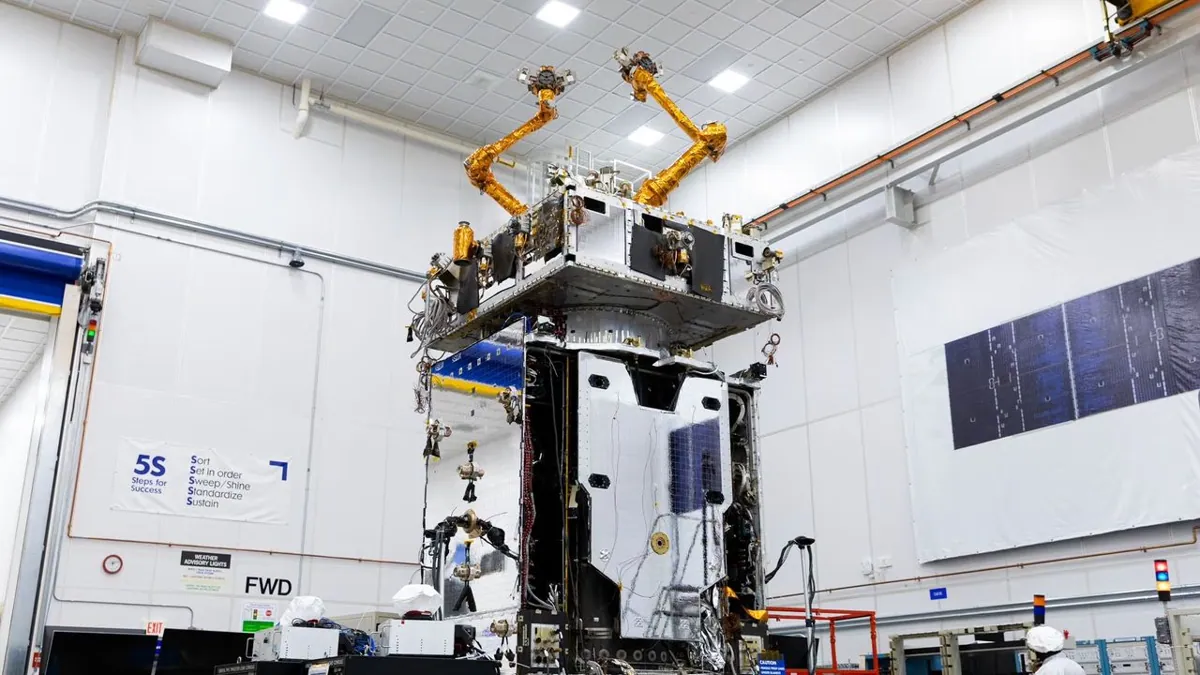
The mission, called MRV-MEV, is operated by SpaceLogistics, a subsidiary of Northrop Grumman. It sends up two distinct pieces of hardware: a Mission Robotic Vehicle (MRV) equipped with two robotic arms, and three Mission Extension Pods (MEPs), which are essentially small propulsion packs meant to be bolted onto existing satellites to give them years of extra life.
The destination is geostationary orbit, roughly 22,236 miles above Earth, where a spacecraft's orbital speed matches the planet's rotation closely enough that it appears to hang motionless over the same spot on the ground. That parking-spot quality makes GEO valuable real estate for communications, weather and spy satellites — and also means those satellites are expensive to replace once they run low on the fuel needed to hold their position.
That's the gap this mission is built to fill. Each MEP, once attached to a client satellite, uses electric propulsion to handle orbit control and manage momentum, essentially taking over the station-keeping job the satellite would otherwise need its own dwindling fuel supply to do. According to a Northrop Grumman fact sheet, a single MEP can add up to eight years of usable life to a typical 2,000-kilogram GEO satellite, and it's operated independently by the client company through its own telemetry and command system.
Two satellite operators have already signed up. Australian operator Optus has booked one of the three MEPs launching today, while satellite giant Intelsat has hired out the other two, according to Tech Times.
How the repair job actually works
The mechanical centerpiece of the mission is the MRV itself, built with two 10-foot robotic arms developed by the U.S. Naval Research Laboratory. The plan calls for the MRV and the three MEPs to travel to geostationary orbit separately, then rendezvous once in position. When the timing is right, the MRV will use its arms to grab an MEP and physically carry it over to install on a client satellite — then repeat the process for the second and third pods. Once all three are delivered, the MRV will stay parked in GEO, waiting for future MEPs to arrive so it can keep working.
Northrop Grumman describes the MRV's capabilities as extending well beyond pod installation. Per the company, it's built to relocate, inspect, repair and upgrade other spacecraft while in orbit. It also carries something called a Passive Refueling Module, which the company says is the first refueling interface standard approved by the U.S. Space Force — meaning the MRV itself can be refueled on orbit rather than going dark once its tanks run low.
That's a meaningful design choice. A servicing vehicle that can be refueled and can keep swapping in new pods isn't a one-and-done mission; it's infrastructure, built to operate for years and support satellites that haven't even launched yet.
Building on two earlier tests
This isn't Northrop Grumman's first attempt at keeping someone else's satellite alive. The company previously flew Mission Extension Vehicle-1, the first commercial satellite-servicing spacecraft ever launched, which reached GEO in October 2019 and docked with the Intelsat 901 communications satellite four months later. A follow-up, MEV-2, launched in August 2020 and docked with Intelsat 10-02 the following spring.
Those two missions proved the basic concept of satellite life extension works, but they operated differently than today's launch. Each MEV was a single, self-contained spacecraft that traveled to its target, docked, and handled the entire life-extension job on its own. There were no detachable pods and no robotic arms involved — just one vehicle permanently paired with one satellite.
MRV-MEV represents a more scalable version of the idea. Instead of building and launching a dedicated servicing spacecraft for every satellite that needs help, Northrop Grumman now has one robotic vehicle capable of distributing multiple pods to multiple clients, then sticking around to do it again once more pods reach orbit.
A notable footnote on the booster
One detail broke from SpaceX's usual routine: there was no first-stage landing attempt after liftoff. According to SpaceX's mission description, the extra performance required to push this payload all the way to geosynchronous transfer orbit meant the booster couldn't be recovered. It was the 32nd and final flight for this particular first-stage booster, which had previously flown missions including CRS-24, Eutelsat HOTBIRD 13F, OneWeb 1, SES-18, SES-19 and 27 Starlink launches. SpaceX's current reuse record for a single booster stands at 36 flights, set earlier this month on a Starlink mission.
Assuming the flight profile holds, the Falcon 9's upper stage will deploy the MRV about 35.5 minutes after liftoff, followed by the three MEPs at 10-minute intervals.
What happens next will play out slowly, over months, as the MRV makes its way to GEO and begins the delicate work of rendezvousing with its targets. But the underlying shift is already clear: satellite operators facing a fuel-starved but otherwise functional spacecraft now have a commercial option to call for a tune-up in orbit, rather than writing the asset off entirely.