SpaceX Fires Up All 33 Engines on Newest Starship Booster, Setting Up Launch as Early as Next Week
The successful static fire clears the way for Flight 13, a critical retest of the upgraded Starship V3 after a bumpy debut in May.
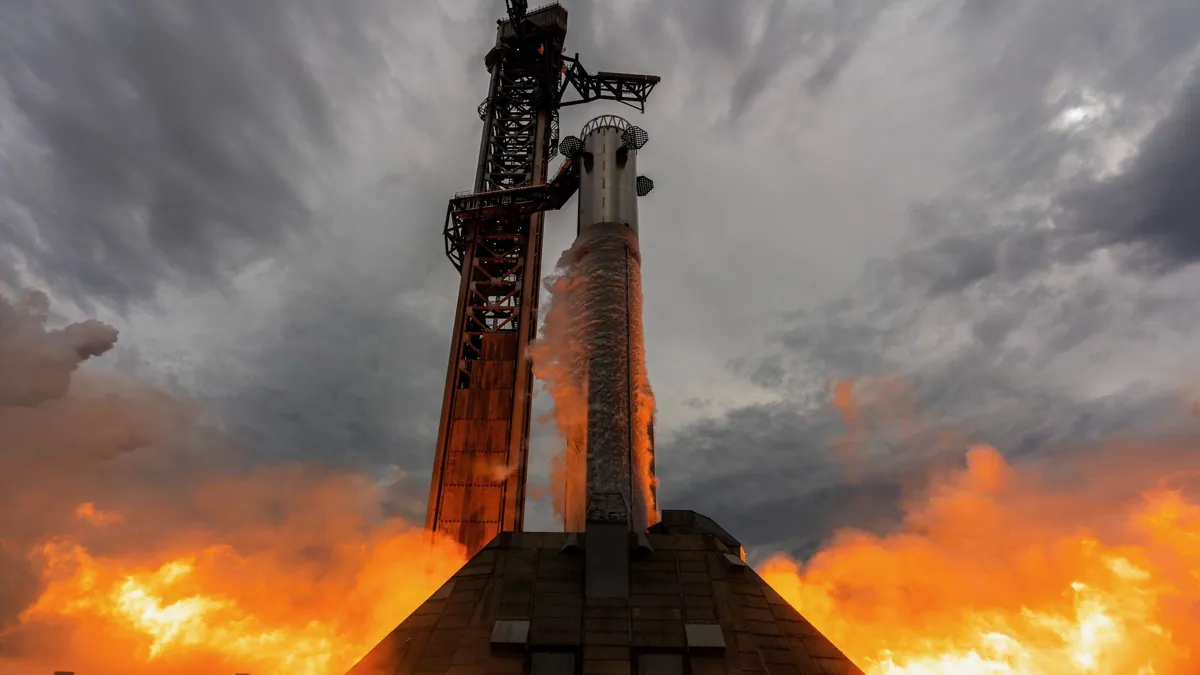
SpaceX lit up all 33 engines on its latest Starship booster Friday, a brief but crucial test that puts the company on track to launch its next Starship flight within days.
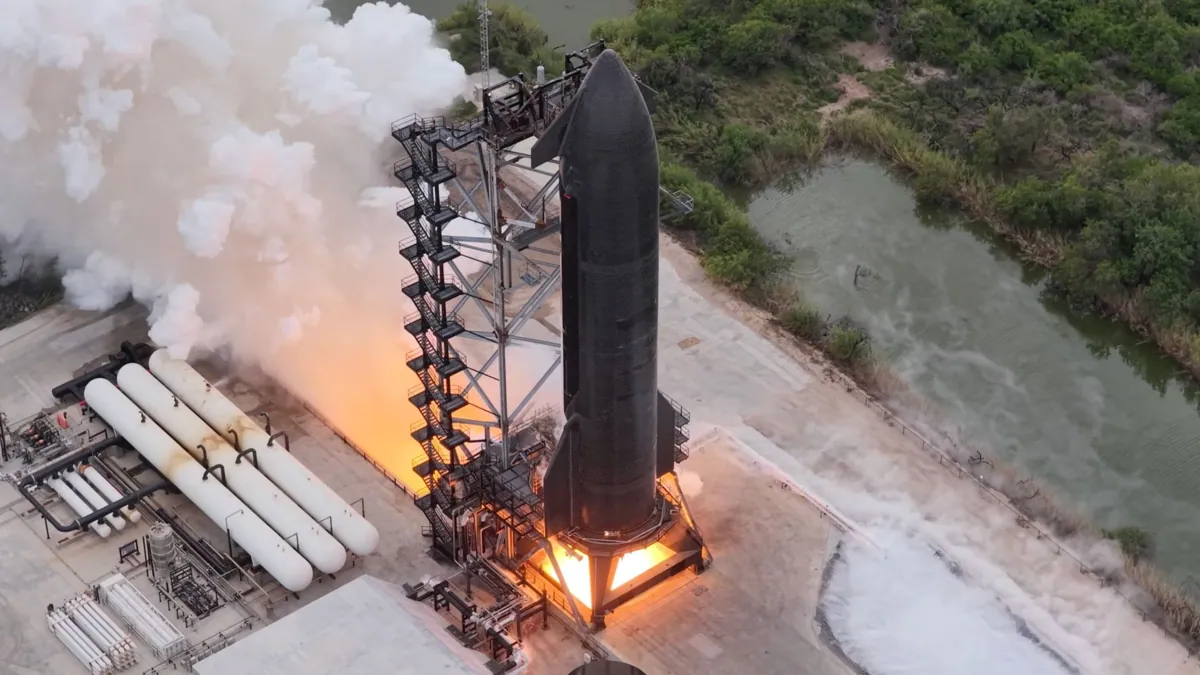
The static fire took place at Starbase, SpaceX's Texas launch site, using Booster 20 — the newest Super Heavy booster off the assembly line. Ground teams moved the booster to the pad on July 9 and set it on its support stand using the launch tower's "Mechazilla" chopstick arms. By Friday morning, SpaceX had closed Boca Chica beach and begun pumping fuel to the pad's tank farm in preparation for the test. Just before 11 a.m. EDT, the booster's engines ignited for roughly 25 seconds, simulating the thrust and conditions of an actual launch while the vehicle stayed anchored to the ground.
That short burn is a major checkpoint. With it done, SpaceX has cleared a key hurdle toward Flight 13, which a Federal Aviation Administration notice suggests could launch as early as Wednesday, July 15.
Booster 20 is only the second "Version 3" Super Heavy booster to reach the pad for testing, and it's carrying SpaceX's upgraded Raptor 3 engines. The V3 iteration of Starship represents a real step up from the previous version: lighter avionics to boost payload capacity, a taller and roomier fuel tank, and hardware built specifically for transferring propellant between spacecraft in orbit — a capability SpaceX will need for many of the missions Starship is ultimately meant to fly.
Why NASA is watching closely
Some of those future missions belong to NASA's Artemis program, which is counting on Starship as one of two contracted lunar landers to carry astronauts down to the moon's surface. That gives Flight 13 stakes beyond SpaceX's own testing schedule. As the timeline for Artemis moon landings compresses, every Starship flight becomes a data point on whether the vehicle can mature fast enough to deliver on that promise.
Flight 13 will largely mirror the flight plan from Flight 12, which launched in May with what the reporting characterizes as mixed results. That mission marked the first flight of the V3 design, and SpaceX flew a more cautious profile than some of its earlier, increasingly ambitious tests. Ship, the upper stage, reached a suborbital trajectory and made a soft splashdown in the Indian Ocean. But Booster 19 failed to execute the maneuvers needed for its own soft ocean landing, and Ship 39 suffered an engine anomaly that forced SpaceX to skip a planned in-space engine relight demonstration.
Flight 13 will fly Ship 40 and Booster 20 through the same basic set of objectives, giving SpaceX a chance to iron out the problems from May before pushing toward more demanding milestones — orbital insertion, in-space propellant transfer, and eventually recovering both stages back at Starbase.
The reusability puzzle
Full reusability is the whole point of Starship's design. SpaceX wants both the booster and the upper stage to eventually fly back to Starbase and get caught by the tower's Mechazilla arms, then get refurbished and reflown, much like the company already does with its Falcon 9 rocket. Falcon 9 launches several times a month and lands its boosters routinely; one recently flew for a record 36th time, launching a batch of Starlink satellites. SpaceX has already managed a handful of Super Heavy booster catches during previous V2 test flights and has reflown two of those recovered boosters.
Catching Ship is a different problem entirely, and SpaceX hasn't attempted it yet. Ship comes down belly-first through the atmosphere, relying on black hexagonal heat shield tiles covering half the vehicle to survive reentry temperatures, while fins near its nose and base manage its orientation during a mostly horizontal freefall — a descent profile with some resemblance to how the space shuttles once returned to Earth. As it nears sea level, though, Ship performs a "flip and burn" maneuver, rotating upright to slow itself for a soft touchdown. On future flights, that touchdown is meant to happen back at Starbase; for now, it's still landing in the Indian Ocean.
Flight 13 gives SpaceX another shot at nailing that flip-and-burn sequence with Ship 40, while also addressing the booster and engine issues that cropped up in May. If the mission goes as planned, it moves Starship V3 a step closer to the bigger tests waiting in the wings: reaching orbit, transferring propellant between spacecraft, and eventually bringing both halves of the rocket home for reuse.