Nvidia's Jetson Chips Are Headed to the Moon
Lunar Outpost's next rover will use Nvidia's GPU platform to power its LiDAR system, likely marking the first GPU to operate on the lunar surface.
Nvidia has put its chips in phones, cars, data centers, and humanoid robots. Now it's aiming for the lunar surface.
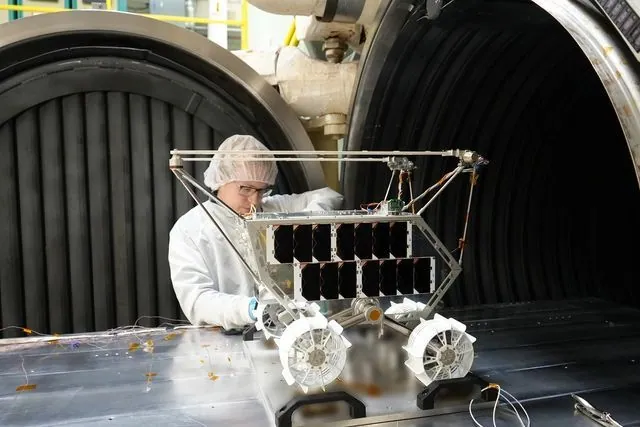
Lunar Outpost, a startup that builds robotics for space infrastructure, announced Thursday that its next Moon rover will run its LiDAR system on Nvidia's Jetson chips. If the mission goes as planned, it will be the first time a GPU has operated on the Moon.
The rover is riding to the lunar surface on a lander built by Intuitive Machines, another company in the fast-growing business of Moon exploration. A follow-up mission will send a rover to Reiner Gamma, a region of the Moon where a magnetic anomaly has puzzled scientists for years. Both missions are expected to launch on Falcon 9 rockets before the end of the year.
For Lunar Outpost, the Jetson deployment is as much an experiment as it is a product decision. The company is running the chip alongside its existing flight computer, a system with a longer track record in space, to see how it holds up.
"We're taking the NVIDIA Jetson and comparing it to our flight compute platform that has a little bit more spaceflight heritage," said Lunar Outpost CEO Justin Cyrus. "[We're] seeing what the pros are, seeing what the cons are. And we're really pushing towards trying to adopt these more capable GPU-powered systems in these extreme environments."
Why NASA cares
The mission fits into a broader push by NASA to get private companies scouting the Moon ahead of a planned return of human astronauts, possibly as early as 2028. The agency's approach mirrors what it did with SpaceX: pay commercial companies to build the vehicles and let them carry scientific instruments that map the terrain and search for resources, water chief among them, that could support a future human presence or even be commercially valuable.
Nvidia's footprint in this effort isn't limited to Lunar Outpost. The company recently struck a partnership with Firefly Aerospace, the first private company to pull off a safe Moon landing, to put a Jetson chip on a satellite orbiting the Moon. That satellite will process imagery for scientists mapping the lunar surface and for tracking the growing number of robotic vehicles operating down there.
Jetson doesn't carry the name recognition of Nvidia's big data-center chips like Blackwell or Vera Rubin, but it plays a distinct role. It's built to be small and power-efficient, letting robots process what their sensors pick up right on the spot rather than shipping data elsewhere first. That local processing is what lets a rover or satellite react to its surroundings in something close to real time.
Cyrus described how that capability is changing Lunar Outpost's approach to autonomy. "Our autonomy stack was a bit more deterministic five years ago, and now it's a combination of deterministic and physical AI, which is pretty fun," he said. "We still run both in parallel, and then it's our job to figure out where's physical AI can actually plug into our stack and help us do things that no one's done before."
A brutal environment for a chip
Running a GPU on the Moon is a much harder engineering problem than running one in orbit near Earth, where most space-based chips currently operate. Low Earth orbit offers some shelter from radiation and extreme temperature swings. The Moon offers none of that. It's exposed directly to cosmic radiation, and its surface temperature swings dramatically as it moves through its cycle of day and night.
"Your system has to survive lunar night and has to do so on very low power," Cyrus said.
If Lunar Outpost's engineers can get the chips to hold up, they expect it to translate into real gains for the rovers themselves: faster interpretation of the environment, and faster decisions about what to do next. That matters because NASA's long-term goal isn't just a handful of visits. The agency wants a sustained human presence on the Moon, and getting there will depend heavily on autonomous systems doing the groundwork first.
"What we at Lunar Outpost are currently working on is how do we go from exploration to permanence, how do we actually build that outpost on the moon?" Cyrus said. "We do think combining our deterministic models plus the physical AI layer—that's what allows us to make a human presence in space sustainable, actually having that robotic workforce."
The bottleneck is the rocket, not the chip
Lunar Outpost has several smaller autonomous rovers slated for launch over the next few years, plus a larger vehicle called Pegasus designed to eventually carry astronauts. Pegasus is waiting on a launch vehicle from Blue Origin, Jeff Bezos's space company, but that rocket suffered an anomaly this summer, and it's unclear when it will fly again.
Cyrus said he's not in a position to speak to Blue Origin's or NASA's exact timelines for getting the rocket back on the pad, but based on what Lunar Outpost has been told, the company is still tracking toward the 2028 target. "It does seem like they're making pretty darn good progress on the pad," he said.
That leaves some of the more ambitious ideas floating around the space industry right now, data centers on the Moon, fleets of autonomous robots building out lunar infrastructure, dependent on something far more mundane than chip design: getting a bigger rocket off the ground.