NASA Joins Japan's Mission to Grab a Piece of One of Mars' Moons
The MMX spacecraft, launching this week, will carry NASA instruments designed to help settle a decades-old debate about where Phobos and Deimos actually came from.
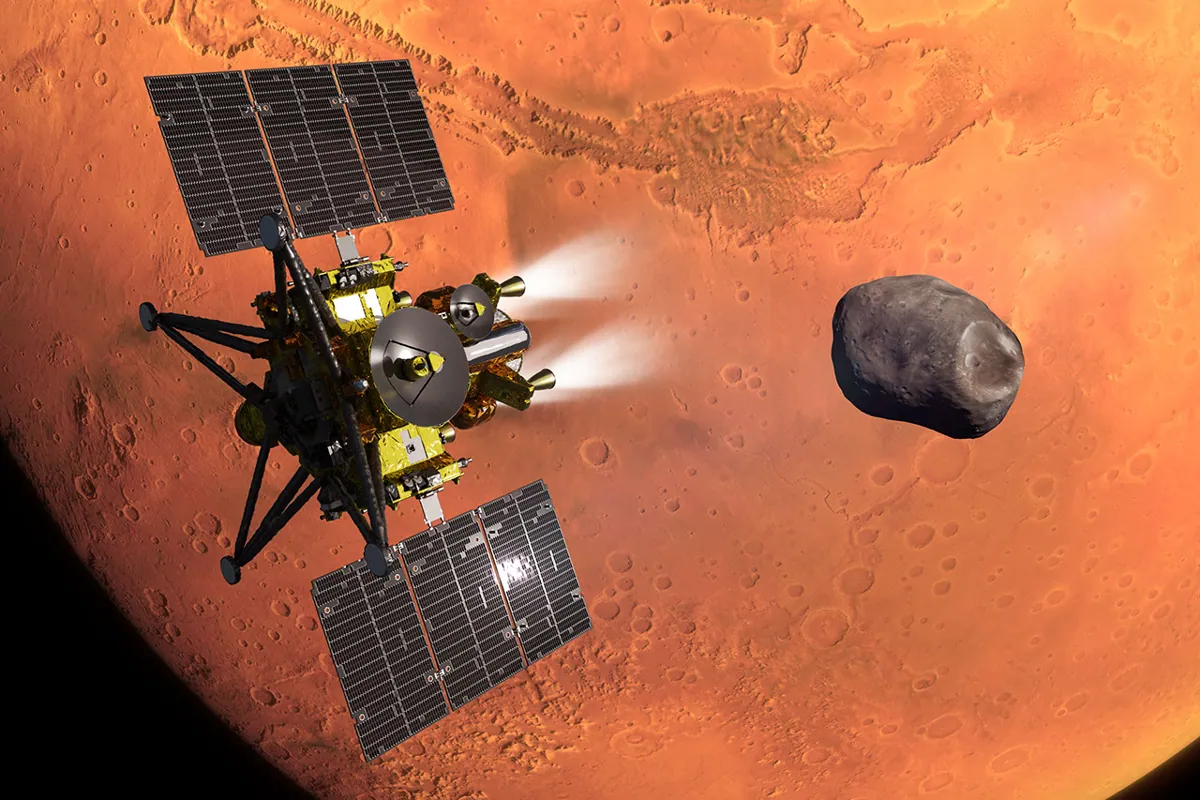
JAXA is set to launch a spacecraft toward Mars this week with a specific goal: bring home a piece of Phobos, one of the planet's two small moons. NASA is a significant partner on the mission, contributing hardware, sample curation, and scientific expertise to help answer a question planetary scientists have argued over for years.
The mission, called MMX (Martian Moons eXploration), is targeting liftoff from JAXA's Tanegashima Space Center on Monday, Oct. 19, at 3:41 p.m. EDT. The spacecraft won't reach Mars until August 2027, when it will begin surveying Phobos and Deimos in detail. According to NASA, it will collect a sample from Phobos no earlier than December 2028 and deliver it back to Earth in 2031, a round trip that spans the better part of a decade.
The core mystery MMX is built to resolve is where Phobos and Deimos came from in the first place. As Tom Statler, MMX program executive and program scientist at NASA Headquarters, put it, the moons "may be the remains of a massive impact on Mars that sent material into orbit around the planet, or they could be ancient asteroids that were captured by Mars' gravity billions of years ago." Those two origin stories lead to very different conclusions, and distinguishing between them has real stakes beyond Mars itself. Statler noted that nailing down the answer could shed light on the period when Earth and the other inner planets were picking up much of their water and organic material, since Mars and its moons were shaped by many of the same early solar system forces.
What NASA is bringing to the mission
NASA's role isn't just advisory. The agency is supplying actual hardware riding on the spacecraft, along with communications support and funding for American scientists on the MMX team.
The headline instrument is MEGANE, short for Mars-moon Exploration with Gamma rays and Neutrons (pronounced "meh-GAH-nay," which is also the Japanese word for eyeglasses). MEGANE will measure neutrons and gamma rays coming off Phobos' surface to work out its chemical makeup, essentially letting scientists "see" what the moon is made of without touching it. That composition data is one of the clearest ways to test which origin story holds up, since captured asteroids and blasted-off Mars debris would carry very different chemical fingerprints.
The second contribution is more hands-on. NASA developed a technology demonstration called the P-Sampler, mounted on one of the spacecraft's landing legs, which uses bursts of high-pressure nitrogen gas to collect loose surface material from Phobos. It works alongside JAXA's own C-Sampler, which is designed to drill a few inches deeper and pull out core samples. Between the two systems, the mission should come away with material from both the surface and just beneath it.
Once that sample gets back to Earth, NASA will take custody of about 15% of it, curating the material at the agency's Johnson Space Center Astromaterials Lab in Houston. That's a long-term commitment: the samples will remain available to researchers for decades, similar to how NASA has managed lunar samples and, more recently, asteroid material from missions like OSIRIS-REx.
Nicky Fox, associate administrator of NASA's Science Mission Directorate, framed the payoff in terms of NASA's own Mars ambitions. "The samples from MMX will bring forth paradigm-shifting science on the Mars system for generations to come, especially as NASA prepares to send the first humans to Mars," Fox said, adding that the sample-curation partnership with JAXA is one NASA is proud to support.
A long collaboration, with more partners behind it
MEGANE was built by the Johns Hopkins Applied Physics Laboratory, while the P-Sampler's pneumatic mechanism came from Honeybee Robotics, a Blue Origin company. NASA's piece of the mission falls under its Discovery Program, which is managed by Marshall Space Flight Center in Huntsville, Alabama, on behalf of the Science Mission Directorate.
Beyond the instruments, NASA-funded researchers are working directly alongside JAXA's team to interpret whatever the spacecraft and its samples reveal. That kind of embedded scientific partnership is as much a part of the mission's value as the hardware itself. The data and physical samples together are meant to give scientists a far more complete picture than orbital images alone ever could.
If MMX launches on schedule and everything goes to plan, the real scientific payoff is still years away. But the mission sets up a rare opportunity: a piece of a Martian moon in a lab on Earth, analyzed down to the chemical element, potentially closing out a debate about the origins of Phobos and Deimos that has simmered since scientists first got a close look at them.