NASA Astronaut Anil Menon Set for First Spaceflight, Launching to ISS July 14
Menon will fly with two Russian cosmonauts on a Soyuz spacecraft for an eight-month mission focused on semiconductor manufacturing, AI-assisted medicine, and human physiology in microgravity.
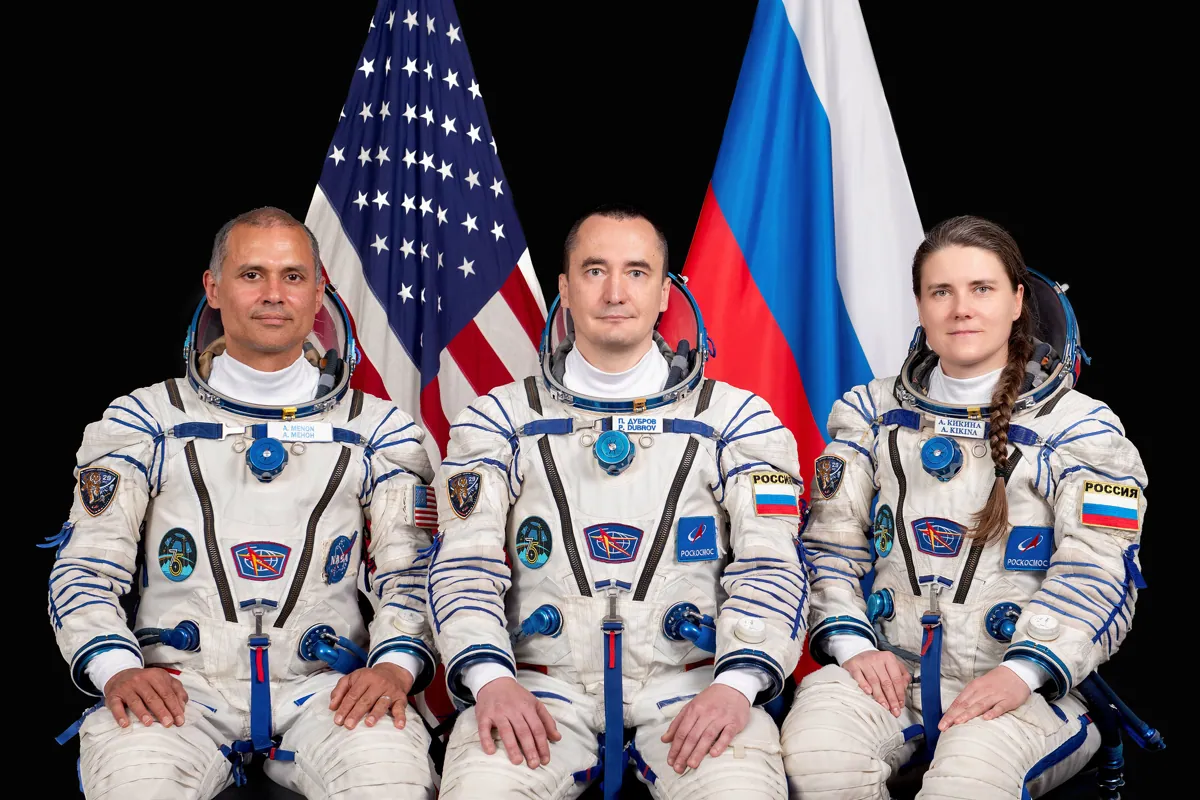
NASA astronaut Anil Menon is about to get his first taste of spaceflight, and it's a long one. Menon will launch Tuesday, July 14, aboard the Roscosmos Soyuz MS-29 spacecraft, joining cosmonauts Pyotr Dubrov and Anna Kikina for an eight-month stay on the International Space Station as part of Expedition 74/75.
Liftoff is set for 10:47 a.m. EDT (7:47 p.m. local time) from the Baikonur Cosmodrome in Kazakhstan, NASA said. The agency will stream the launch and docking live on NASA+, Amazon Prime, and its YouTube channel, with coverage beginning at 9:45 a.m. Eastern.
The trip to orbit is short by spaceflight standards. After two orbits and roughly three hours in transit, the Soyuz will automatically dock with the station's Prichal module at 1:56 p.m., with hatches opening a short time later. NASA has laid out a detailed viewing schedule for anyone who wants to watch the whole sequence unfold: rendezvous and docking coverage starts at 1:10 p.m., followed by hatch-opening and welcome ceremony coverage at 3:30 p.m., with the hatch itself expected to open around 3:55 p.m. All times are subject to change depending on real-time operations.
Once aboard, Menon, Dubrov, and Kikina will link up with a crew already in place: NASA astronauts Jessica Meir, Jack Hathaway, and Chris Williams, ESA astronaut Sophie Adenot, and Roscosmos cosmonauts Sergey Kud-Sverchkov, Sergei Mikaev, and Andrey Fedyaev. That brings the station's population to eleven, at least until the newly arrived trio settles into the long-duration rhythm of station life.
For Menon, this is a debut. For Dubrov and Kikina, it's a return trip, their second time living aboard the orbiting laboratory. All three are expected to remain on the station until they return to Earth in April 2027.
What Menon will actually be doing up there
The eight months aren't just about endurance. Menon has a packed research docket that touches on manufacturing, medicine, and the basic biology of living off Earth.
One thread of his work involves refining how semiconductor crystals are grown in space. Microgravity changes how materials form, and NASA has been building on prior research aimed at scaling up in-space production of these crystals, components that feed into high-performance computing, artificial intelligence systems, and medical devices. The idea is that space itself could eventually become a manufacturing environment for materials that are difficult or impossible to produce with the same quality on Earth.
Menon will also work on ultrasound imaging that combines augmented reality with artificial intelligence, technology that could let astronauts diagnose and treat medical issues without needing real-time guidance from doctors on the ground. That matters more as missions get longer and farther from Earth, where communication delays make live medical support increasingly impractical.
He'll also serve as a research subject himself, helping scientists study how blood flow changes in microgravity. That research feeds directly into efforts to protect astronauts on future long-duration missions, where cardiovascular changes are one of the more persistent unknowns of spending extended time off-planet.
Rounding out his research load, Menon will test bioprinting of vascular constructs in microgravity, essentially, printing biological tissue structures in orbit, to help researchers better understand the aging process and inform future therapeutic development.
Why it fits into NASA's bigger picture
None of this happens in isolation. NASA has framed the space station's ongoing work as a proving ground for problems that have to be solved before humans can safely go farther, whether that's a return to the Moon under the Artemis program or an eventual crewed mission to Mars. The station has now supported continuous human presence for more than 25 years, and NASA points to that uninterrupted stretch as the foundation for both the scientific breakthroughs already achieved and the ones still ahead.
The research Menon is taking on, materials manufacturing, AI-assisted medicine, and human physiology in space, reads like a checklist for the kind of self-sufficiency long-duration missions will eventually demand. A mission to Mars won't have the luxury of a quick resupply run or a doctor on call from Houston. Work like this is meant to close that gap well before astronauts actually need it closed.
For now, the more immediate marker is Tuesday's launch window. If the schedule holds, Menon will go from first-time flyer to full station resident in a matter of hours, with an eight-month mission, and a long list of experiments, waiting on the other side of docking.