Webb Telescope Finds a Third Hidden Planet in a System Astronomers Thought They Knew
Beta Pictoris d wasn't spotted as a point of light but sniffed out through its atmosphere's chemical signature, a method that could change how astronomers hunt for distant worlds.
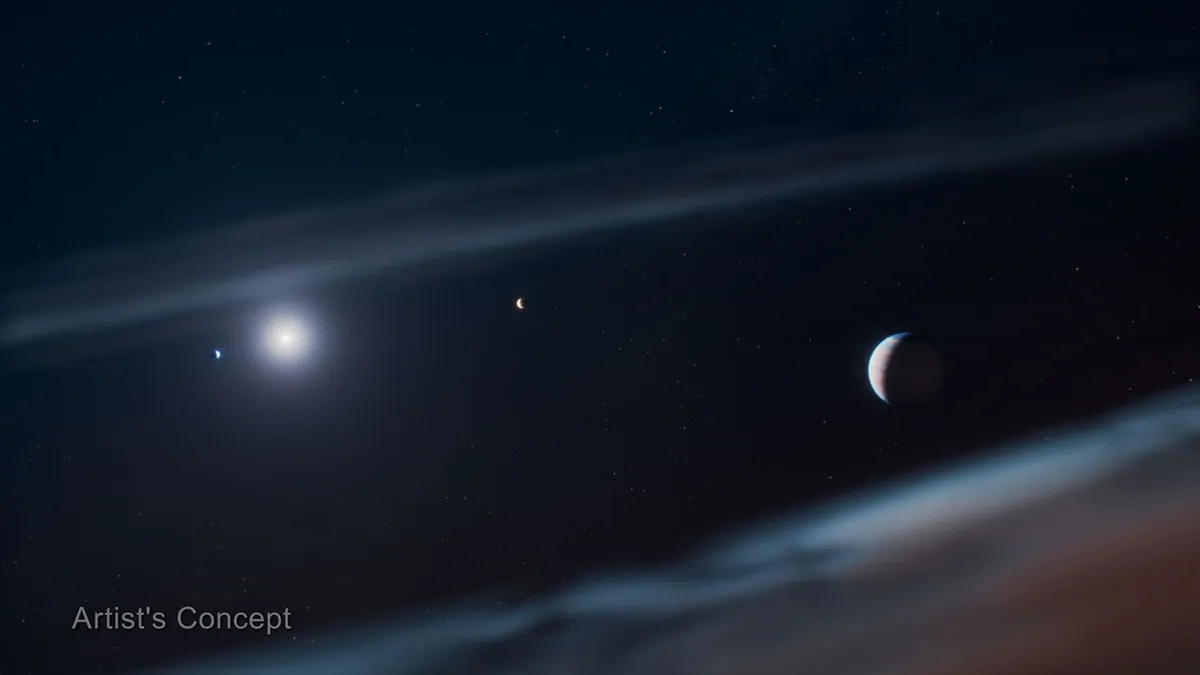
Astronomers have found a third planet lurking in Beta Pictoris, one of the most photographed and studied star systems beyond our own, and they weren't even looking for it.
The system, located 63 light-years from Earth, already had two known giant planets: Beta Pictoris b, one of the first exoplanets ever directly photographed, and Beta Pictoris c. The new discovery, Beta Pictoris d, makes this only the second known planetary system with at least three directly imaged planets. But what makes the find notable isn't just the planet count. It's how researchers found it.
Instead of spotting a bright dot of reflected starlight, the way most directly imaged exoplanets are found, the team picked up the planet's chemical fingerprint buried in spectroscopic data. That's a fundamentally different technique, and one that scientists say could open new doors for finding worlds that have been hiding in plain sight.
The discovery, led by Aidan Gibbs, a postdoctoral researcher at the University of California, San Diego, is detailed in a study published Wednesday in the Astrophysical Journal Letters. "This discovery adds another piece to an already fascinating planetary system," Gibbs said, according to NASA. "Beta Pictoris has long served as a laboratory for understanding how planetary systems form and evolve, and now we have another planet helping us tell that story."
An accidental find
Beta Pictoris is young by cosmic standards, about 23 million years old, and it's surrounded by a debris disk, a ring of dust and rocky leftovers from planet formation. That combination makes it a favorite target for astronomers trying to understand how planetary systems come together.
The research team wasn't hunting for a new planet at all. They were using the James Webb Space Telescope's NIRSpec instrument, specifically its Integral Field Unit, to study the atmosphere of the already-known Beta Pictoris b. That instrument captures both an image and a spectrum, a kind of chemical breakdown of light, for every pixel.
"We weren't looking for a new planet," Gibbs said. "We were trying to understand one we already knew existed. Then, this telltale signal appeared in the data where we didn't expect it."
That signal showed up as an odd pattern of peaks and dips in a region of the data where the researchers expected a smooth spectrum, since that area was supposed to just reflect starlight bouncing off dust. Instead, they saw a distinct barcode-like pattern of carbon monoxide absorption lines, a chemical signature commonly found in the atmospheres of giant planets.
Because spectroscopy captures motion as well as composition, the team could also calculate the object's radial velocity. That data let them confirm the object's speed, position, and orbital alignment with the debris disk matched what would be expected for a planet orbiting Beta Pictoris, ruling out the possibility that it was a background star or a brown dwarf with carbon monoxide of its own.
Jean-Baptiste Ruffio, a research scientist at UC San Diego and principal investigator on the observations, said the team has learned to be skeptical of unexplained bright spots in imaging data. "They can be instrumental artifacts or other structures in the debris disk," Ruffio said, according to NASA. "By obtaining a spectrum at the same time as the image, we were able to quickly confirm our suspicions."
Follow-up observations using Webb's MIRI instrument, made possible through a Director's Discretionary Time request, detected water vapor and methane in the planet's atmosphere, adding further confirmation and giving scientists a fuller picture of its chemistry.
Smaller, wider, and buried in fog
Based on the team's modeling, Beta Pictoris d is likely at least twice the mass of Jupiter, making it the smallest of the system's three known giant planets. It appears to orbit its star at roughly 30 astronomical units, a distance comparable to Neptune's orbit around the Sun, making it the outermost of the three planets. That orbit sits just inside the inner boundary of the system's debris disk.
That positioning helps explain why the planet went unnoticed for so long. Beta Pictoris hosts one of the brightest known debris disks, and its scattered starlight acts like a kind of cosmic fog that obscures faint planets from conventional imaging. The spectroscopic method used here effectively cut through that fog by focusing only on the narrow, specific wavelengths tied to a planet's atmosphere rather than trying to isolate a point of reflected light.
Scientists say Beta Pictoris d's presence may also explain some of the debris disk's stranger features, including its unusually sharp inner edge. In fact, researchers had previously predicted that a planet like this one should exist based on those very structural quirks in the disk.
A separate imaging study, led by Ben Sutlieff of the University of Edinburgh and Markus Bonse of the European Southern Observatory, independently confirmed the planet's existence using data from the European Southern Observatory's Very Large Telescope along with Webb's NIRCam instrument.
A new way to hunt for planets
What sets this discovery apart from most exoplanet imaging work is the order of operations. Typically, astronomers spot a point of light first and study its chemistry later. Here, the spectroscopic signal came first, and it delivered chemical and motion data immediately, before the planet was even confirmed to exist.
"A spectrum contains an incredible amount of information," Ruffio said. "You don't just learn that something is a planet; you immediately begin learning about its temperature, chemistry, and motion."
NASA describes this as the first directly imaged planet found primarily through moderate-resolution spectroscopy rather than traditional coronagraphic imaging, which blocks out a star's glare to look for planetary light directly. That distinction matters because it suggests astronomers now have another tool for finding planets hidden in messy, dust-filled environments where standard imaging struggles.
The team plans to keep digging through Webb's data to pin down more details about Beta Pictoris d, including its temperature, atmospheric makeup, and precise orbit. For a system that's been photographed and analyzed for decades, the fact that it just handed over a hidden third planet is a reminder that even the most familiar corners of the sky can still surprise the people watching them closest.