NASA Is Sending Three Helicopters to Mars at Once, and They'll Land Themselves
The SkyFall mission will drop a trio of Ingenuity-inspired rotorcraft directly into the Martian atmosphere in 2028, with radar instruments aimed at finding buried ice.
NASA is building on the surprise hit of its Mars helicopter program by sending not one, but three, aerial vehicles to the Red Planet at the same time. The SkyFall mission is slated to launch in 2028, riding to Mars aboard SR-1 Freedom, which NASA describes as the first fission nuclear-powered interplanetary spacecraft, according to Space.com.
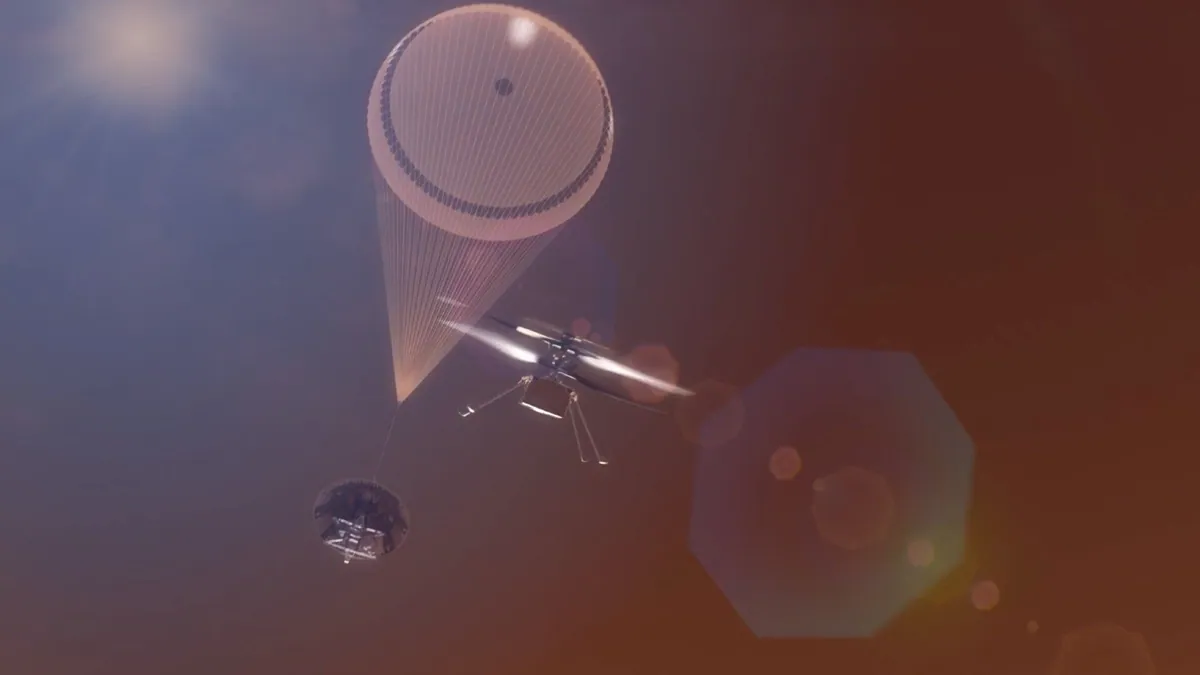
The three helicopters won't need a rover to drop them off. Instead, they'll be released straight from the carrier spacecraft into the Martian atmosphere, separating, descending, and landing under their own power, each touching down independently. NASA and its partners are calling this the "SkyFall maneuver," and it's a deliberate departure from how the last Mars helicopter got to the surface.
That helicopter was Ingenuity, which hitched a ride underneath the Perseverance rover and ended up flying more than 70 missions at Jezero Crater before a damaged rotor grounded it for good. It was originally designed to fly five times. SkyFall is explicitly built on that success, and the new helicopters are described as only slightly larger than Ingenuity, designed to operate the same way. Matthew Golombek, SkyFall's project scientist at NASA's Jet Propulsion Laboratory, told Space.com that the experience gained from operating Ingenuity will be directly relevant to running the new fleet.
Skipping the rover isn't just an engineering flex. According to a statement from AeroVironment, the Arlington, Virginia-based company co-designing and co-manufacturing the helicopters with JPL, eliminating the need for a single-use lander stage or a host rover "significantly reduces the technical and financial risk of getting to the Martian surface." AeroVironment previously co-developed Ingenuity, and Jeff Rodrian, head of the company's MacCready Works R&D arm, said SkyFall shows Mars helicopters can become "a repeatable product line, not a one-off delivery."
Where they'll land, and why
SR-1's trajectory will bring the SkyFall capsule down in Mars' northern hemisphere during the planet's spring season, timed to avoid dust storms. The helicopters will be released from the entry vehicle at roughly under a mile up, about 3,300 feet, and then fly themselves down to the surface.
Picking exactly where on Mars they'll explore is still a work in progress. NASA's Mars Exploration Program and the SkyFall project at JPL are jointly deciding the "why and where" of the mission's flight paths, with a first workshop on candidate landing sites and nearby exploration zones scheduled for early next year. That meeting is meant to produce a ranked list of potential sites, which will then get more detailed study ahead of a second workshop in late 2027. Final site selection happens after both workshops wrap.
One target has already emerged as a frontrunner. Golombek told Space.com that the project has identified "a design reference landing site that targets subsurface water ice deposits with glacial/periglacial terrains." That focus on buried ice runs through the entire mission.
What the helicopters carry
All three SkyFall vehicles will fly with an identical payload: five instruments plus engineering navigation cameras, covering the subsurface structure of Mars, surface geology and geomorphology, atmospheric meteorology, and the radiation environment. There's no dedicated wind sensor, but the helicopters themselves can act as makeshift ones, and they can even switch into a "Balloon Mode" that lets them drift along with the ambient wind.
The standout instrument is a ground-penetrating radar carried by each helicopter, capable of detecting layering beneath the surface at depths orbital radar can't reach. Those layers could be rock, buried ice, or a mix of both. Finding near-surface ice matters for two reasons: it preserves a record of Mars' past climate, and it represents what the mission describes as a high-priority environment that could have hosted past life, or might still harbor it today. It's also a resource planners are eyeing for future astronauts.
Will Pomerantz, head of Space Ventures at AeroVironment, told Space.com that the science community will likely steer the helicopters toward specific spots where the radar can map out where ice sits underground. "Just like here on Earth, Mars helicopters can cover distance quickly and can go places that might be impossible to reach by ground," Pomerantz said.
How far they can roam
Golombek said the helicopters are capable of flying one to two kilometers every other sol (a Martian day), which adds up to possible traverses of 125 to a little over 185 miles over the course of a mission. They're designed to operate for six months, with a goal of stretching that to a full Earth year, flying roughly every other sol along the way.
Pomerantz put the stakes simply: "The three SkyFall helicopters are going to show us parts of Mars we've never seen before and return mountains of data for scientists to pore over."
With landing sites still months from being finalized and launch several years out, the mission is in its early planning stages. But the shift from a single experimental rotorcraft bolted to a rover, to three independently landing, independently flying helicopters built as a repeatable design, marks a real step up in ambition for aerial exploration of Mars.