NASA's Roman Space Telescope Arrives in Florida for August Launch
The flagship observatory, built to survey the cosmos on a scale far beyond Hubble, is now in final prep at Kennedy Space Center ahead of its Aug. 30 liftoff.
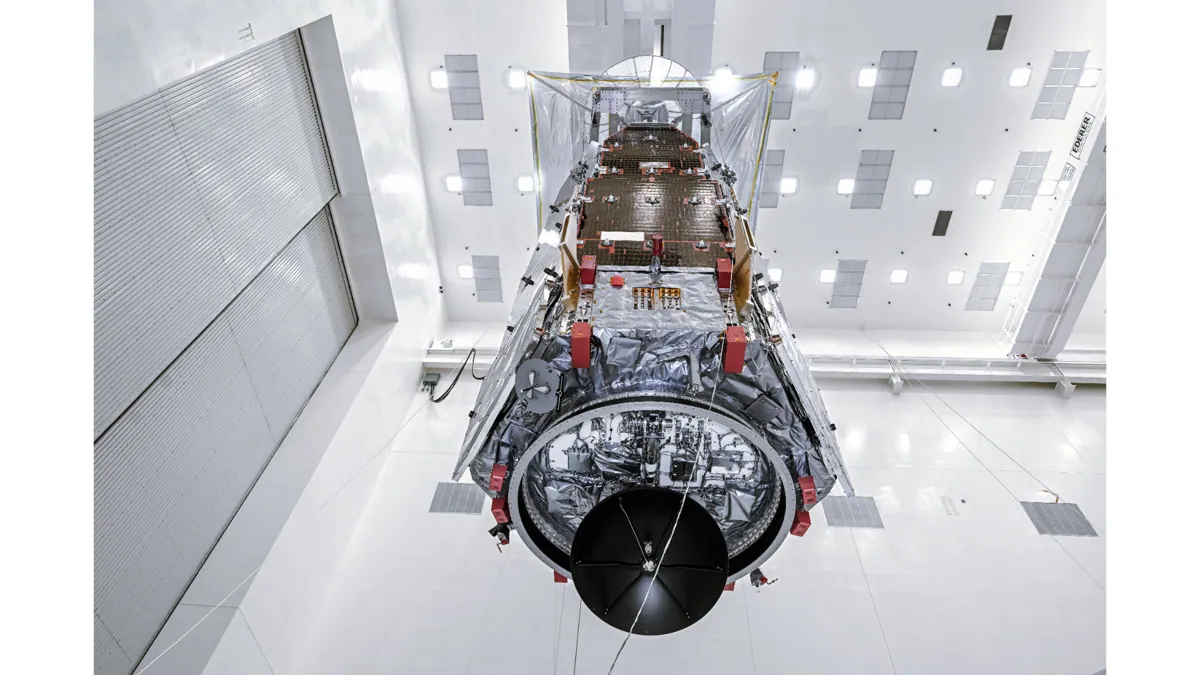
NASA's Nancy Grace Roman Space Telescope has left the lab bench behind and moved into launch mode. The spacecraft is currently inside a clean room at NASA's Kennedy Space Center in Florida, going through the final round of preparations before it heads to orbit on Aug. 30 — a date that's now just over a month and a half away.
A photo taken on June 26 captures the moment well: Roman suspended in mid-air inside the Payload Hazardous Servicing Facility, KSC's secure clean room where spacecraft get fueled, tested, and readied for flight. Technicians used a crane to hoist the telescope into a specialized stand, where engineers can continue working on it in the weeks before launch. The image looks almost weightless, which is fitting, given where Roman is headed.
The telescope made the trip to Florida after wrapping up assembly and testing at NASA's Goddard Space Flight Center in Maryland. That handoff from Goddard to Kennedy marks the last major milestone before the spacecraft gets bolted onto a rocket. From here on, it's fueling, final checks, and the countdown.
A telescope built for scale
Roman is named for Nancy Grace Roman, NASA's first chief of astronomy and a figure widely credited with shaping how the agency approaches space-based observation. It's a fitting namesake for a mission built around the idea of thinking bigger. Roman's field of view is at least 100 times larger than the Hubble Space Telescope's, according to Space.com. That's not a marginal upgrade — it means Roman can capture sweeping cosmic vistas in single exposures that would take Hubble a huge number of separate images to piece together.
That wide-angle capability is the whole point. Roman's science mission centers on two of the biggest open questions in astrophysics: dark matter and dark energy, the invisible material and mysterious force that together make up most of the universe but remain almost entirely unexplained. Studying them requires surveying enormous swaths of sky and cataloging how galaxies and light distribute across vast distances, exactly the kind of large-scale mapping Roman's wide field of view is designed for.
The telescope also carries a tech demonstration instrument called the Roman Coronagraph, which will attempt something Hubble was never built for: taking direct images of exoplanets, worlds orbiting stars outside our solar system. Most exoplanets are detected indirectly today, through the way they tug on their star or dim its light as they pass in front of it. A coronagraph works differently, blocking out a star's overwhelming glare so the much fainter light of a planet nearby can actually be photographed. If it performs as hoped, it's a step toward eventually taking pictures of other worlds rather than just inferring their existence from data.
What comes next
Roman has been a long time coming. Scientists have anticipated the mission for years as a natural successor to Hubble and a complement to the James Webb Space Telescope, each instrument built for a different kind of cosmic reconnaissance. Webb peers deep and close, resolving fine detail on individual objects. Roman is built to go wide, surveying huge stretches of the universe in one pass to catch patterns and rare events that narrower telescopes would simply miss.
With the spacecraft now at Kennedy and inside the clean room, the mission has entered its final and most delicate phase. Every step between now and launch, fueling, testing, integration with its rocket, carries the kind of scrutiny you'd expect for a flagship-class mission with a price tag and scientific ambition to match. Barring delays, Roman lifts off Aug. 30, beginning a mission designed to answer some of the largest questions in cosmology by looking at the sky in the widest way NASA has yet attempted.