NASA's Next Big Telescope Could Catch Black Holes Devouring Stars 11 Billion Years Ago
The Roman Space Telescope, launching August 30, is expected to spot hundreds of star-shredding events from the universe's early, crowded "cosmic noon" — data that could settle a running debate about how supermassive black holes got so big so fast.
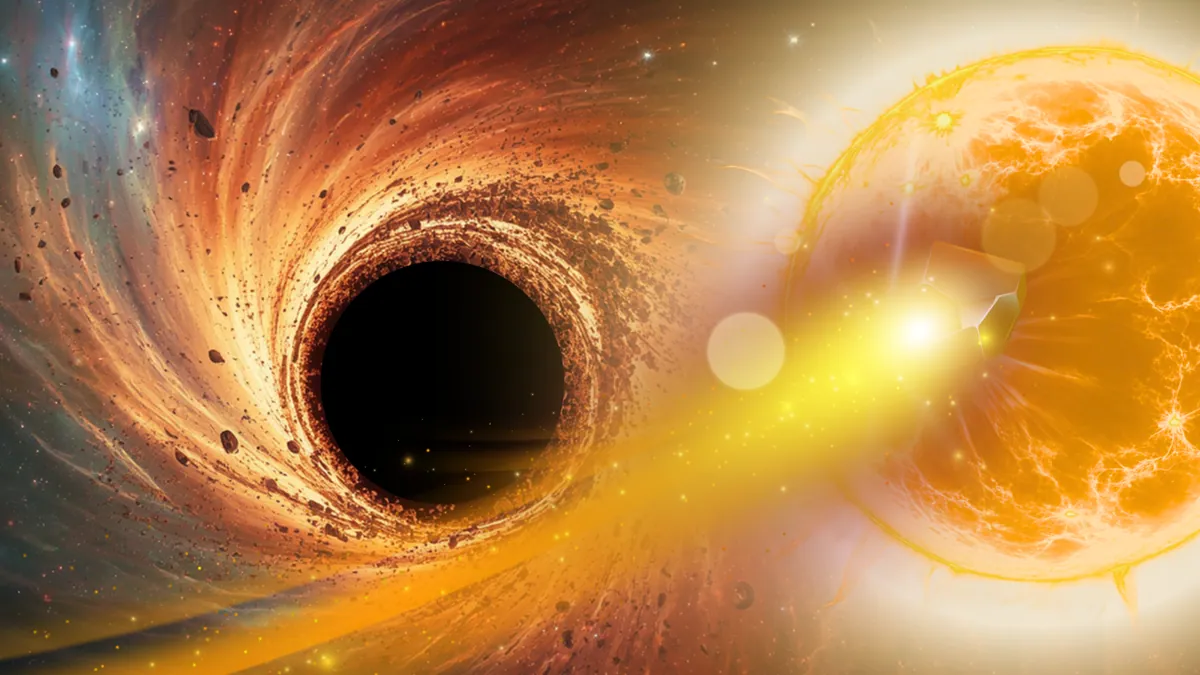
NASA is set to launch the Nancy Grace Roman Space Telescope on August 30, 2026, and among its many jobs, one stands out for sheer violence: catching supermassive black holes in the act of tearing stars apart, billions of years ago.
These events are called tidal disruption events, or TDEs. They happen when a star's orbit strays too close to a supermassive black hole and gets caught in a gravitational tug-of-war so extreme that the star stretches into a long, glowing stream of plasma — a process astronomers, with some flair, call "spaghettification." That stellar spaghetti gets fed gradually into the black hole, and for a brief window, the resulting flare can outshine every star in the black hole's home galaxy combined.
That brightness matters because supermassive black holes are otherwise nearly impossible to study directly. They're wrapped in an event horizon, the point of no return past which nothing, not even light, escapes. The only way to learn anything about them is to watch what happens to matter swirling around the outside, in what's called an accretion disk. Bigger black holes, the billion-solar-mass giants, tend to swallow stars whole before much light escapes. It's the smaller ones — in the range of 100,000 to 100 million solar masses — that put on the dramatic, visible show when a star wanders too close. That makes TDEs one of the best tools astronomers have for finding and measuring these lighter supermassive black holes, which otherwise stay dark and undetectable.
Until recently, scientists assumed TDEs would have been rare in the early universe, on the theory that the first supermassive black holes simply hadn't had time to bulk up past the 100,000-solar-mass threshold needed to produce one. But a new study, published July 14 in The Astrophysical Journal, argues that assumption may be wrong — particularly during a stretch of cosmic history known as "cosmic noon," roughly 11 to 12 billion years ago, when galaxies were young, dense, and packed with activity. The research team estimates Roman's survey work could turn up hundreds of TDEs dating back to that era, out of thousands to tens of thousands detected annually overall.
A puzzle Webb created that Roman might solve
The timing lines up with a problem NASA's other flagship telescope handed astronomers a few years ago. Since the James Webb Space Telescope began returning data in July 2022, it has repeatedly found supermassive black holes already in place when the universe was less than a billion years old. That's a problem, because the standard growth story for these objects — mergers plus steady feeding — should take longer than that to produce something so massive. Somehow, these black holes got huge unreasonably fast.
Two competing explanations have emerged. One, the "light seed" model, holds that supermassive black holes start small, as remnants of collapsed massive stars weighing maybe a few hundred solar masses, then grow through repeated mergers and aggressive feeding. If this is right, essentially every young galaxy should have a black hole seed at its core from early on.
The other, the "heavy seed" model, proposes that some early black holes formed directly from the collapse of massive clouds of primordial gas and dust, skipping the intermediate step of stellar death entirely. That would give them a head start, letting them begin merging and feeding before the first generation of stars had even died. But because these direct-collapse events would be rare, this model predicts that massive black holes should have been much less common in cosmic-noon galaxies than the light-seed model would suggest.
This is where TDEs come in. Since these star-shredding flares are associated with the lighter end of the supermassive black hole population, counting how often they occur at different points in cosmic history offers a way to estimate how many lighter black holes existed at a given epoch — and that, in turn, helps determine which growth model actually holds up.
"Tidal disruption events help us probe the population of light supermassive black holes, which can help us discriminate between these models," said Mitchell Karmen of Johns Hopkins University, who led the research, in a statement.
What Roman brings to the hunt
The tool for the job is Roman's High-Latitude Time-Domain Survey, which will repeatedly scan a patch of sky roughly equivalent to 90 full moons, watching for the telltale flares of stars being consumed. Repeated observation is key for catching transients — events, as the name implies, that flare up and then fade, sometimes on timescales of weeks or months.
"The Roman Space Telescope is going to be transformative for transient science," Karmen said. "Thanks to Roman's high sensitivity, we can find multiple tidal disruption events out to greater distances and earlier cosmic times than ever before."
Team member Suvi Gezari, an associate professor of astronomy at the University of Maryland, framed the payoff in terms of redshift, the measurement astronomers use as a proxy for cosmic distance and, therefore, time. "Just by counting the number of TDEs as a function of redshift, you can put meaningful constraints on the population of million-solar-mass black holes," she said. "Roman will be transformative in that it can probe tidal disruption events out to greater distances, so you can look at how the rate of TDEs evolves over time."
Gezari drew a direct comparison to Webb's impact on the field: "Just like the JWST has transformed our understanding of distant, high-redshift galaxies, Roman is poised to transform our understanding of high-redshift transients."
If the predictions hold, Roman won't just add more black holes to the catalog. It will help answer a question that's been nagging astronomers since Webb's earliest images came back: whether the universe's most massive black holes started small and merged their way to dominance, or arrived already oversized, skipping the slow climb entirely.