New Horizons Wakes Up 5.9 Billion Miles From Home, Ready to Phone In a Year's Worth of Data
NASA's Pluto probe spent nearly a year in hibernation mode and has come back online in good health, with a new science campaign already on the calendar.
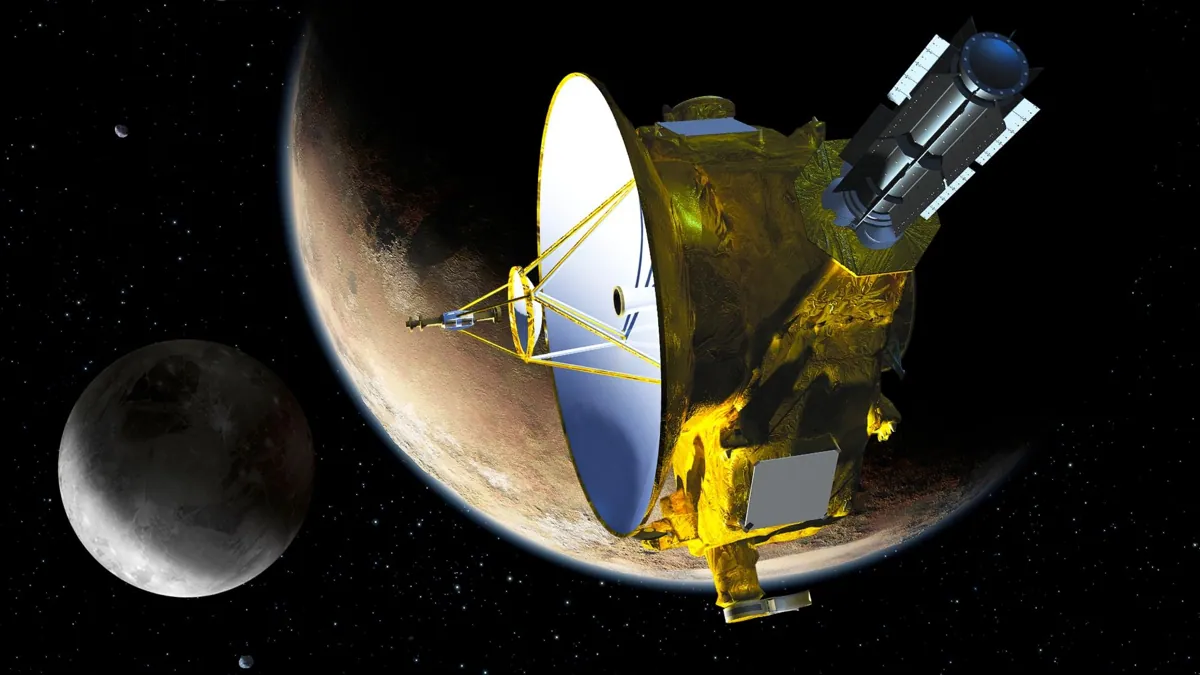
NASA's New Horizons spacecraft has come out of hibernation nearly 6 billion miles from Earth, checking in "in good health" after nearly a year of quiet cruising through the outer solar system, according to a NASA statement.
The probe is currently 5.9 billion miles (9.5 billion kilometers) away, a distance so extreme that its radio signals take about nine hours to reach mission control. It entered hibernation last August, a standard operating mode for long-haul deep space missions where most onboard systems power down to conserve resources while the instruments keep quietly gathering data. Now that it's awake, New Horizons will start downlinking 321 days' worth of collected data and reporting back on how its hardware is holding up in the cold and dark of deep space.
Early signs suggest the spacecraft came through in excellent shape. "Every status report through this hibernation period was 'green,' meaning all was well aboard New Horizons each and every week," said Alice Bowman, the mission's operations manager at the Johns Hopkins Applied Physics Laboratory (APL), in the NASA statement.
A Decade Past Pluto
New Horizons has already banked a historic résumé. It's the only spacecraft to have flown by the Pluto system, a milestone it hit back in 2015. Four years after that, it swept past Arrokoth, a snowman-shaped icy body one billion miles beyond Pluto that ranks as the most distant object humans have ever explored up close.
Since then, the mission has shifted its attention outward, studying objects in the Kuiper Belt — the wide, frigid ring of icy debris circling the solar system beyond Neptune — while also probing the far edge of the sun's influence. The spacecraft is currently pulling away from Earth at roughly 300 million miles (483 million kilometers) per year, according to NASA.
Next Stop: The Termination Shock
With the wake-up complete, New Horizons has a specific assignment waiting. In about three weeks, it will begin studying hydrogen in the outer heliosphere, the vast bubble of space shaped by the solar wind, the constant stream of charged particles the sun throws off in every direction.
That data matters because it touches on one of the more elusive boundaries in the solar system: the termination shock, the point where the solar wind abruptly slows as it runs into the thin gas of interstellar space. Only NASA's twin Voyager probes have ever crossed that boundary, but they did it without the kind of sensitive instrumentation New Horizons carries, meaning this mission could capture a level of detail on that region that's never been recorded before.
Pontus Brandt, New Horizons' project scientist at APL, described the significance in blunt terms to Space.com previously: "The data from the termination shock encounter will be a treasure trove for space physicists worldwide who are eager to understand how this vast boundary works." He added a broader point about what missions like this reveal: "All these discoveries from pioneering missions like Voyager and New Horizons teach us how little we know about what lies beyond."
For a spacecraft that launched to study a single dwarf planet and ended up redefining how far humanity's instruments can reach, the coming weeks mark another quiet but meaningful chapter. There's no dramatic flyby this time, no new world coming into focus through its cameras. Just a healthy probe, billions of miles from home, settling in to measure something almost nobody has ever measured before.