NASA Races to Save a Falling $500 Million Space Telescope
A private company built and launched a rescue spacecraft in just nine months to keep the Swift Observatory from burning up in Earth's atmosphere.
NASA is scrambling to rescue one of its most productive space telescopes before it falls out of the sky. The Neil Gehrels Swift Observatory, a gamma-ray-hunting spacecraft launched back in 2004, has been losing altitude faster than expected thanks to recent solar storms, and without help it could burn up in Earth's atmosphere as soon as this year.
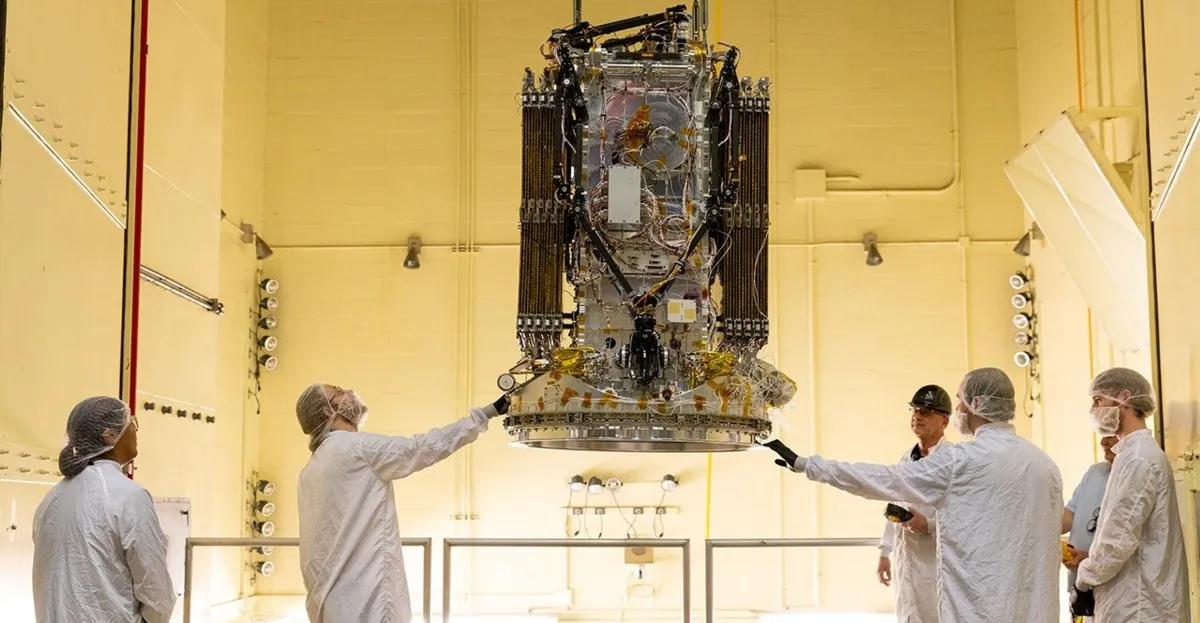
The problem is that Swift was never built with a way to fix that. It has no propulsion system of its own, meaning it can't nudge itself back into a safer orbit the way many modern satellites can. So NASA turned to an outside contractor, Katalyst Space Technologies, to build and fly a rescue mission from scratch. That mission, using a spacecraft called Link, launched on Friday with one job: catch up to Swift, dock with it, and physically push it back into a higher, safer orbit.
Swift is currently circling Earth at an altitude of 224 miles, well below where it started. Link is designed to boost it by roughly 150 miles, restoring the kind of orbital cushion that would keep it flying for years rather than months. To do that, Link relies on a three-armed design built for grappling onto a satellite that was never meant to be serviced in orbit at all — a genuinely difficult piece of engineering, made harder by the timeline NASA gave Katalyst to work with.
A nine-month sprint against orbital decay
What makes this rescue notable isn't just the maneuver itself, it's how fast Katalyst had to pull it off. NASA determined that Swift would drop too low to be saved by October, which meant the company had to design, build, test, and launch a satellite-servicing spacecraft in about nine months. According to The Verge, the whole effort cost roughly $30 million — a modest price tag next to the $500 million spacecraft it's trying to save.
That cost comparison is really the whole case for the mission. Swift has been in continuous operation for two decades, and losing it now would mean losing not just the hardware but two decades of irreplaceable observational continuity. Spending $30 million to protect a $500 million asset, on a compressed timeline, is the kind of bet that only makes sense if the science being protected is worth it.
And in Swift's case, it is. The observatory's specialty is gamma-ray bursts, the extraordinarily energetic explosions that rank among the most powerful events in the universe. Studying them has been central to piecing together what the early universe looked like, giving astronomers a window into cosmic events from billions of years ago. Losing Swift wouldn't just end one mission, it would cut off an ongoing stream of data about phenomena that are difficult to observe any other way.
Why this happened now
The immediate trigger for Swift's orbital decline is solar activity. Increased solar storms heat and expand Earth's upper atmosphere, which increases drag on satellites orbiting at lower altitudes. That drag pulls spacecraft down faster than their designers originally planned for, and it's a growing headache across the satellite industry generally, not just for aging science missions like Swift. What makes Swift particularly vulnerable is that it has no thrusters to compensate. Many newer satellites carry propulsion systems specifically so they can periodically raise their own orbits and outlast exactly this kind of atmospheric drag. Swift, designed and launched in 2004, wasn't built with that kind of self-correction in mind, because in-orbit servicing wasn't yet a practical option.
That's what makes Katalyst's approach significant beyond just this one mission. Link isn't refueling Swift or repairing it, it's essentially giving a boost to a satellite that was engineered without any expectation of outside help. If it works, it demonstrates a capability that could matter for a lot of the aging infrastructure currently in orbit: spacecraft that are otherwise healthy and scientifically valuable but slowly losing altitude with no way to help themselves.
For now, the mission's success will come down to whether Link can actually rendezvous with Swift, grapple it successfully, and execute the boost as planned. If it does, Swift gets a new lease on life and NASA gets a real-world proof point for commercial satellite-servicing missions. If it doesn't, a two-decade run of groundbreaking gamma-ray astronomy comes to an end well before anyone at NASA wanted it to.