NASA Tops Off Roman Space Telescope Ahead of August 30 Launch
The observatory, designed to capture data at a scale that dwarfs Hubble's entire 35-year archive, is now fueled and on track for a rare on-time, under-budget debut.
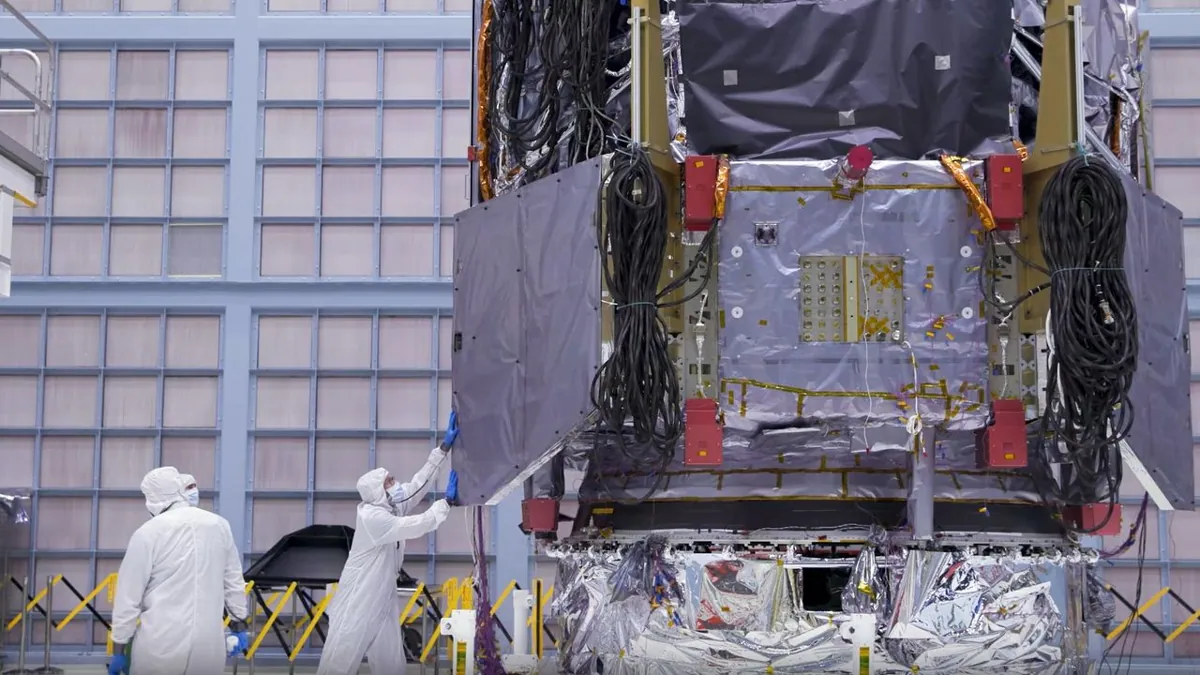
NASA has finished fueling the Roman Space Telescope, clearing a major hurdle before its planned launch on August 30 at 7:26 a.m. EDT aboard a SpaceX Falcon Heavy rocket. The agency confirmed the fueling on Tuesday, July 28, after ground teams pumped the observatory full of hydrazine on July 25.
That timeline matters because Roman has been something of an outlier in modern spaceflight: the project is reportedly nine months ahead of schedule and under budget, according to NASA. Big space telescopes rarely get to say that. If the August 30 date holds, it'll be a rare case of a flagship mission arriving early.
Hydrazine itself is a familiar workhorse in spacecraft propulsion, prized for its efficiency but notorious for being toxic and unstable to handle. NASA and others in the industry have been trying to move away from it in favor of safer alternatives, but for Roman, it remains the fuel of choice to get the telescope where it needs to go and keep it there.
And where it needs to go is far from trivial. Roman is headed to Lagrange point 2, a gravitationally stable location roughly a million miles from Earth where the pull of the sun and Earth balance out enough that spacecraft can hold position without burning through fuel constantly. It's also home to the James Webb Space Telescope, meaning NASA will soon have two of its most advanced instruments operating in the same neighborhood of space. According to NASA, Roman's propellant will power two types of thrusters, one set to maintain its orbit around L2 and another to keep its solar panels angled toward the sun, which supplies the observatory's power for the entire mission.
A data firehose unlike anything before it
What sets Roman apart isn't just where it's going. It's how much it will see once it gets there. NASA expects the telescope to generate over 500 terabytes of data annually. For context, Hubble has produced more than 400 terabytes total across 35 years in orbit. Roman is set to blow past that in a single year.
That torrent of data is meant to power research into some of astrophysics' biggest open questions: the nature of dark matter and dark energy, the mechanics of supernova explosions, and the search for exoplanets that could potentially support life.
Filling in the gaps James Webb can't
Roman won't replace the James Webb Space Telescope. It's built to work alongside it. Both instruments see in infrared, the wavelength range that lets astronomers peer through cosmic dust and observe extremely distant, ancient light. But where JWST is built for depth, capturing extraordinarily detailed images of specific, narrow targets, Roman is built for breadth.
Its Wide Field Instrument can capture images of the infrared sky roughly 50 times larger than what JWST can capture in a single shot. In practice, that means Roman can scan huge stretches of the universe, flag objects worth a closer look, and hand off promising targets to JWST for detailed follow-up. It can also catch short-lived cosmic events that JWST's narrower field of view would likely miss entirely.
That wide-angle approach is especially useful for studying dark matter and dark energy, phenomena that can't be observed directly and are instead inferred by how they influence the movement of galaxies. A telescope that can track many galaxies simultaneously, rather than one at a time, is far better suited to that kind of large-scale pattern-hunting.
Dominic Benford, program scientist for the Nancy Grace Roman Space Telescope, previously told Space.com the mission would push observations of stellar explosions into territory no telescope has reached before: "So we're going to see thousands of supernovae, and some of these are going to be further away than any supernovae we've ever seen before."
What comes next
With fueling complete, Roman now heads toward final launch preparations ahead of its August 30 target date. If it launches on schedule and settles successfully into orbit near JWST at L2, astronomers will have, for the first time, a genuine wide-view-and-close-up pairing working in tandem, one telescope casting a broad net across the sky, the other zooming in on whatever it finds most interesting. That combination, more than any single spec, is what has scientists watching this launch closely.