NASA's Nuclear-Powered Mars Mission Just Hired Its Heat Shield Maker
Firefly Aerospace will build the aeroshell that protects Skyfall's descent stage, moving the helicopter-dropping Mars mission a step closer to its planned 2028 launch.
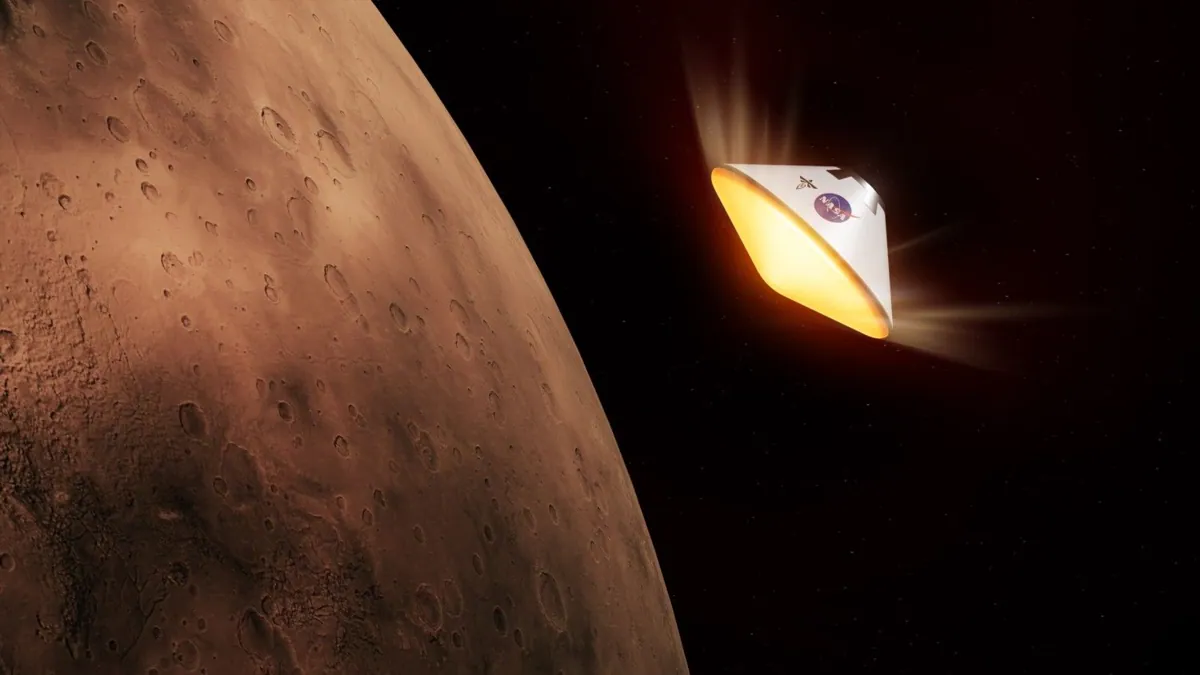
NASA's plan to fly three helicopters to Mars just got a little more real. Firefly Aerospace has been selected to design and build the protective aeroshell for the descent stage of Skyfall, NASA's first nuclear-powered interplanetary mission, under a $13 million subcontract from the agency's Jet Propulsion Laboratory.
If the name Skyfall sounds dramatic, that's because the mission plan is genuinely unusual. Rather than landing on Mars in the conventional sense, the spacecraft will release its three helicopters mid-descent, letting them fly free through the Martian atmosphere to begin scouting the surface. NASA is calling this the "SkyFall Maneuver," and it's the reason Firefly's job description looks a little different from a typical Mars lander contract.
No landing required
Skyfall is set to launch in 2028 carrying three helicopters modeled on Ingenuity, the pioneering drone that rode to Mars strapped to the Perseverance rover and became the first aircraft to fly on another planet. This time, though, there's no rover involved and no touchdown for the main spacecraft. Instead, the descent stage will drop its helicopter trio while still falling through the Martian sky, and the aircraft will take flight almost immediately to start their work.
That work centers on hunting for water ice. NASA wants the helicopters' onboard prospecting instruments to map potential resources on the Martian surface, data that could help identify landing sites for future crewed missions. It's also NASA's first attempt at powering an interplanetary probe with nuclear energy, a significant technical leap for a mission already built around an atypical delivery method.
Firefly's piece of that puzzle is the aeroshell, which includes both the heat shield and the backshell that will encase the descent stage during its plunge through the Martian atmosphere. That structure has to do two jobs at once: shield the hardware from the intense heat of atmospheric entry, and provide the aerodynamic stability needed to guide the capsule out of the vacuum of space and into a controlled descent, accurately enough that the helicopters can be released at the right moment.
Home turf advantage, sort of
This marks the first project Firefly will develop at its expanded Texas facility, known as Gloworks. Once the aeroshell design work wraps up there, manufacturing and testing will shift to the company's Rocket Ranch site in Briggs, Texas, before the finished hardware ships to JPL for integration with the rest of the Skyfall spacecraft.
Firefly is leaning on experience from across its existing portfolio, including its Blue Ghost lunar lander and its Alpha and Eclipse rockets. Blue Ghost launched in January 2025 and touched down on the moon roughly two months later, becoming only the second commercial lander ever to achieve a soft lunar landing.
"We've proved our ability to execute off-Earth missions at a fraction of the cost and timeline through our successful Blue Ghost lunar mission," said Ray Allensworth, Firefly's vice president of spacecraft, according to a company statement. "Now we're applying these lessons learned and utilizing our proven technologies to continue accelerating and lowering costs for future missions to the moon, Mars, and beyond."
Notably, this contract asks less of Firefly in one respect: unlike Blue Ghost, there's no actual landing to engineer. But Skyfall's destination — and its stakes — are considerably higher. Mars entry, descent and the timed release of three separate aircraft mid-fall is a far more complex sequence than settling a single lander onto the moon.
What's next
With the aeroshell contract now in place, Skyfall's hardware development moves from concept to construction. JPL continues to manage the overall mission, with Firefly's contribution flowing from design at Gloworks through manufacturing and testing at Rocket Ranch, and finally to spacecraft integration at JPL ahead of the targeted 2028 launch. How the SkyFall Maneuver performs in practice, releasing three helicopters into Martian flight during descent rather than after a landing, will be one of the mission's defining tests once it reaches the Red Planet.