China Catches a Falling Rocket at Sea, Cracking a Milestone Only SpaceX Had Reached
The Long March 10B's debut flight ended with its first stage settling into a net on a recovery ship, a feat China says opens the door to reusable rockets of its own.
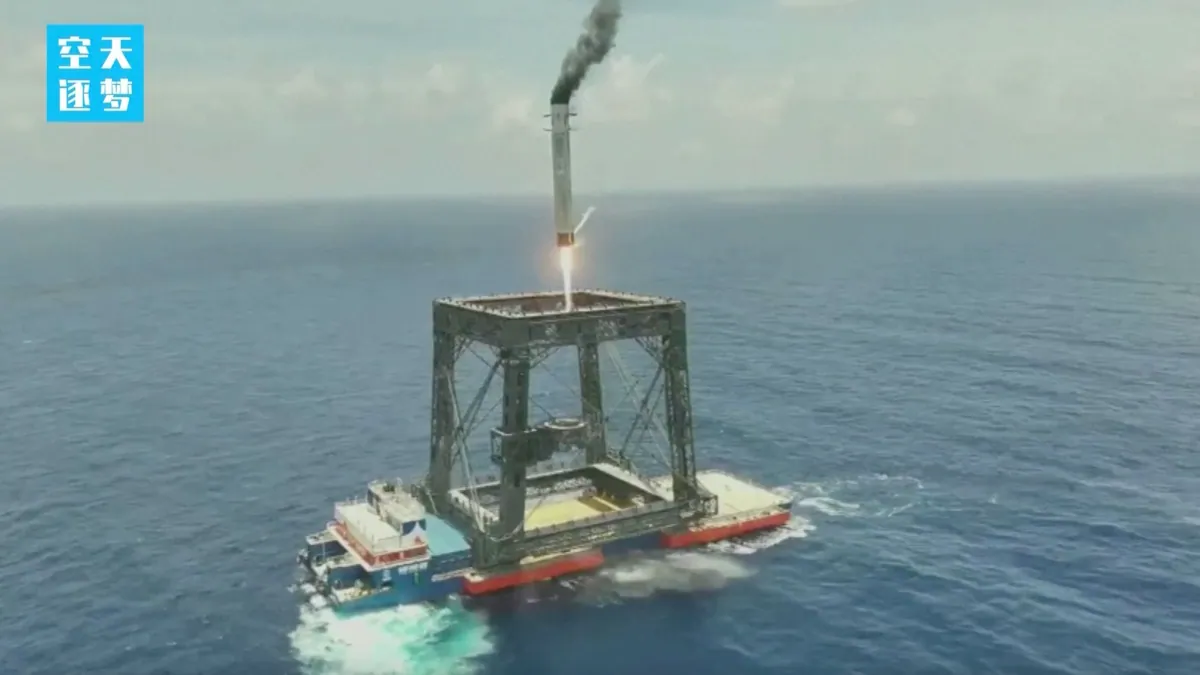
China pulled off something no other country has managed: catching an orbital rocket's booster during an actual launch, using a net strung across a ship at sea.
The moment came Friday during the maiden flight of the Long March 10B, a new rocket built by the China Aerospace Science and Technology Corporation (CASC), the state-owned contractor that anchors China's space program. Rather than landing on solid ground or a floating platform the way SpaceX's boosters do, the Long March 10B's first stage descended vertically and settled into a net-like catch structure mounted on a recovery vessel — a method nobody had tried on an orbital mission before.
CASC didn't undersell the moment. In a social media post announcing the result, the company called it, in translation, "my country's first successful controlled recovery of a launch vehicle and the world's first network-based recovery of a launch vehicle." The statement went further, framing the flight as a "historic breakthrough" that would help accelerate China's broader ambitions in space access.
What actually happened
The Long March 10B is a two-stage rocket standing roughly 207 feet tall, according to CASC. Its first stage runs on kerosene and liquid oxygen, while the second stage burns liquid oxygen and liquid methane — a propellant combination increasingly popular among newer rockets because it burns cleaner and leaves less residue on reusable hardware. Flying in its reusable configuration, the rocket is designed to carry about 16 tons of payload to low Earth orbit.
This wasn't a bare-bones test hop, either. The rocket launched with an actual satellite on board, which CASC said reached "its predetermined orbit." The company gave no further details on the spacecraft itself or its orbital parameters.
The recovery sequence, as CASC described it, unfolded fast: about six minutes after stage separation, the first stage flipped back to vertical and touched down on the sea-based platform's net system. The launch lifted off from the Hainan Commercial Space Launch Site at 12:15 a.m. EDT (0415 GMT, or 12:15 p.m. local time in Beijing). CASC called both the launch and the recovery "a complete success" and said it plans to refly this same first stage before the end of the year — a claim that, if it holds up, would mark China's first demonstrated rocket reuse in practice, not just on paper.
Why the landing method matters
Every orbital rocket that has ever landed itself has done so the way SpaceX does it: touching down on legs, either on a drone ship or back at the launch site. China's choice to catch the booster in a net changes the engineering problem considerably. It shifts some of the burden of a soft landing from the rocket's own structure and legs onto the ship's catch system, an approach that, notably, echoes what SpaceX has been experimenting with for its much larger Starship booster using mechanical arms at the launch tower.
CASC framed the reusable design as a direct cost play, saying the configuration "significantly reduces launch costs, offering advantages of large payload capacity and high cost-effectiveness." That's the same logic SpaceX has ridden to dominance: by recovering and reflying boosters rather than throwing them away after every flight, a launch provider can fly more often for less money per flight. SpaceX has landed orbital-class boosters more than 600 times at this point, and that volume of reuse is a big reason it now controls so much of the global commercial launch market.
China's crowded field of reusable rockets
The Long March 10B isn't China's only swing at this problem, and it's not the first attempt — just the first to succeed. CASC's Long March 12A and Landspace's Zhuque-3, built by the Beijing-based private company Landspace, both debuted in December. Both reached orbit as intended, but in both cases the first stage failed to land.
Beyond those, a handful of other Chinese companies are racing to build their own reusable launch vehicles: CAS Space is developing Kinetica-2, Galactic Energy is working on Pallas-1, and Deep Blue Aerospace is building Nebula 1. Taken together, it points to a launch industry in China that's placing a serious, coordinated bet on reusability as the future of getting to orbit, rather than treating it as a side project.
If that bet pays off across multiple companies and vehicles, China could end up with a stable of reusable rockets flying with something approaching the cadence of SpaceX's Falcon 9 — currently the workhorse of global spaceflight precisely because it flies so often and so cheaply. Friday's net-and-net recovery is a single data point, but it's the first time any of these Chinese programs has actually closed the loop: launch, recover, and — if the promised reflight happens on schedule later this year — fly again.