Microsoft's Latest Patch Tuesday Fixes a Record 622 Security Flaws
The update also kills a bug that could quietly eat up to 500GB of storage and adds a long-requested update-delay feature to Windows 11.
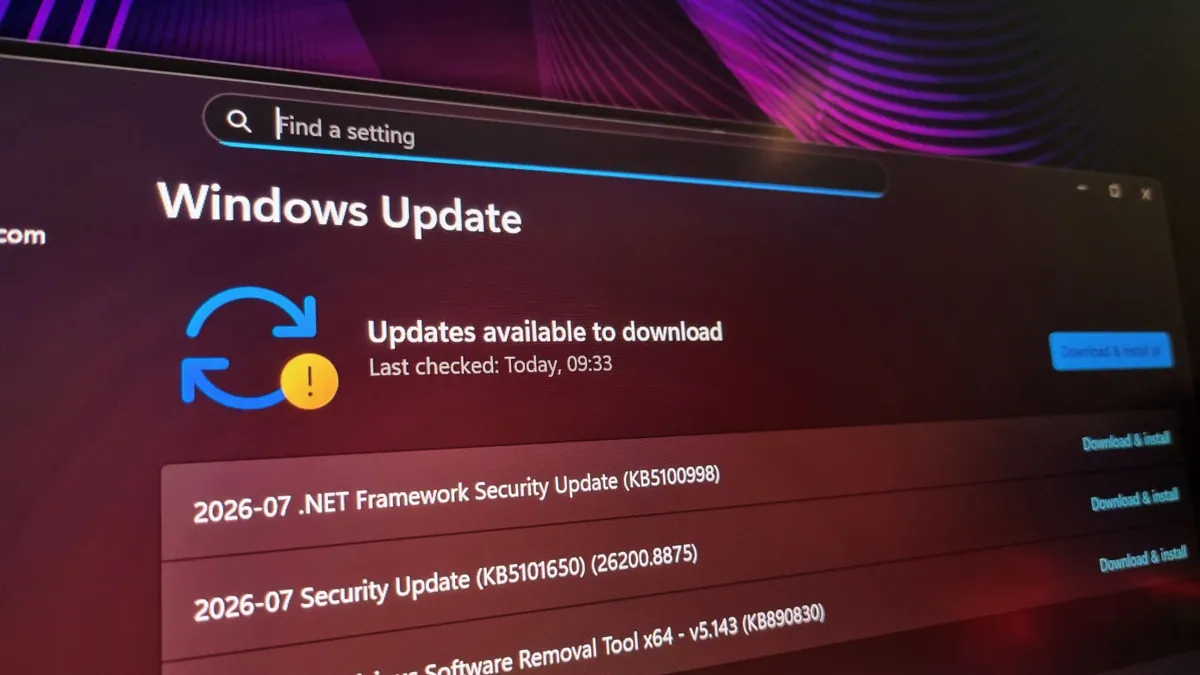
Microsoft just shipped its biggest Patch Tuesday on record, closing out 622 security vulnerabilities in a single update cycle. That's more than triple the 206 CVEs (Common Vulnerabilities and Exposures, the standard tracking system for security flaws) fixed in the previous round, according to The Register.
The jump lines up with a push Microsoft has been making to fold AI into its vulnerability-hunting process, and this release looks like early evidence that the approach is paying off. More than 500 of the 622 fixes touch Windows directly, including a patch for a zero-day vulnerability in BitLocker, Windows' disk encryption tool. That flaw may be connected to exploits security researcher Nightmare-Eclipse surfaced earlier this year.
What's actually in the update
The centerpiece for Windows 11 users is a cumulative update labeled KB5101650. Beyond the security patches, it fixes a bug tied to a file called "CapabilityAccessManager.db-wal," part of the system that manages app permissions on Windows 11. Under certain conditions, that file could balloon to as much as 500GB, silently chewing through storage. The timing is particularly bad given the ongoing SSD and memory shortage that's made storage more expensive and harder to come by. Microsoft says that issue is now resolved.
KB5101650 also brings a feature to all Windows 11 machines that had previously been limited to Windows Insiders: the ability to pause updates for up to 35 days at a stretch. According to Windows Latest, users have found they can extend that window further by unpausing and immediately re-pausing, effectively resetting the clock. That gives people more room to hold off on an update if something looks unstable, rather than being forced into installing it on Microsoft's schedule.
Not a completely clean rollout
The update isn't landing everywhere without issue. Microsoft has flagged a compatibility problem affecting a limited number of Dell laptops running Intel processors. The company warns that the incompatibility can lead to unexpected shutdowns, degraded performance, excess heat, and faster battery drain. As a result, the update is being held back from those specific machines for now.
"We are working together with Dell to prevent the affected models from experiencing the issue and plan to release a resolution for affected devices in the coming days," Microsoft said.
Why the scale matters
A record-setting patch count is notable on its own, but the context is what makes it interesting. Microsoft has talked about using AI to speed up vulnerability detection, and a threefold jump in fixes in one cycle suggests that effort is starting to surface issues that might otherwise have gone unnoticed or taken longer to catch manually. For a platform running on hundreds of millions of PCs, catching more flaws faster is a meaningful shift in how security maintenance gets done.
For everyday users, the practical takeaways are simpler: a nasty storage-eating bug is gone, a real BitLocker zero-day is patched, and there's now more flexibility to delay updates if you want to wait and see how a rollout goes. The Dell/Intel hiccup is a reminder that even a record-breaking patch cycle doesn't mean a friction-free one, and anyone on an affected Dell laptop should watch for Microsoft's promised fix in the near future rather than forcing the update through.