Japan's MMX Mission Launches Today to Grab a Piece of Mars' Mysterious Moon
The decade-long round trip to Phobos aims to settle a long-standing debate about where the Red Planet's moons actually came from.
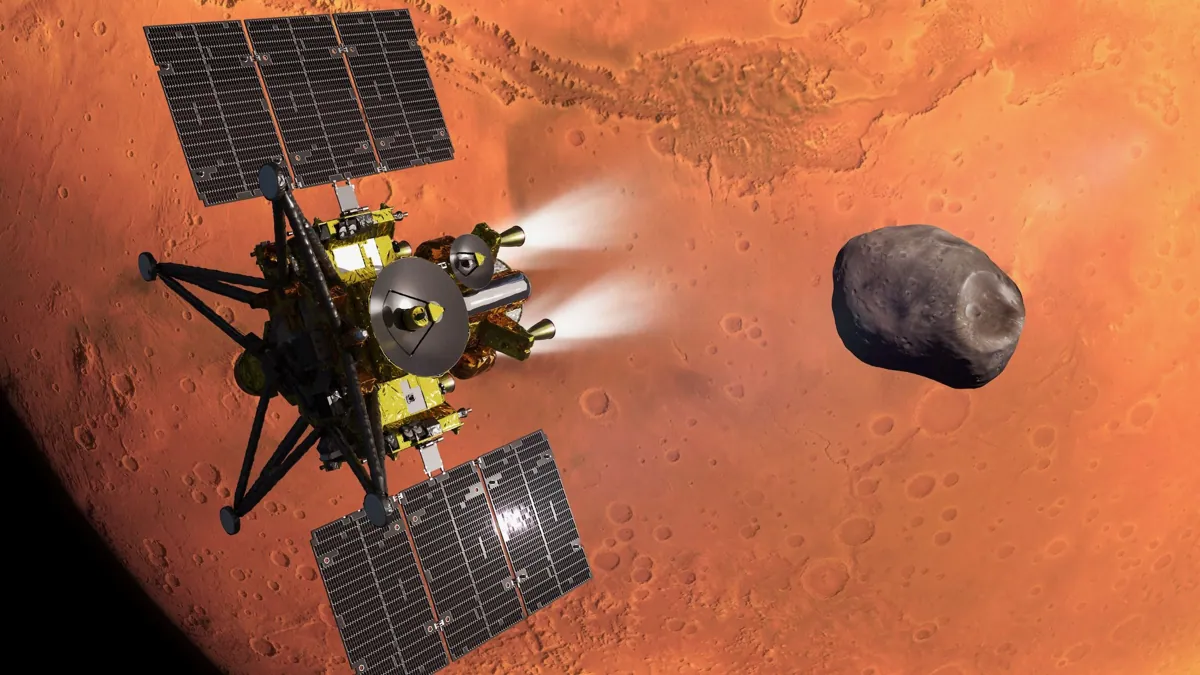
Japan is sending a spacecraft to steal a piece of Mars today, by way of one of its moons.
The Martian Moons eXploration mission, known as MMX, is set to launch October 19 aboard an H3 rocket from Japan's Tanegashima Space Center, with liftoff scheduled for 3:41 p.m. EDT (4:41 a.m. October 20 in Japan). The Japan Aerospace Exploration Agency, or JAXA, is streaming the launch live, with coverage starting at 2:45 p.m. EDT.
The target isn't Mars itself but Phobos, the larger of the planet's two small moons. If the mission goes as planned, MMX will spend the better part of a decade studying Phobos and its sibling moon Deimos, land briefly on Phobos' surface, scoop up material, and haul it back to Earth for scientists to examine.
That sample could resolve a question that has puzzled astronomers for decades: where did these moons actually come from?
A mystery Earth's own moon doesn't have
Earth's moon has a known backstory. Scientists broadly agree it formed when a Mars-sized object slammed into early Earth, blasting debris into orbit that eventually clumped together. Phobos and Deimos offer no such clarity.
As Tom Statler, MMX program executive and program scientist at NASA Headquarters, put it in an October 15 statement, the two moons "may be the remains of a massive impact on Mars that sent material into orbit around the planet, or they could be ancient asteroids that were captured by Mars' gravity billions of years ago." Both theories have supporters, and nobody has had the data to settle the argument.
That data gap matters beyond just moon trivia. Statler noted that nailing down the answer "will help illuminate that early era when Earth and the other inner planets may have been acquiring much of their water and organic compounds" — in other words, a close look at Phobos could tell us something about how rocky planets, including our own, ended up with the ingredients for life.
Phobos and Deimos are tiny by any measure. Phobos spans about 14 miles across, Deimos roughly 8 miles — more like oversized asteroids than proper moons. That scale is part of why their origin has been so hard to pin down from a distance.
The long road to a sample
MMX's itinerary stretches out over years. The spacecraft won't even reach the Mars system until August 2027, and it will take another month after that to settle into orbit around Phobos. From there, it will spend roughly 18 months observing both moons remotely before getting hands-on.
In early 2029, MMX will release a small rover called Idefix onto Phobos' surface. Built jointly by French and German space agencies, Idefix weighs about 55 pounds on Earth, though it won't feel like much on Phobos. According to the European Space Agency's mission description, Phobos' gravity is so weak that Idefix will effectively weigh about 15 grams there — roughly half an ounce. The rover's job, per ESA, is twofold: scout the terrain to help the main spacecraft pick a landing spot, and analyze the composition and texture of Phobos' surface firsthand.
The main event comes in 2030, when the MMX mothership itself touches down on Phobos to collect at least 10 grams of surface material. Afterward, it departs for Earth, with the return capsule expected to land in 2031 carrying the collected samples for laboratory analysis around the world.
That's a full decade from launch to touchdown of that capsule — a timeline that underscores just how logistically demanding deep-space sample-return missions are, even when the target is comparatively close.
Why the launch got delayed
MMX wasn't originally supposed to launch this late. The mission had targeted a 2024 liftoff, but problems with the H3 rocket pushed it back. That wasn't a trivial slip: because Earth and Mars only line up favorably for efficient interplanetary launches once every 26 months, missing that 2024 window meant MMX had to wait for the next alignment rather than simply launching a few months later.
That orbital mechanics constraint is a recurring headache for Mars missions generally, and it's a big part of why space agencies treat these launch windows with such urgency. Miss one, and the next opportunity can be more than two years away.
Japan's sample-return track record
This isn't Japan's first attempt at hauling pieces of another world back home. JAXA's Hayabusa mission returned samples from the asteroid Itokawa in 2010, and its successor, Hayabusa2, brought back material from the asteroid Ryugu a decade later. Both missions established Japan as one of the few space programs with proven sample-return capability.
MMX represents a more ambitious step: a moon of another planet, rather than a free-floating asteroid, with a more complex multi-phase mission involving a rover, an orbital survey phase, and an actual landing by the main spacecraft rather than a touch-and-go sampling maneuver.
NASA is a partner on the mission as well, contributing a scientific instrument, a technology demonstration, communications support, and funding for American researchers on the MMX science team, though the mission itself is led by Japan.
If MMX pulls off its sequence of maneuvers over the next decade, the payoff is a definitive answer to a question that's lingered since telescopes first got a good look at Phobos and Deimos. Whether that sample points to a violent impact on Mars or a captured asteroid, scientists will finally have physical evidence instead of competing theories. For now, the mission starts with a single rocket launch and a very long wait.