NASA's Roman Space Telescope Set to Launch Aug. 30, Months Ahead of Schedule
The $4 billion observatory will survey the sky so fast that one month of its work would take Hubble roughly a century to match.
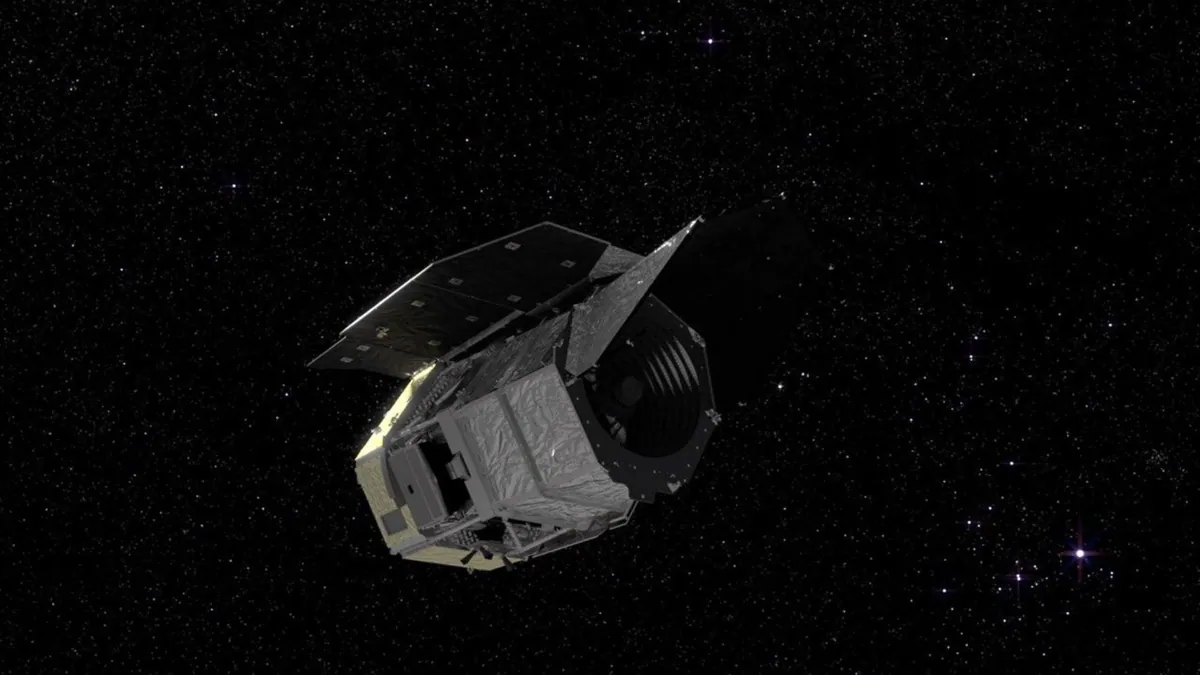
NASA's next flagship space telescope has a launch date, and it's coming up fast. The Nancy Grace Roman Space Telescope is scheduled to lift off aboard a SpaceX rocket on Aug. 30 at 7:26 a.m. EDT, according to a NASA status update delivered Wednesday at the agency's Goddard Space Flight Center in Greenbelt, Maryland. That's nine months earlier than originally planned, and the mission team used the briefing to lay out just how much ground the $4 billion telescope is about to cover, literally and figuratively.
"In 30 days, we're going to be launching Roman, testing it out, opening the deployable aperture cover, looking at the sky, and sending data down to the ground for the first time," said Jeremy Perkins, Roman's telescope integration and test scientist, at the press conference.
The update follows news just days earlier that Roman has been fully loaded with hydrazine, a highly efficient but toxic and unstable propellant that NASA is trying to phase out over the long term, though it's still standard for missions like this one until better alternatives exist. Roman needs a substantial supply of it. The telescope is headed to Lagrange Point 2, a gravitationally stable spot about a million miles from Earth, on the opposite side from the sun, where it will join the James Webb Space Telescope. That location lets a spacecraft keep its instruments shielded from heat while its solar panels stay pointed at the sun. Getting there and staying there both take fuel.
"We do a final orbit insertion around day 100 to get into our final orbit around L2," Perkins said. "After that, we have enough fuel to do all of the momentum dumps and the station keeping maneuvers that we need to do for five years and more."
With fueling complete, the next milestone is encapsulation, when the observatory gets sealed into the fairing that will carry it to space aboard a SpaceX Falcon Heavy. According to Jackie Townsend, Roman's project manager, that step happens in about three weeks. "The Roman dream team continues to do mighty things, and I am delighted to say yet again, Roman is ready for launch," Townsend said.
A firehose of data
The scale of what Roman is expected to produce is hard to grasp by ordinary standards. Scientists anticipate it will generate more than 500 terabytes of data per year. For comparison, Hubble has produced about 400 terabytes total across roughly 35 years in orbit.
"Roman has broadly the same sensitivity and sharpness of vision as Hubble, but we survey the sky much faster, so that one month of observations to survey our Milky Way galaxy would take about a century with Hubble," said Julie McEnery, Roman's senior project scientist.
To put the size of a single Roman image in perspective, McEnery offered this: displaying one full image from the telescope's largest survey would require more than half a million 4K televisions, arranged across an area covering 45 city blocks in Manhattan.
Roman isn't trying to outdo Webb at Webb's own game. It carries near-infrared capability through its Wide-Field Instrument, but its sensors aren't as sensitive as Webb's. Where Roman wins is field of view: a single Roman image spans roughly 50 times more sky than a Webb image. McEnery framed the division of labor this way: "Webb is designed to be able to probe very deeply and with exquisite sensitivity into the universe so we can find rare things in the early universe. But you need Roman to find rare things in the more nearby universe."
She pointed to the "little red dots," strange objects that keep turning up in Webb's deep-field images of the early universe, as a case study. Understanding what they actually are requires finding many more examples, something Webb's narrow, ultra-zoomed view isn't built for. Roman's wide-angle surveys are.
What Roman is built to find
Two of Roman's core capabilities stand out. Its coronagraph, an instrument designed to block out a star's glare, is expected to open new territory in exoplanet research by letting scientists directly image planets that would otherwise be washed out by their host star's light. McEnery described the technique bluntly: "I think of this as doing magic with physics. We're taking advantage of the wave properties of light to cancel out the light from a star, so that we can image planets next to it."
Separately, the Wide-Field Instrument is set to image around 2 billion galaxies as part of Roman's main survey, data that scientists hope will help pin down the behavior of dark matter and dark energy, phenomena that can't be observed directly but leave detectable fingerprints on the galaxies and light around them.
Even so, the mission team was careful to note that the biggest discoveries from a telescope like this often aren't the ones anyone predicted going in. Shawn Domagal-Goldman, director of the astrophysics division at NASA Headquarters, drew a comparison to Hubble and Webb, both originally built to study distant galaxies. "But because we have a Hubble and Webb, we're able to track asteroids that would pose a threat to Earth or to future lunar outposts on the lunar surface," he said. "Those were impossibilities that are now just possible and sometimes routine."
Honoring a namesake
The telescope is named for Nancy Grace Roman, NASA's first chief of astronomy and the agency's first female executive, whose foundational work helped shape both the Hubble program and the broader field of exoplanet science decades before the first exoplanet was ever confirmed. She's often referred to as the "mother of Hubble."
Townsend suggested the mission might one day inspire its own successor in the same way. "The next Dr. Nancy Grace Roman, sitting in a classroom somewhere next year, will be studying our data and hopefully catch the science bug and go on to transform the world in the same way that Dr. Nancy Grace Roman did," she said. "I could not be prouder to be part of this project."
Barring delays, the countdown now sits at roughly a month. If the Aug. 30 launch holds, Roman will spend its first 100 days in transit before settling into its final orbit at L2, and not long after that, begin sending back the kind of data volume no previous NASA observatory has ever attempted to produce.