Europe's Hera Probe Closes In on the Asteroid NASA Deliberately Smashed
Four years after DART reshaped Dimorphos's orbit in humanity's first planetary defense test, ESA's follow-up spacecraft begins a months-long approach to measure exactly what the impact left behind.
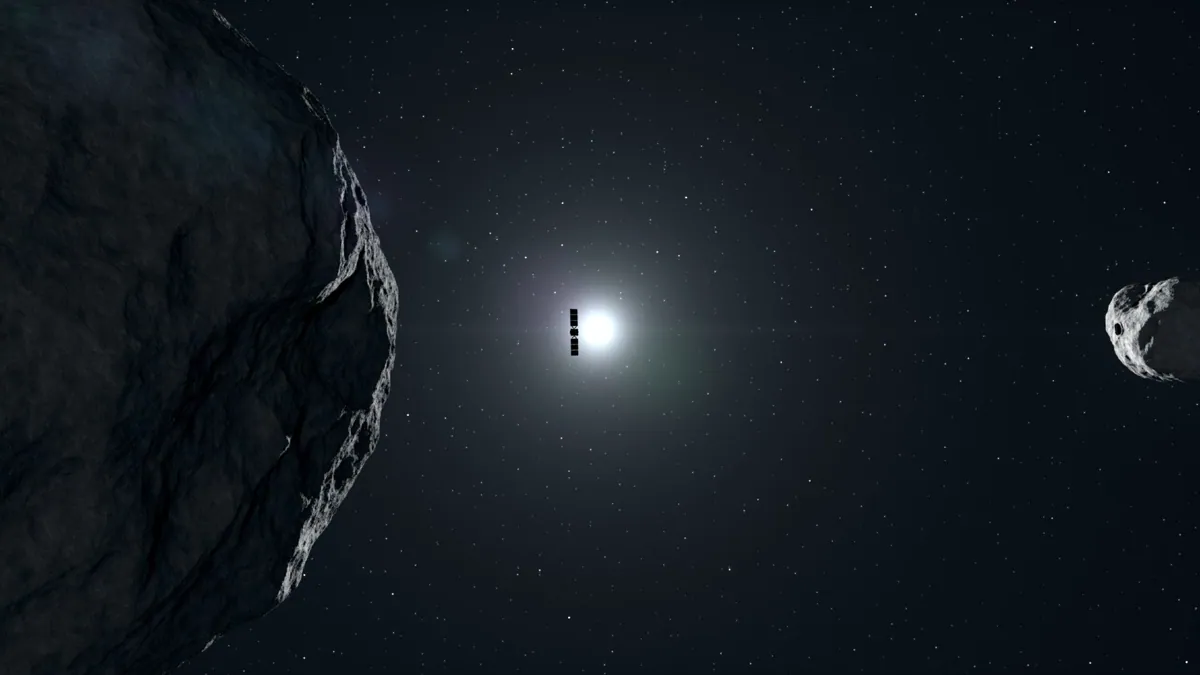
In 2022, NASA aimed a spacecraft at an asteroid and hit it on purpose. Now the investigation into what that crash actually did is about to begin.
The European Space Agency's Hera spacecraft starts its arrival at the Didymos-Dimorphos asteroid system this month, kicking off a series of braking maneuvers that will bring it close enough to study the scene of humanity's first planetary defense experiment. The first of those maneuvers is scheduled for October 15.
Planetary defense is exactly what it sounds like: figuring out how to protect Earth from a future asteroid strike. Back in September 2022, NASA's DART spacecraft — short for Double Asteroid Redirection Test — rammed itself into Dimorphos, a small asteroid orbiting a larger one called Didymos, to see whether a deliberate impact could nudge a space rock off a collision course. It worked. The crash shortened Dimorphos's orbit around Didymos by roughly 33 minutes, proof that kinetic impact is a viable way to deflect a threatening asteroid.
But DART was a one-way trip, and the spacecraft didn't survive to document its own handiwork. Scientists have spent four years piecing together what happened using telescopes on the ground and in space, which was enough to measure the orbital shift but not nearly enough to answer the harder questions. Hera, launched in October 2024, is the mission built to close that gap by actually returning to the crash site.
"Hera wants to be the detective, like Inspector Colombo, going back to the crash scene," said Patrick Michel, a planetary scientist at the French National Centre for Scientific Research and the mission's principal investigator, according to Space.com.
What nobody knows yet
The broad strokes of the DART impact are well established. What's missing is the detail. "We know that there was a lot of material kicked up," said Angela Stickle, a planetary scientist at Johns Hopkins University's Applied Physics Laboratory who worked on both missions. "We know that we probably left a pretty significant mark on Dimorphos."
But scientists still don't know how big a crater the impact carved out, or whether it scattered and rearranged the boulders covering the asteroid's surface. There are signs that Dimorphos may now be tumbling rather than orbiting smoothly, and some evidence suggests material shifted between Dimorphos and Didymos after the strike.
Even the headline result, the orbital change, turned out to be messier than expected. Cristina Thomas, a planetary astronomer at Northern Arizona University affiliated with both missions, said the time Dimorphos took to circle Didymos kept shifting for at least six months after impact, for reasons researchers still can't fully explain. "This thing that we thought was going to be very cut and dry turned out to be really interesting and complicated," Thomas said.
That ambiguity is the whole reason Hera exists. Ground-based observation can tell you an orbit changed. Only a spacecraft parked next to the asteroid can tell you why.
A slow, careful approach
Hera's arrival isn't a single event but a sequence. After the first braking maneuver on October 15, the spacecraft will execute two more, gradually slowing its approach. If all goes as planned, Hera will be within about 20 miles of the two asteroids by early November and will start its initial science observations from there. It will move in even closer by early December.
For the team, this is uncharted emotional territory as much as scientific territory. It's the first time scientists will be revisiting a specific location in space they've already seen, without knowing what they'll find when they get there. "For us, it's like a new world," Michel said. "The new image won't have anything to do with the previous one, so that's really exciting."
Among the things researchers will be looking for: any surviving debris from DART itself. They don't expect much. "We were coming in really fast, so typically, the whole spacecraft you would expect to just kind of shatter or melt," Stickle said. There's a small chance that pieces of DART's two long solar panels broke off and survived the impact intact, and that the panels may even explain why some models suggest the crater could be oval-shaped rather than round.
Two tiny spacecraft, one big first
Hera isn't traveling alone. In January, it's set to release two small companion spacecraft, known as CubeSats, that have been riding along since launch. One, named Milani, will analyze the composition of material on and around Dimorphos. The other, Juventas, carries radar designed to look beneath the surface, which would mark the first time scientists have directly studied the interior of an asteroid. Juventas is expected to end its mission by attempting a landing on Dimorphos, and Milani may try a landing of its own.
The three spacecraft will work together into early 2027, with Hera itself expected to keep operating at least through September 2027. Together, they'll produce the most detailed look ever assembled of a binary asteroid system, a pair of space rocks orbiting each other, which no spacecraft has studied up close in this kind of depth before.
Part of what makes Didymos and Dimorphos a good test case, researchers say, is how unremarkable they otherwise are. "It's very ordinary, and I mean that in the best possible way," Thomas said. Ordinary, except for the fact that humans once deliberately slammed a spacecraft into one of them, turning an obscure asteroid pair into the proving ground for how Earth might someday defend itself.
With arrival now days away, the team is treating it less like a source of anxiety than a long-awaited payoff. "Nothing really worries me," Michel said. "It's really just excitement now."
What Hera finds over the coming months will shape how future missions plan real asteroid deflections, not test runs. The crater size, the behavior of the debris, the mechanics of that drifting orbit: all of it feeds into how confidently engineers can calculate the force needed to move a genuinely dangerous asteroid off course. For now, the detective is just arriving at the scene.