Starlink Satellites Are Now Dodging Something Almost Every Week — and the Math Is Starting to Worry Experts
SpaceX's constellation performed more than 355,000 collision-avoidance maneuvers in the past year, and researchers say the growing swarm of satellites is quietly stacking up risk that current safety math doesn't fully capture.
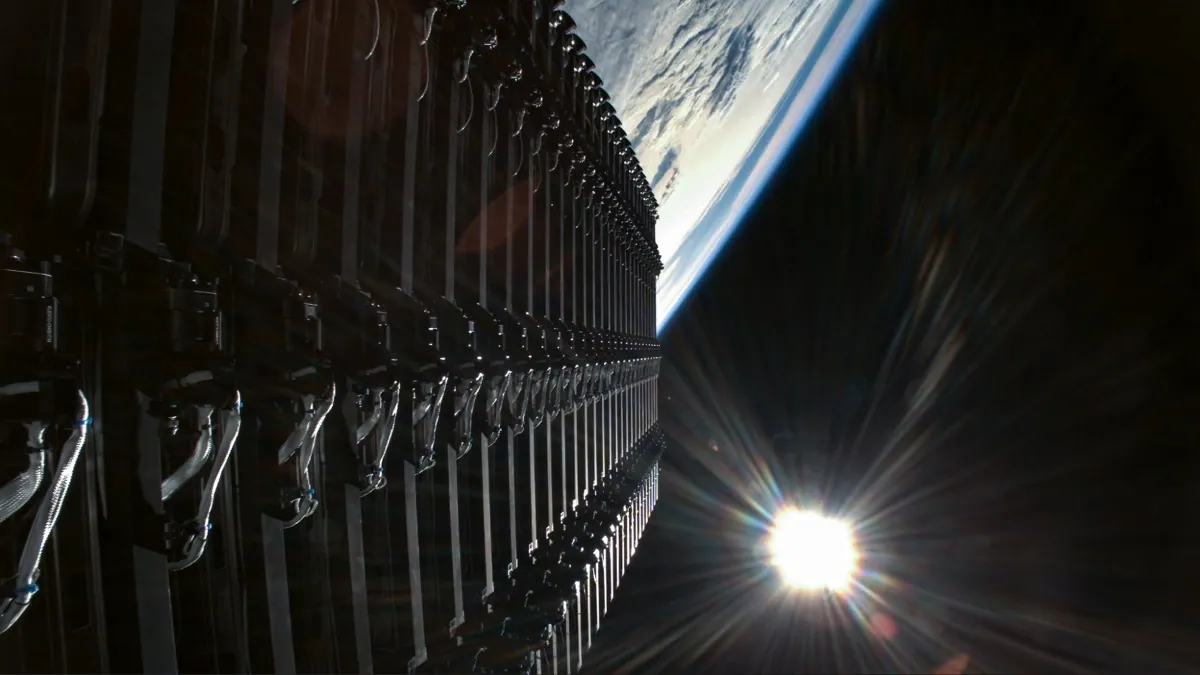
SpaceX's Starlink satellites swerved out of harm's way more than 355,000 times over the past year, a figure that's tripled since 2024 and now works out to roughly one dodge per satellite every week. That's according to SpaceX's own semiannual filing with the Federal Communications Commission, and the trend line has space safety experts warning that the constellation's rapid growth may be quietly building toward a collision nobody can prevent.
The numbers break down like this: between December 2025 and May 2026, Starlink satellites performed 207,152 avoidance maneuvers, up from 148,696 in the previous six-month reporting period. Add those two together and you get more than 355,000 maneuvers across the full year from June 2025 to May 2026 — averaging out to over 40 dodges per satellite annually.
The obvious driver is scale. Starlink has ballooned from about 6,000 satellites in 2024 to more than 10,000 as of June 2026, part of a broader surge in orbital traffic that's pushed the total number of operational spacecraft from roughly 10,000 to about 16,000 over the same stretch. SpaceX's satellites, which orbit between 298 and 342 miles up, rely on an autonomous system that triggers a maneuver whenever the odds of a collision climb above 3 in 10 million.
The uncomfortable math behind the maneuvers
Hugh Lewis, a professor of astronautics at the University of Birmingham who tracks space sustainability, told Space.com he believes the constellation is on a path toward an eventual collision involving one of its own operational satellites — not because SpaceX is careless, but almost in spite of how well it's managing things.
"I think we're heading towards a situation where there will be a collision involving an operational satellite in the constellation," Lewis said. "And it will not be for the lack of trying to avoid those things. It will be in spite of all those maneuvers."
The problem, as Lewis explains it, is one of accumulated probability. Each individual maneuver knocks the collision risk down to about one in a million — small enough to look negligible on paper. But run that calculation across hundreds of thousands of maneuvers, and the leftover risk starts to add up into something that isn't negligible at all.
"The problem is that if you make a million manoeuvres and you have a residual probability of one in a million, you end up with an aggregate risk across your entire constellation that you can't get rid of," Lewis said.
By his estimate, SpaceX could rack up a cumulative one million lifetime maneuvers as early as June 2027. Given that SpaceX has asked the FCC for approval to eventually grow Starlink to 100,000 satellites, Lewis projects the constellation could be performing more than a million maneuvers in a single year by 2030. That's the point at which the "one in a million" risk per maneuver stops being a rounding error and starts becoming a real number.
Why more satellites means much more risk, not just a little more
Tommaso Sgobba, director of the International Association for the Advancement of Space Safety, framed the growth problem in terms of pairings rather than raw satellite counts. Packing more satellites into the same orbital band doesn't just add risk incrementally, he said — it multiplies the number of potential close encounters that need to be tracked.
"The more satellites you pack into [an orbital] shell, the more pairs of satellites exist that could potentially cross paths," Sgobba wrote in an email to Space.com. "Adding satellites does not just add risk one unit at a time, it multiplies the number of possible pairings. Double the satellites in a shell and you roughly quadruple the number of pairs that need to be watched."
Sgobba also raised a separate, thornier issue: the predictions used to trigger these maneuvers aren't as reliable as they might seem. Atmospheric drag, which shifts with space weather, remains genuinely hard to forecast, which injects real uncertainty into every conjunction alert. That means operators may not always be able to distinguish a genuine threat from statistical noise.
"Satellites are frequently dodging ghosts, burning fuel and shortening their operational lives in the process," Sgobba wrote.
Currently, Starlink satellites handle this unilaterally. Rather than coordinating with the operator of another satellite to determine who moves, SpaceX's system automatically maneuvers whenever it flags a conjunction — whether the object in question is debris or another active spacecraft. As the dominant constellation in orbit, SpaceX effectively absorbs most of the burden of keeping the shared airspace clear.
A crowded neighborhood getting more crowded
Starlink isn't the only mega-constellation racing toward deployment. Amazon's Kuiper (referred to in the reporting as Amazon LEO) and China's Qianfan, also known as Thousand Sails, are both being built out in low Earth orbit, and Thousand Sails in particular is expected to occupy orbital territory that significantly overlaps with Starlink's.
Lewis argues that the only reliable way to manage multiple giant constellations safely is to keep their orbits from intersecting at all — but that's not how things are shaping up. Complicating matters further, a wave of proposed orbital data center projects are eyeing many of the same convenient altitude bands, raising the odds of even more overlap.
"The safe thing to do is to separate the constellations," Lewis said. "But then you are talking about orbital carrying capacity and the first mover benefit, because if I go into a particular altitude with my constellation, then nobody else can use it."
That tension — between safety through separation and the practical reality that whoever launches first effectively claims the real estate — sits at the center of the broader debate over how crowded orbit is allowed to get.
Sgobba's proposed fix is regulatory rather than technical: require companies to disclose, before launch, how many collision-avoidance maneuvers a constellation of a given size and density is expected to need each year, and whether its satellites actually carry enough fuel and autonomy to pull them all off.
"Right now, there is no clear requirement for a company to say, before launch, how many collision avoidance maneuvers a constellation of this size and density will need every year and whether the satellites carry enough fuel and automation to actually perform them all," he wrote.
His broader point is that none of this needs to be treated as a mystery. The crowding of low Earth orbit, he argues, is a predictable engineering workload, and regulators should be demanding those projections upfront rather than responding to near-miss headlines after the fact.
For now, Starlink's collision-avoidance system keeps working exactly as designed, satellite by satellite, week after week. The question raised by Lewis and Sgobba isn't whether the system works today. It's what happens when the constellation, and its neighbors, grow large enough that "working" stops being enough.