A 300-Mile Clay Belt on Mars Could Be Where Europe's Rover Finds Its Best Shot at Ancient Life
New mapping of Martian clay deposits near the ExoMars rover's landing site suggests a much bigger, wetter ancient environment than previously understood.
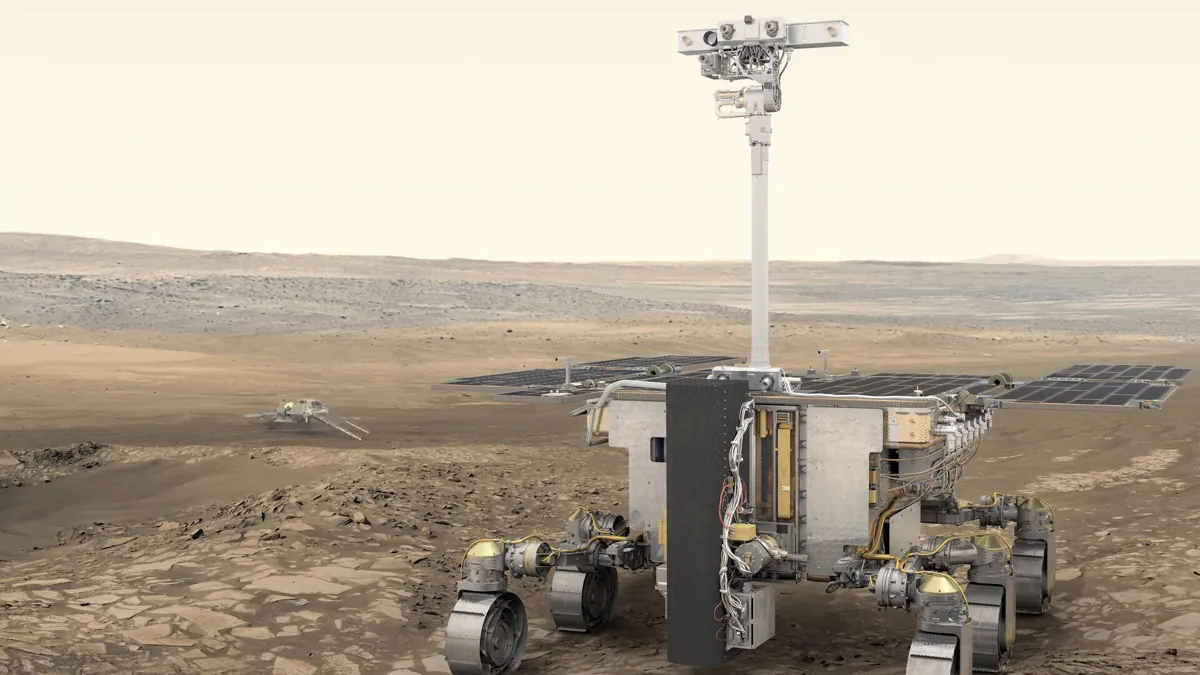
Mars scientists have a new reason to be excited about a patch of ground called Oxia Planum, and it comes down to dirt. Specifically, clay.
A new study finds that clay deposits at Oxia Planum, the planned landing site for the European Space Agency's ExoMars Rosalind Franklin rover, stretch roughly 186 miles (300 kilometers) across the Martian surface, reaching all the way to a valley called Mawrth Vallis. That's a much larger footprint than a single isolated puddle of ancient water would leave behind, and researchers say it points to something bigger: a regional, possibly ocean-scale, wet period on early Mars that could have left behind exactly the kind of chemical fingerprints scientists need to determine whether the planet ever hosted life.
Clay matters here because of how it forms. On Earth, clay minerals typically form when water interacts with rock over long stretches of time, and that process can trap and preserve organic material. If Mars once had warm, nutrient-rich seabeds, as ESA suggests, clay could be the medium holding onto whatever chemical traces that ancient environment left behind. That makes it a prime target for a rover built specifically to hunt for biosignatures, the physical or chemical evidence that life once existed somewhere.
Why Oxia Planum, and why now
Rosalind Franklin's mission has been in the works for years, and the rover is now aiming for a 2028 launch as part of ESA's ExoMars program, which also includes the Trace Gas Orbiter already circling Mars. The new research gives mission planners a clearer picture of exactly what the rover will be driving into.
To map the clay, researchers used the OMEGA instrument aboard ESA's Mars Express orbiter along with data from NASA's Mars Reconnaissance Orbiter, studying mineral composition and rock layering across the stretch of terrain between Oxia Planum and Mawrth Vallis. They found matching mineral layers at both locations, along with signs that water chemistry shifted over time, evidence consistent with a long, evolving wet period rather than a brief, isolated event.
"Because the area is so large, we are not talking about a localised occurrence, but rather a regional or global process that would have required immense amounts of water," said Jorge Vago, ExoMars project scientist, according to the ESA statement. He added that the team is targeting the oldest deposits in that sequence, calling the implications for Mars's early geology and climate "very relevant" to the rover's search for life.
Lead author Inés Torres Auré of the University of Lyon in France framed the discovery as revealing a process that shaped Martian clay on a large scale, rather than something confined to one small basin.
Scientists now think Oxia Planum may have once held a body of water on the scale of an ocean, or that the region experienced major flooding roughly four billion years ago. Either scenario would fit with the broader timeline researchers have pieced together for Mars: liquid water is believed to have persisted on the surface until around three billion years ago, when it evaporated as the planet's atmosphere thinned. Before that point, Mars likely had rivers, lakes, and a thicker atmosphere, conditions that make many scientists suspect the planet was habitable at some point in its deep past, even though that has never been confirmed.
What the rover will actually do
The orbital data gives researchers a map. The rover is what will let them dig into the ground truth. Elliot Sefton-Nash, ExoMars deputy project scientist, said the plan is to use Rosalind Franklin's onboard instruments to verify what's been spotted from space, study the ancient environment that produced these mineral layers, and check whether any of it preserved evidence of past Martian life. As he put it in the ESA statement, "Warmth and nutrients on an early martian seabed could have provided habitats for early life."
That verification step matters because orbital instruments can only tell you so much from hundreds of miles up. Rosalind Franklin is built to get its hands dirty. It carries a drill capable of reaching below the Martian surface, where material is better shielded from radiation and more likely to have preserved organic compounds intact, something surface samples are less likely to offer. The rover will work in tandem with the Trace Gas Orbiter, combining ground-level drilling with orbital observation.
The stakes here are worth putting in context. This isn't the first time researchers have gotten excited about potential signs of life on Mars. Last year, scientists identified what's currently considered the strongest candidate biosignature found on the planet so far. That discovery hasn't been confirmed as actual evidence of life, and it likely won't be until a mission can study it, or something like it, up close. That's precisely the gap Rosalind Franklin is designed to close.
Water remains the common thread through all of this. Life as we understand it on Earth requires it, and while alien life could in theory look nothing like anything found here, water is still the baseline scientists are searching around. Finding a 300-kilometer clay belt that points to a sustained, planet-scale wet period gives the ExoMars team a much stronger case that Oxia Planum isn't just a reasonable landing site, but potentially one of the best places on Mars to look for the chemical remnants of a habitable past.
The rover's 2028 launch is still a few years out, and there's plenty that could shift between now and then. But this study gives the mission team something valuable ahead of touchdown: a clearer, evidence-backed reason to believe they're aiming at the right patch of ground.