Chrome Adds a Softer Warning for Websites That Look Fishy, But Not Dangerous
Google is splitting its browser warnings into two tiers, giving users more context before they click into a site that might be phishing, scammy, or just off.
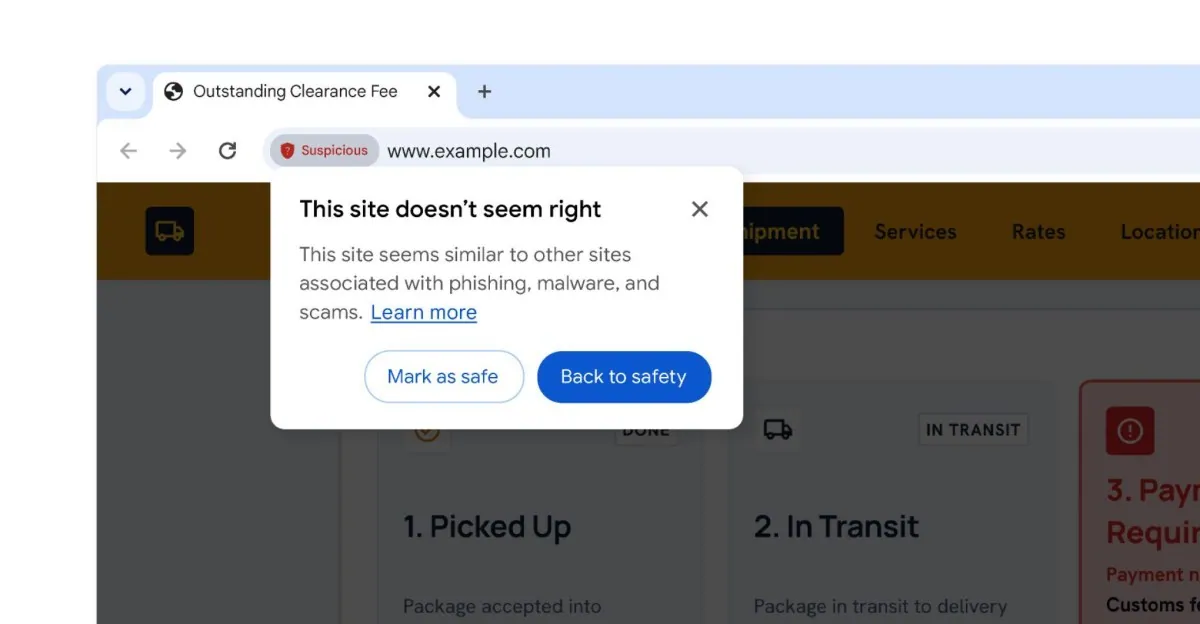
Google is giving Chrome a new way to flag websites that look off without treating them as outright threats. The browser will now display a "suspicious" site warning for pages that share traits with known phishing, malware, or scam sites, but don't meet the bar for Chrome's existing, more severe "dangerous" label.
The idea is to give users more nuance. Right now, Chrome's dangerous-site warning is a blunt instrument: a near full-screen red alert that's hard to miss and meant to be hard to ignore. That's appropriate when Google is highly confident a site is malicious. But plenty of sketchy-looking pages fall into a grayer zone, where there's a real chance something's wrong but not enough certainty to slap on the maximum warning. The new suspicious-site notification is built for that middle ground.
According to The Verge, Google describes the suspicious warning as reflecting a "lower confidence verdict" with a possible risk of harm, meaning the system could be flagging the site incorrectly. The guidance from Google is blunt about where the burden of proof lies, though: users should only proceed if they're completely certain the site is actually safe. Dangerous-site warnings, by contrast, carry a "high confidence verdict" and "high risk of user harm," and Google's message there is simpler: don't go.
Two warnings, two very different feels
The visual design does a lot of the work in telling these apart. The suspicious-site warning shows up as a pop-up window, on both desktop and mobile, with the actual webpage still visible underneath but darkened. There's also a "Mark as safe" button, so if Chrome got it wrong, you can clear the flag and move on.
The dangerous-site warning is the one Chrome users already know, and it's built to be much harder to brush past. The warning message swallows nearly the entire screen, and the site itself gets replaced with a solid red background. There's no ambiguity in that design, which is the point: Google wants that treatment reserved for cases where it's confident the risk is real.
This two-tier structure isn't a brand-new concept for Chrome. Google rolled out a similar approach for file downloads back in 2024, separating "suspicious" and "dangerous" downloads with distinct visual treatments rather than lumping every flagged file into one generic blocker. Extending that same logic to website visits brings Chrome's two biggest attack surfaces, downloads and links, under a more consistent warning system.
Part of a bigger scam-detection push
The suspicious-site warning isn't arriving alone. Google also announced improvements to its Gemini-powered scam detection for users enrolled in Chrome's Enhanced Protection tier, the browser's highest level of Safe Browsing security. That's notable because it suggests Google is leaning further into AI-driven analysis to catch scam patterns that might not trip traditional blocklists, which typically rely on known bad URLs or signatures rather than behavioral or stylistic red flags.
One open question, per The Verge's reporting: it's not yet clear whether the new suspicious-site warnings are rolling out to all Chrome users or only to those who've opted into Enhanced Protection. The Verge has asked Google for clarification and plans to update once it hears back.
Phishing and scam sites have gotten harder to spot at a glance, often mimicking real login pages or checkout flows convincingly enough to fool careful users, not just careless ones. A warning system that can communicate gradations of risk, rather than just an on/off switch, gives Chrome a better shot at catching more of that gray-area territory without crying wolf on every unfamiliar page. Whether it actually cuts down on successful scams will depend on how well Google's underlying detection holds up once the feature is live for everyone.