A U.S. Satellite Just Caught China's Secret Space Plane in the Act
A commercial imaging satellite snapped Shenlong docked to another spacecraft in orbit, offering the clearest look yet at a program Beijing still won't explain.
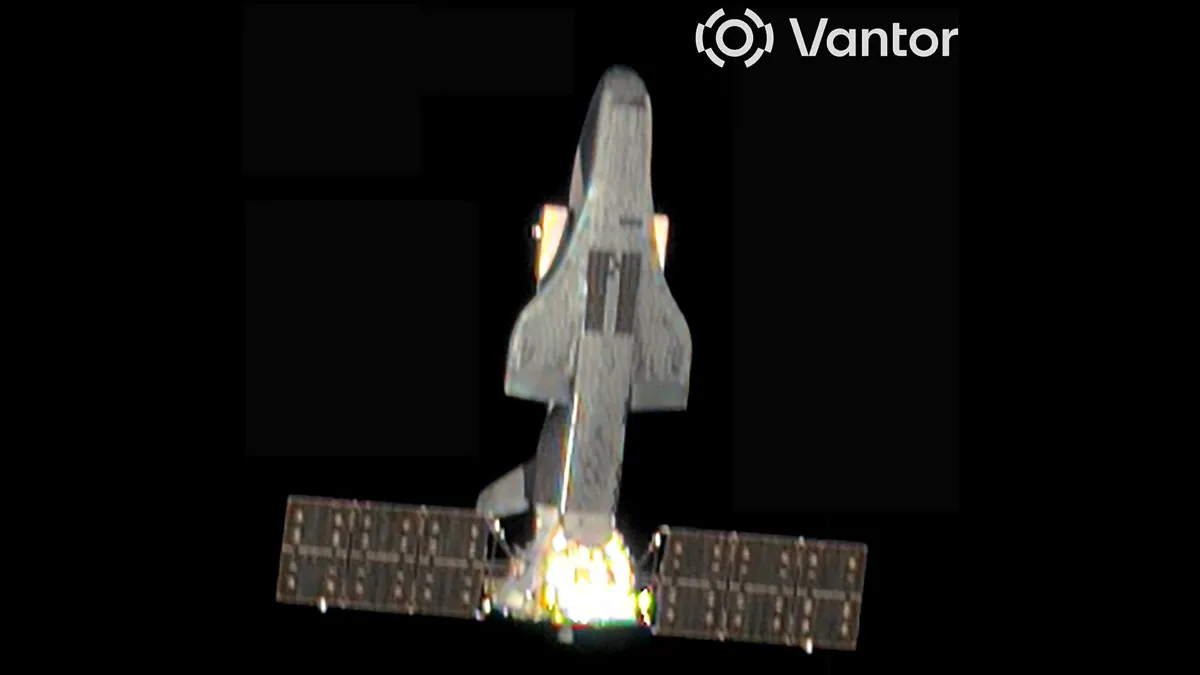
A U.S. military intelligence agency has published a striking new image of Shenlong, China's uncrewed space plane, showing it docked to another satellite hundreds of miles above Earth. It's the sharpest look the public has gotten yet at a spacecraft that's been quietly reshaping the conversation around military activity in orbit.
The photo was captured in 2024 by Vantor's WorldView 3 satellite, shooting from roughly 56 miles away with a resolution of 4.5 centimeters per pixel — fine enough to pick out real structure on a spacecraft rather than just a bright dot against black sky. Observers on the ground have photographed Shenlong before, but this is the first time anyone has released an orbital shot with this kind of clarity.
What it shows is almost as interesting as how it was taken. Shenlong appears docked to another satellite with its solar panels fully deployed; nobody outside classified circles seems to know what that second spacecraft is. Shenlong's own payload bay doors are visible too, caught open in the frame.
A program built on fragments
China's space agency has said only that Shenlong is testing technology meant to make "round-trip" access to space more convenient and affordable for peaceful purposes. That's about as much official detail as exists. Everything else has been pieced together by outside observers watching the spacecraft from mission to mission.
And there's a pattern. Shenlong launched on its fourth mission in February 2026, and prior flights have shown a habit of releasing objects while in orbit. In June 2026, the space-tracking firm LeoLabs reported picking up a new object near the space plane and said it had cataloged it with high confidence as something ejected from Shenlong. LeoLabs noted the behavior was "consistent with sub-satellite deployments conducted by the space plane in previous missions."
That wasn't a one-off. Something similar happened during Shenlong's third mission, which wrapped up in 2024, and on its second mission in 2023 the craft released an object and may have carried out proximity and rendezvous operations — maneuvers where two spacecraft deliberately close the distance between them. It's possible some of these releases are nothing more dramatic than shedding hardware before landing. But without official confirmation, the ambiguity is the point: this is military space, and very little gets explained.
America has its own version
China isn't the only country flying a mystery space plane. The U.S. operates the Boeing-built X-37B, and the Space Force has been almost as tight-lipped about it as Beijing has been about Shenlong. In February 2025, Space Force released its first photo of the X-37B actually in orbit, apparently in a high Earth orbit with its own payload bay doors open. Two years earlier, in 2023, the service put out its first official painting of an X-37B-type craft, depicting it intercepting another satellite — an artistic hint rather than a confirmed capability, but a hint nonetheless.
That symmetry isn't an accident. Both countries fly robotic space planes capable of long-duration missions, both have shown signs of releasing or interacting with other objects in orbit, and both release just enough imagery to signal they're watching without saying exactly what their spacecraft can do.
With the U.S. and China openly jockeying for position in what's now routinely described as a new space race, these occasional photo releases function less like transparency and more like controlled flexing. A single sharp image says "we see what you're doing, and we want you to know it" without actually disclosing anything that would help an adversary plan around it.
What happens next is likely more of the same: another mission, another object spotted nearby, another round of speculation from firms like LeoLabs trying to reconstruct intent from orbital mechanics alone. Until either government decides to say more, that's the only window the public is going to get into what these space planes are actually built to do.