China Sends Home First Close-Up Photo of Earth's Mysterious Quasi-Moon
The Tianwen-2 spacecraft closed to within 12 miles of Kamo'oalewa, a tiny asteroid some scientists suspect is a broken-off piece of our own moon.
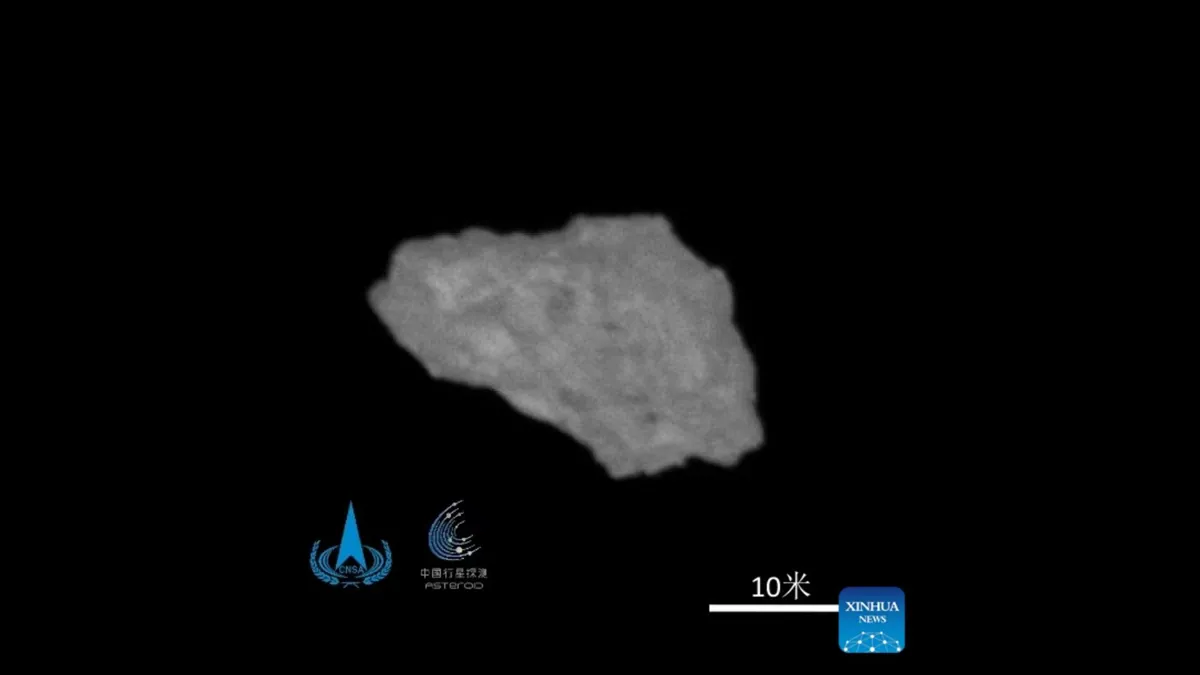
China's Tianwen-2 spacecraft has beamed back the first close-up image of Kamo'oalewa, a strange little space rock that shadows Earth's orbit without technically qualifying as a moon. The picture, captured on July 2 and released by China's Xinhua news outlet, shows a lumpy, irregular object roughly 50 to 65 feet across — smaller than a football field, and shaped nothing like the tidy round rocks we usually picture when we think "asteroid."
Getting that photo took some doing. Tianwen-2 launched on May 28, 2025, aboard a Long March 3B rocket from the Xichang spaceport in southwestern China, then flew roughly 620 million miles to reach its target. The probe eased into position about 12 miles from Kamo'oalewa, close enough to start its real work: nearly a year of study using 11 different scientific instruments before it attempts something no Chinese mission has done before — scooping up a physical sample and sending it back to Earth.
Kamo'oalewa, also cataloged as asteroid 2016 HO3, belongs to a small and slightly odd family of objects called quasi-moons, or quasi-satellites. They're not true moons, because they don't actually orbit Earth. Instead, they circle the sun on paths that happen to keep them tethered near our planet, occasionally getting nudged around by Earth's gravity without ever settling into a stable orbit the way our actual moon has. Earth currently has at least seven known quasi-moons, and the roster shifts over time as Earth's gravity temporarily grabs passing objects before releasing them back into solar orbit.
A piece of home?
What makes Kamo'oalewa especially interesting to scientists isn't just its odd orbital behavior — it's where it might have come from. Most near-Earth asteroids are thought to be refugees from the main asteroid belt between Mars and Jupiter. Kamo'oalewa may not be one of them. A 2024 study published in Nature Astronomy proposed that it could actually be a fragment of our own moon, blasted into space by the impact that carved out the moon's Giordano Bruno crater. Estimates put that potential collision somewhere between 1 million and 10 million years ago — recent, in geological terms.
If that theory holds up, Kamo'oalewa wouldn't just be a random rock drifting near Earth. It would be a literal chip off the moon, still tagging along in a solar orbit that keeps it in our planetary neighborhood. Proving it, though, requires more than photos and remote instrument readings. That's where the sample comes in. If Tianwen-2 successfully collects material from the asteroid's surface and gets it back to Earth, scientists will finally have physical evidence to test whether Kamo'oalewa's composition matches lunar material.
Following in Hayabusa and OSIRIS-REx's footsteps
Tianwen-2 is China's first mission to attempt an asteroid sample return, but it's not the first in the world to try. Japan got there first, with its Hayabusa spacecraft pulling off the world's inaugural asteroid sample-return mission in 2010, delivering material from asteroid Itokawa. The United States followed with OSIRIS-REx, which grabbed a sample from asteroid Bennu and returned it to Earth in 2023. That mission has already paid scientific dividends — researchers found amino acids in the Bennu material, the same building blocks considered essential for life as we know it.
Whether Tianwen-2 can match that success remains to be seen, but the mission's setup gives a sense of how methodical the approach is. Rather than rushing in, the spacecraft is spending months studying Kamo'oalewa up close with its full instrument suite before it even attempts to touch the surface. Given the asteroid's small size and irregular shape, that caution makes sense; there's not a lot of room for error when your target is barely bigger than a large building.
The mission also gave the public its first real look at the spacecraft itself only after launch. China's space agency released an image of Tianwen-2 taken from about 1.8 million miles from Earth, roughly a week after liftoff, marking the first time the public got a clear view of the probe's design.
What comes next
Tianwen-2 is China's first mission to an asteroid, but it's the country's second planetary exploration effort overall, following Tianwen-1, which delivered an orbiter and rover to Mars in 2020. China isn't stopping here. Tianwen-3, a Mars sample-return mission, is planned for launch in 2028, and Tianwen-4 is slated to follow two years later with a mission to study Jupiter and Uranus.
For now, the attention stays on Kamo'oalewa. Over the coming months, Tianwen-2's instruments will map the asteroid's surface, study its composition, and prepare for the sampling attempt that could settle, one way or another, whether this tiny quasi-moon really is a fragment of our own moon that got knocked loose millions of years ago.