Blue Origin Bets Big on Florida, Plans to Scale New Glenn Toward 150 Launches a Year
The company's latest Cape Canaveral expansion signals it intends to challenge SpaceX's dominance on the Space Coast by building for a far higher launch tempo.
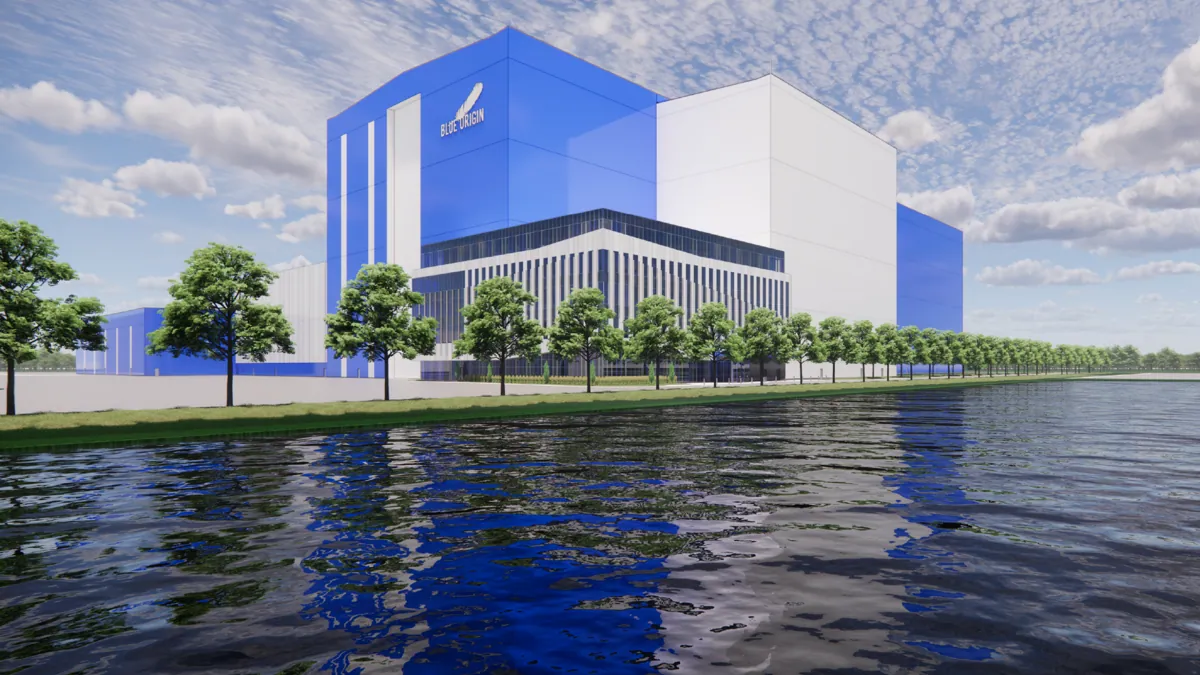
Blue Origin wants to go from launching a handful of rockets a year to launching one roughly every two or three days. On Friday, the company laid out a sweeping expansion of its Florida operations aimed at eventually supporting 150 New Glenn launches annually from Cape Canaveral — a number that would put it in the same league as the busiest launch operations on the planet.
The plan adds two new launch pads for New Glenn, on top of two already under construction, bringing the eventual total to four. Blue Origin is also building a new manufacturing facility dedicated to producing up to 150 upper stages for a larger version of New Glenn, and it intends to procure two additional landing ships to catch and recover the rocket's first stage. Right now the company has just one such ship, named Jacklyn. Rounding out the announcement is a new customer integration facility, developed jointly with the US Space Force, that will include four separate payload bays so multiple missions can be processed in parallel rather than one at a time.
Ian Richardson, Blue Origin's senior vice president of operations, framed the buildout as infrastructure for a future launch cadence the company doesn't yet have. "These investments are centered on one goal: building the capacity to support more missions, more reliably, and more efficiently," he wrote in a company update. He added that the goal is to support "multiple flights per week by the end of the decade."
A $3 billion bet
The scale of the investment is notable on its own. Blue Origin has now put roughly $3 billion into Florida facilities and infrastructure, according to the company, most of it tied to building and launching New Glenn. That spending has translated into more than 5,000 employees in the state and a supplier network of 500 companies. Richardson said the company's manufacturing and operations footprint has more than doubled in the past couple of years and now spans more than 20 sites across Brevard and Orange Counties.
What makes that spending pattern striking is the gap between infrastructure and flight history. New Glenn has launched to orbit exactly twice. Blue Origin is essentially building out factory floors, landing ships, and a four-bay payload facility for a cadence it hasn't come close to demonstrating yet, betting that demand and reliability will catch up to the capacity it's putting in the ground now.
The SpaceX subtext
Richardson's update contained a line that reads like a direct shot across the bow of the Space Coast's dominant player: Blue Origin, he wrote, is "the only company — and the largest employer — to manufacture, launch, and refurbish rockets on the Space Coast." That's a claim clearly aimed at SpaceX, which has launched hundreds of orbital missions from Florida over the years and has long been the undisputed heavyweight of the region's launch business.
Blue Origin isn't competing with that track record today. But the infrastructure it's describing — multiple pads, a dedicated recovery fleet, a mass-production line for upper stages, and a military-partnered integration facility built for parallel processing — is the kind of setup a company builds when it expects to be launching constantly, not occasionally. If New Glenn's flight rate climbs anywhere close to what this buildout implies, Florida's Space Coast could end up with two companies running industrial-scale rocket operations instead of one.
For now, the numbers are aspirational. Two orbital launches versus a stated goal of 150 a year is a enormous distance to close. But the capital, the real estate, and the hardware orders described in Friday's announcement suggest Blue Origin is treating that gap as something to engineer its way past, not just talk about.