Amazon Folds Its Cloud Gaming Service Into Prime Video
Luna's game library now lives inside the streaming app, letting Prime members jump from a movie to "Hogwarts Legacy" without leaving the couch.
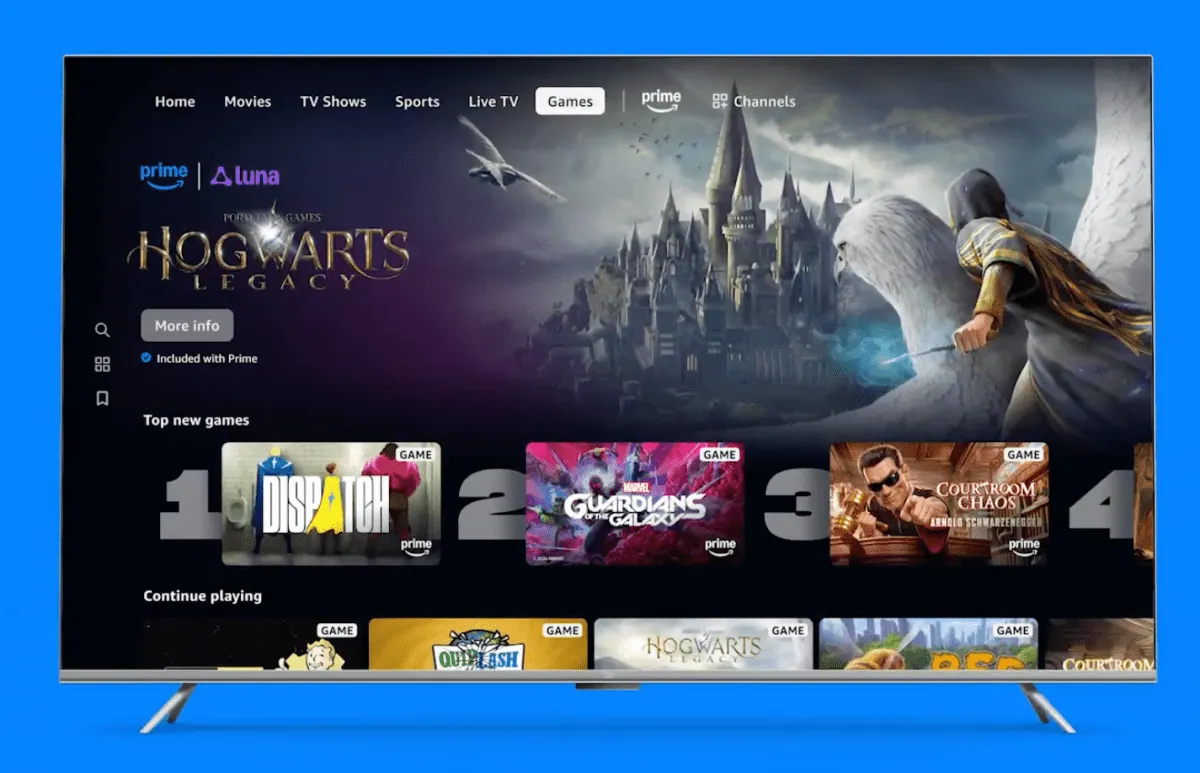
Amazon announced Thursday that games are coming to Prime Video, folding its Luna cloud gaming service directly into the streaming app rather than keeping it as a separate destination. Starting today, Fire TV owners in the U.S. and U.K. can find a new "Games" tab sitting alongside the movies and TV shows, stocked with titles like "Hogwarts Legacy," "EA Sports FC 26," "Indiana Jones and the Great Circle," "Clue," and "Taboo."
The pitch is simple: stop making people hunt for a separate app to play games they already have access to through Prime. Until now, Luna's library was walled off in its own standalone app, available to Prime members but functionally invisible unless you already knew to look for it. Now those games sit next to whatever you were about to binge, one click away.
It's a page straight out of Netflix's playbook. Netflix has spent the past several years quietly building out a games catalog, leaning heavily into party and mobile titles as a way to keep subscribers inside its ecosystem longer. Amazon already had the pieces to do something similar. It's owned Luna for years. It just hadn't put those pieces in the same place people already spend their time.
Making cloud gaming feel like Netflix, not a niche app
Cloud gaming works by streaming a game from remote servers the same way a video streams from Netflix's, meaning there's no console or gaming PC required, no downloads, no install times. In theory, that lowers the barrier to entry dramatically. In practice, standalone cloud gaming apps have struggled to break out of a niche audience, largely because people don't go looking for a dedicated gaming app the way they reach for a streaming one out of habit.
Amazon is betting that habit is the whole game. By putting Luna's titles inside Prime Video, the company is wagering that someone who opens the app to watch something will stumble across a game, try it on impulse, and stick around. Jeff Gattis, Amazon's general manager of gaming, framed it that way in a press release: "For a lot of people, games have been harder to find than they should be. Bringing Luna inside Prime Video allows Prime members to discover games more naturally, and if they see one they like, they click it and they're in. That's less time searching and more time playing great games included with their Prime membership."
The library isn't just licensed blockbusters. Amazon's own gaming division has titles in the mix too, including its "Courtroom Chaos" games and a co-op card battler called "Masters of the Universe: Legends Unite." Mixed in with those are board-game-night staples like "Clue" and "Taboo," a nod toward the kind of casual, group-friendly games that have worked well for Netflix's party game push. It's a deliberate spread: AAA single-player titles, sports games, party classics, and Amazon-made originals all sitting in the same tab.
Playing is straightforward on the hardware side. Prime members can start a game with a controller or use their phone as one, no extra hardware purchase required beyond a Fire TV. Amazon has been explicit about the intent behind that design choice, saying its goal is to strip away the traditional cost and complexity barriers to gaming, whether that's an expensive console, a gaming PC, or simply not knowing where to start.
What comes next
For now, this is a Fire TV, U.S.-and-U.K. rollout. Amazon says it plans to bring the games tab to additional devices and additional countries in the coming months, though it hasn't detailed a timeline or which markets are next. The company also says it will add new titles on a monthly basis, suggesting this launch lineup is a starting point rather than the finished library.
The real test isn't whether Amazon can technically stream "Hogwarts Legacy" to a TV, that part's been solved for a while now. It's whether burying games inside a streaming app actually gets casual viewers to try them, or whether gaming remains something people seek out deliberately rather than stumble into between episodes. Netflix's own experiment offers a data point either way, and Amazon, with Prime's massive built-in subscriber base, now has one of the biggest possible stages to find out.