Apple Finally Makes Its Own Smart Home Gadgets, With Help From LG and Schneider Electric
The new Apple Home Collection brings a UWB-unlocking deadbolt, a two-camera doorbell, and Matter-friendly thermostats designed to work with Apple's home platform out of the box.
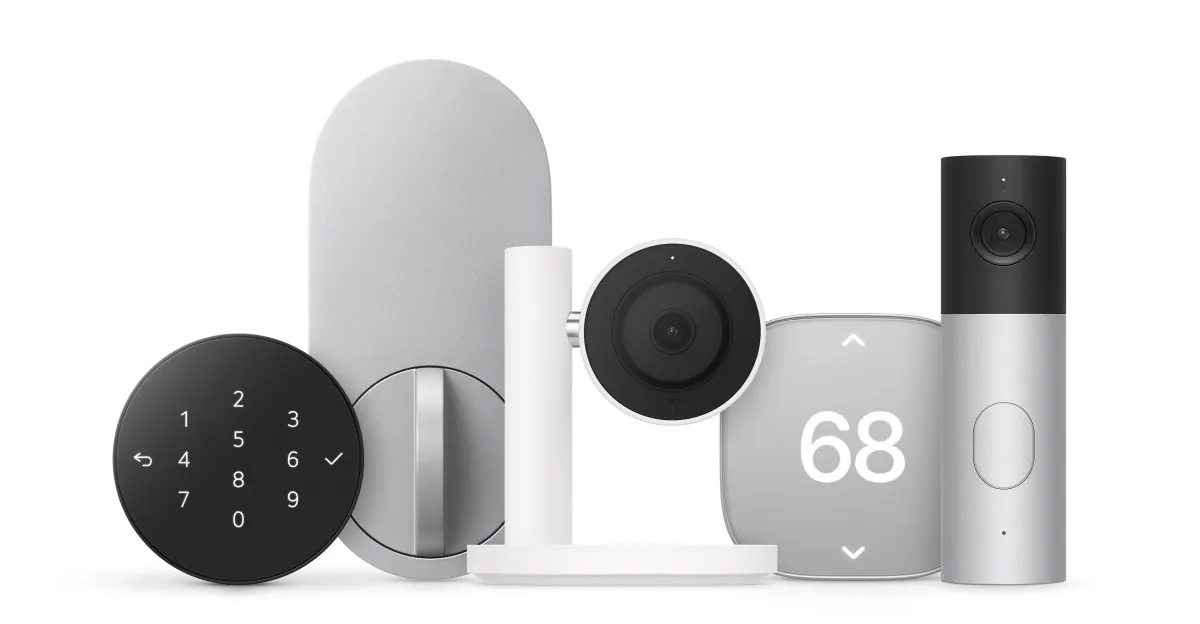
Apple has spent years letting other companies build the hardware for its smart home platform. That changes today. At its Welcome Home event in New York City, Apple introduced the Apple Home Collection, a six-device lineup built in partnership with LG Electronics and Schneider Electric that covers the basics of a modern smart home: a video doorbell, an indoor camera, two outdoor camera options, a smart deadbolt, and a pair of thermostats.
LG and Schneider Electric are the ones actually manufacturing the hardware, but Apple says it co-developed every product in the collection, which is a meaningfully different arrangement than how Apple Home has worked up to now. Previously, Apple set the rules and let third parties build whatever they wanted within them. This time, Apple had a hand in the design and engineering from the start, with the explicit goal of making each device feel native to the platform rather than bolted onto it.
The announcement lands as part of a bigger push into the smart home that also includes Apple's new Siri-powered HomeView smart display, along with a refreshed Apple TV 4K and a second-generation HomePod Mini, both shown at the same event. HomeView is clearly meant to be the hub that ties all of this together, and several of the new cameras are built to talk to it directly.
A deliberately unflashy look
Visually, the collection sticks to one playbook: black or silver bodies, occasional white accents, nothing that calls attention to itself. The cameras share a tubular shape that's more utilitarian than stylish. Having seen the devices installed in Apple's demo smart home in Tribeca, the overall impression is restrained bordering on plain, closer to something you'd get from the French smart home brand Netatmo than to a design flex. That seems intentional. Apple's stated priorities for the whole lineup are ease of setup, everyday reliability, and data privacy, not visual drama.
Every device in the collection runs through the Apple Home app exclusively, with no third-party apps or account logins required. Setup is modeled on how you'd pair AirPods or a HomePod: tap the device with your iPhone, and Bluetooth and NFC handle the rest. Apple says all the accessories are managed by an iPhone or by whatever device is acting as your Apple Home Hub, and that communication across the system is end-to-end encrypted, meaning Apple itself can't see who has access to your footage or data.
Whether that translates into a smoother real-world experience is still an open question. The setup process is the easy part to fix. The harder, more persistent problems with smart cameras and locks tend to show up weeks later, in dropped connections or flaky Wi-Fi handoffs, and that's not something you can evaluate from a press demo. Apple hasn't said anything about how these devices perform over time, because nobody outside the company has tested them yet.
Strategically, though, the move makes sense. Amazon has Ring. Google has Nest. Both companies can point a new smart home customer toward a complete, in-house product line. Until now, Apple couldn't do the same for Apple Home; it could only point people toward a shelf of third-party options with varying quality and varying levels of platform integration. The Apple Home Collection closes that gap.
The lock: hands-free entry via UWB
The standout piece of hardware here is the LG smart lock, priced at $349. It's a full-replacement deadbolt for US-style doors, and it supports Apple Home Key with hands-free unlocking powered by ultra-wideband (UWB) radio. That means you don't have to tap your phone or watch against the lock. If your phone is in your pocket or bag, the door simply unlocks as you approach. According to The Verge's reporting, this makes it only the third lock on the market to support Apple's UWB-based hands-free unlocking.
The lock also has a keypad for PIN entry and a physical keyhole concealed beneath a rotating keypad cover, plus a traditional thumbturn on the interior side for manual operation. It runs on standard AA batteries and uses Matter-over-Thread for connectivity, and it supports the Aliro smart lock standard, an industry specification for compatible digital locks. It comes in black or silver on the housing, though the front faceplate is black-only. It launches in the US and Canada starting in December.
The doorbell and cameras
The LG video doorbell costs $249 and uses two cameras instead of the usual one: a front-facing lens for visitors and a second one angled down to catch packages at the doorstep. Both shoot at up to 2.5K resolution. A motion-activated light brightens the floor area, both to help the downward camera see packages clearly and to light your way at the door after dark. It needs to be hardwired into existing doorbell wiring, and it can ring through to HomePods as a chime. Apple hasn't announced a release date, but it's planned for the US, Canada, and the UK.
It runs on HomeKit Secure Video, Apple's framework for processing camera footage, and supports smart notifications that distinguish between Familiar Faces, pets, packages, and vehicles. With an iCloud subscription, recorded clips save automatically to the cloud; footage is processed locally on an Apple Home Hub first and then sent up end-to-end encrypted. On top of that, if you turn on Apple Intelligence for the camera using a supported phone (iPhone 15 Pro or newer), you get AI-generated text descriptions that add more detail than a standard notification. Those AI-enhanced clips run through Apple's Private Cloud Compute system and need a higher iCloud storage tier.
The indoor camera, at $199, shares the same tubular look and supports up to 2.5K resolution through HomeKit Secure Video. Its one distinguishing trick: it tilts up and down automatically, so you can set it to angle away from view the moment you walk in the door. Paired with HomeKit Secure Video's existing ability to pause recording when someone in the household arrives home, that tilt feature adds a visual cue that the camera has actually stopped watching.
Outdoors, there are two versions. A wired camera without lights runs $299, and one with motion-activated floodlights runs $399. Both come in black or silver, shoot up to 2.5K, and support HomeKit Secure Video. None of the three cameras has a confirmed release date yet, though all are planned for the US, Canada, and the UK.
All three LG cameras connect to HomeView, Apple's new smart display, which can surface a live feed the moment someone rings the doorbell or when you remotely check in on a camera, and can play back saved recordings. HomeView can show up to nine live feeds at once, which is a useful detail if you're the kind of household running cameras on every entrance.
Thermostats built to disappear
Rounding out the collection are two thermostats, a round model from LG and a square one from Schneider Electric, both priced at $199. Both are built for North American HVAC systems and work whether or not your setup has a C-wire, the extra wire that powers many smart thermostats. They arrive in the US and Canada starting in December.
Design-wise, they match the collection's low-key aesthetic: an opaque display with touch controls layered on top, and on the Schneider model, a glowing orb animation that appears when it's adjusting the temperature. The intent seems to be blending into a wall rather than becoming a focal point, a contrast with Google's latest Nest thermostat, which leans into being a visible design object.
Both thermostats support Matter, the cross-platform smart home standard, so they'll work with ecosystems beyond Apple Home if needed. Each ships with remote sensors for tracking temperature and humidity in other rooms. Apple's reporting suggests they should also support Apple Home's adaptive temperature features, though that detail was still being confirmed with Apple at the time of the announcement.
Taken together, the Apple Home Collection is less about any single standout gadget and more about Apple finally having a default answer when someone asks which smart home hardware to buy. The specs look competitive on paper. What happens once these devices are actually living on people's walls and doors, through months of Wi-Fi hiccups and firmware updates, is the part nobody can answer yet.