Amazon's $200 Echo Time Wants to Watch You Sleep (So It Can Wake You Up Better)
The new smart alarm clock pairs a bigger, fully round touchscreen with sensors that track your breathing to time your wake-up for the right point in your sleep cycle.
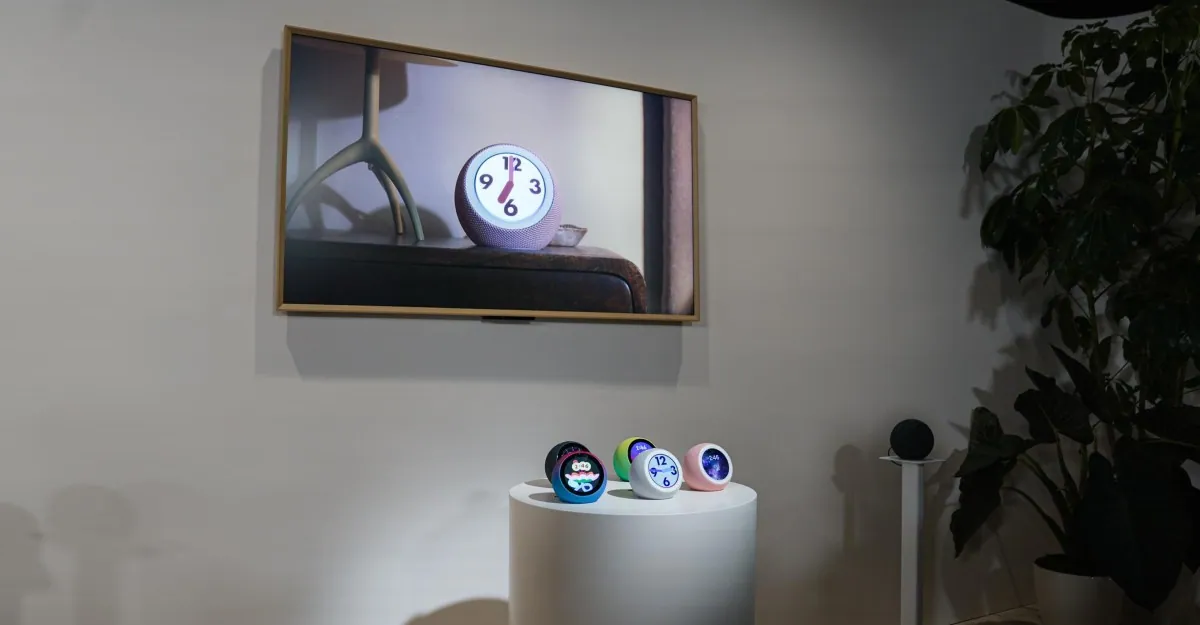
Amazon has a new gadget for your nightstand, and this one is paying attention while you sleep. The Echo Time, announced this week alongside a refreshed Echo Dot, is a $199.99 smart alarm clock built around a 3.2-inch touchscreen and a sleep-sensing feature that tries to wake you at the ideal moment in your sleep cycle rather than jolting you awake on a fixed schedule. It's available to order now.
The Verge got hands-on time with the Time at Amazon's New York event, and the device reads as a clear step up from the Echo Spot, one of the more popular smart clocks on the market. The headline upgrade is simple but meaningful: you can now set an alarm directly on the touchscreen. That sounds minor until you remember the alternative — barking a command at Alexa in the dark next to someone trying to sleep. Touch input fixes an annoyance that's dogged voice-first bedside devices for years.
A bigger, smarter screen
The Time's display is a genuine upgrade over the Spot's. Where the Spot crams its interface into a cramped 2.83-inch semicircle, the Time's 3.2-inch screen is fully round, which according to The Verge makes the clock face itself noticeably bigger and easier to read from across the room.
Amazon also redesigned how the screen behaves. No matter what you ask Alexa to do — turn on the lights, play a song, pull up a video doorbell feed — the display handles the request and then snaps back to showing the clock. If you've got music playing or a timer running, small icons sit above the time so you can tap in for details without losing the clock as the default view. It's a design choice that keeps the device feeling like a clock first and a smart speaker second, which matters a lot when the thing is sitting six inches from your face at 2 a.m.
That logic extends to brightness. The Time's screen can dim below 0.3 nits, and in a demo described by The Verge, it was barely visible even in a well-lit room — a good sign for anyone who's been annoyed by a too-bright display in a dark bedroom. The reviewer noted that claim will really get tested once the device is sitting on an actual nightstand overnight.
The sleep-sensing pitch
The feature Amazon is clearly leaning on hardest is sleep sensing. Like the Spot, the Time has no camera, which keeps it firmly in bedside-appropriate territory rather than Echo Show territory. Instead, it adds an ultrasound transducer on top of the motion-detecting ultrasound sensor already found in the Echo Dot. Together, those sensors are meant to track breathing patterns and small body movements to estimate what sleep stage you're in, then wake you up to an hour before your set alarm time if it detects you're at an optimal point to rise.
It's an opt-in feature, and Amazon built in a quick off-switch: hitting the mute button disables it immediately. The pitch is familiar from other sleep-tech products — rather than yanking you out of deep sleep at a fixed time, the clock tries to catch you in a lighter phase nearby.
For people who can't resist the snooze button, the Time includes alarm tones designed to start quiet and gradually "build energy" each time you hit snooze, whether by tapping the top of the speaker or telling Alexa directly. There's also a sunrise wake-up mode that slowly warms and brightens the clock face instead of blasting a sound. In the demo, that effect looked subtle, but the room was already bright — The Verge suggested it would likely be more noticeable in an actual dark bedroom, right next to someone's face.
Smart home hub, hundreds of faces
Because the Time runs on the same internals as the new Echo Dot, it doubles as a smart home hub supporting Zigbee, Thread, and Matter. That means it can pair directly with smart bulbs in the room and brighten them in sync with the clock face — essentially extending the sunrise effect to your actual lights, not just the small screen.
Amazon also went big on customization: hundreds of clock faces are available, with options to tweak them further. The Time comes in pink, black, and white, plus two kid-focused versions in colors Amazon calls galactic grape and cosmic lime. Those kids' editions run $209.99 and include a year of Amazon Kids Plus, which adds a Sleep Studio feature — guided bedtime routines that prompt kids to brush their teeth and put on pajamas, wind-down prompts, and gradual light dimming. The kids' models also get animated character clock faces alongside analog designs meant to help kids learn to tell time.
The verdict, with an asterisk
On paper, the Time addresses most of what held the Spot back, and at roughly double the price, it's reasonable to expect that. The main reservation from The Verge's hands-on time was size: the Time felt a bit large for a bedside table, though still smaller than the widely used Hatch Restore. A big screen next to your bed is only useful if it doesn't just become another thing competing with your phone for space.
Amazon sells an optional $39.99 stand that angles the screen and makes the device feel less bulky sitting there. Whether the Time earns a spot on the nightstand long-term will come down to real-world testing — how it performs through an actual night of sleep, not a bright demo room in Manhattan.