Tesla's New Roadster Uses Actual SpaceX Rocket Thrusters to Fly
At a reveal event in Texas, Elon Musk showed off a Roadster that sticks to walls, launches off ramps, and barrel-rolls through the air — and it's not just for show.
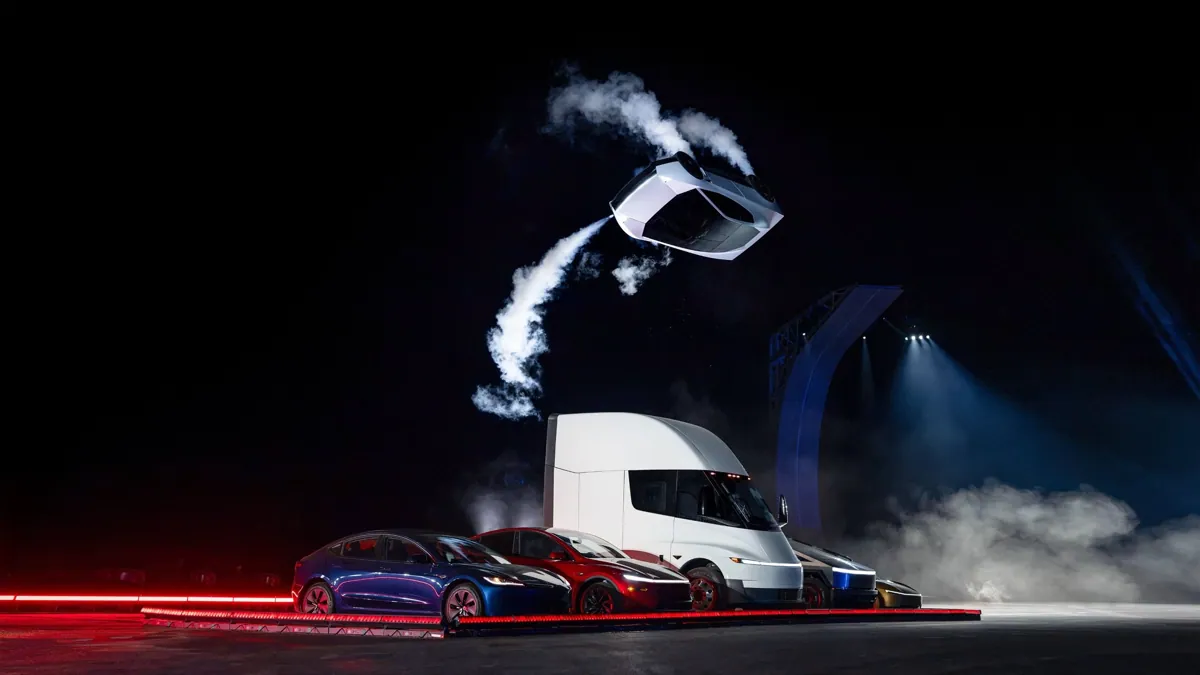
Tesla finally pulled the cover off its next-generation Roadster on Thursday night, and the unveiling doubled as one of the stranger car demos in recent memory. During a livestreamed event at SpaceX's rocket-testing facility in McGregor, Texas, the company showed the Roadster driving up a ramp, clinging upside-down to an overhang, launching itself into the air, performing a barrel roll, and landing — all without a human driver.
"This is not necessarily a safety-optimized car, OK?" Elon Musk said at the event. "But it takes the fun meter to 11 out of 10."
The flight wasn't a visual effect. Tesla says the Roadster is built with 10 small cold-gas thrusters, fed by roughly 600 liters (about 250 kilograms, or 550 pounds) of compressed air stored in carbon fiber pressure vessels that Tesla says fill "every usable void in the car," according to a post from the company on X. Tesla Engineering Vice President Lars Moravy confirmed the air storage figures during the presentation.
Musk explained that the car has main thrusters mounted in the rear for propulsion and separate attitude-control thrusters that manage orientation in the air. "So it can basically fly like a rocket, and it could do rolls," he said. "It could do, like, crazy gymnastics — whatever you want, really." During the demo, the team used the thrusters to launch the Roadster clear over a line of six parked vehicles, including a Tesla semi-truck cab.
Before any of that, though, came the suction stunt. The Roadster drove up a ramp that steepened into a vertical wall and then an overhanging ledge, and the car stuck to the surface using a fan-based suction system built into its chassis. Musk leaned into the moment: "I mean, this car really sucks, OK? This car could suck the chrome off a trailer hitch. It could suck a tennis ball through a hose pipe."
Beyond the showmanship, Musk said the suction system has a practical purpose — keeping the car pinned to the pavement during hard, high-speed cornering.
A long-promised car, finally taking shape
None of this came entirely out of nowhere. Tesla first announced the new Roadster back in 2017, originally targeting a 2020 release. In 2018, Musk said on Twitter (now X, following his 2022 purchase of the platform) that an optional "SpaceX package" would add roughly 10 small rocket thrusters arranged around the car, improving acceleration, braking, and cornering — and possibly, he mused at the time, letting it fly. Seven years later, that teased feature made its public debut.
The mannequin sitting in the driver's seat during the stunts was a deliberate callback: it wore a black-and-white SpaceX spacesuit, echoing "Starman," the dummy Musk launched into orbit in February 2018 behind the wheel of his own cherry-red first-generation Roadster, aboard the debut flight of SpaceX's Falcon Heavy rocket. That car and its passenger are still out there, looping around the sun — modeling suggests they'll keep orbiting for millions of years before eventually colliding with Earth or Venus.
Musk also worked in a reference to PayPal co-founder Peter Thiel's famous line about technological disappointment: "A friend of mine, Peter Thiel, once said that the future promised us flying cars, but instead we got 140 characters. Well, not anymore."
What you can actually buy
Despite the spectacle, the new Roadster isn't on the road yet. Musk said Tesla aims to start production in 2028, and the flying "Rocket" version isn't available for reservation on Tesla's site at all — it's invite-only, and given how unlikely regulators are to approve a thruster-equipped flying car for everyday driving, it will likely stay a rare showpiece for a small circle of wealthy buyers rather than something anyone can order.
Two other variants are listed for sale now: "Performance" and "Thrust." Tesla describes the Performance model as "road ready," featuring active aerodynamics and a multi-mode suction system. The Thrust version is pitched as "race ready," adding acceleration thrusters on top of the same active aero and suction setup. Reserving a Performance model costs $50,000; the Thrust reservation runs $250,000. Tesla hasn't disclosed full pricing for any Roadster variant yet.
For now, the flying Roadster is a proof of concept wrapped in a marketing spectacle, built to demonstrate what SpaceX hardware can do when it's bolted to a consumer car. Whether any of that translates into a production vehicle regular buyers can drive is a question that won't be answered until Tesla actually starts building these things in 2028.