Samsung's New Foldable Screen Tech Tackles the Crease Problem
Flex Titanium combines two titanium components to make foldable displays thinner and sturdier, with the Galaxy Z Fold 8 as its first showcase — and Apple's rumored foldable iPhone could benefit too.
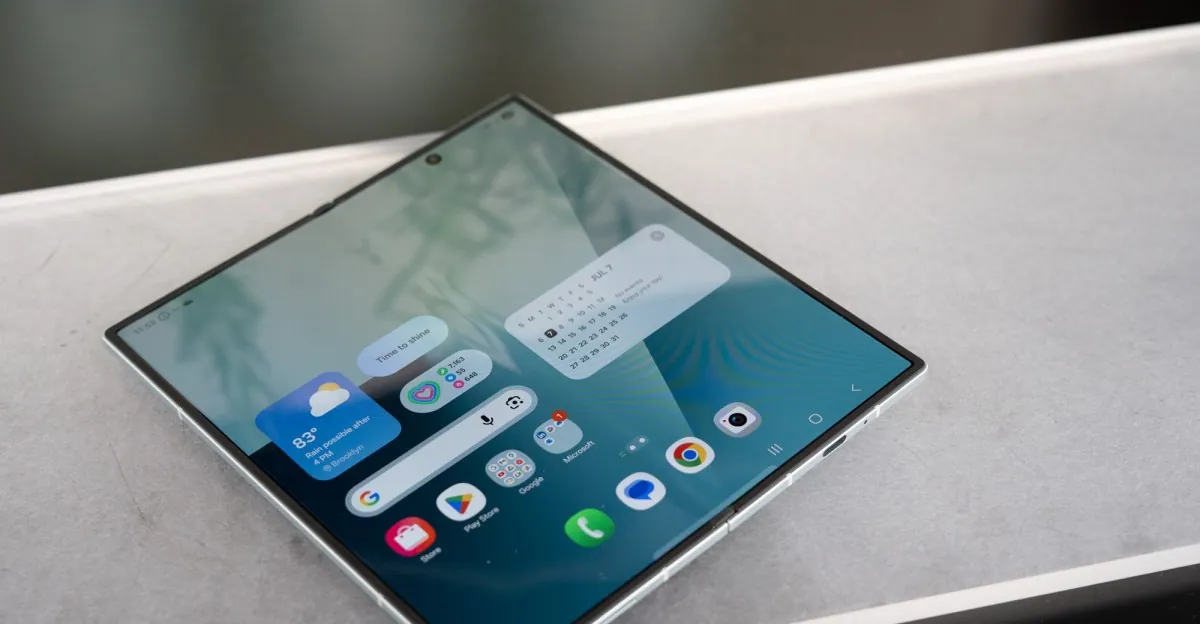
Every foldable phone on the market shares one stubborn flaw: fold a screen enough times and you get a crease, a visible line down the middle where the display bends. Samsung says it has a real answer to that problem now. The company just unveiled Flex Titanium, a new flexible display technology built to be slimmer, tougher, and far less prone to creasing than what's currently in Galaxy Z Fold and Flip phones.
Samsung describes Flex Titanium as the payoff from seven generations of foldable phone development. It'll make its debut in the upcoming Galaxy Z Fold 8 and Galaxy Z Fold 8 Ultra. Given that Samsung Display has long supplied screens to Apple, there's also a real chance this technology shows up in Apple's rumored foldable iPhone, expected to arrive later this year.
Two pieces of titanium, one thinner screen
The name gives away the approach: Flex Titanium relies on two titanium-based components working together. The first is a titanium-alloy film that sits underneath the OLED panel and provides structural support. According to Samsung, this film delivers 20 times greater mechanical stiffness than the polymer film used in current foldables, despite measuring roughly one-third the thickness of a human hair.
The second component is a titanium plate positioned beneath that film, which allows for tighter bonding with the display module. Samsung says this improves stability once the phone is unfolded and being used, while still preserving the flexibility a screen needs to survive thousands of fold cycles.
Beyond structural improvements, Samsung says the new display tech also cuts power consumption and delivers what it calls "ultra-vivid" visual resolution. In its announcement, Samsung summed up the goal this way: "Together, these advancements enable a strong foldable display that maximizes content immersion on a seamless screen and reduces crease visibility — all while keeping it slim."
Why the crease keeps coming back
This isn't Samsung's first swing at killing the crease. Earlier this year, Samsung Display showed off a separate creaseless OLED prototype, and speculation immediately centered on Apple's foldable iPhone as its likely destination. At the time, Samsung Display was careful to frame that prototype as pure research, calling it "an R&D concept, with no fixed timeline or plan for commercialization." Since then, reports have surfaced that Samsung signed a three-year exclusivity deal to supply screens for Apple's foldable, which is rumored to arrive largely crease-free.
Flex Titanium appears to be a more immediate, shippable step in that same direction, rather than the longer-term prototype work. It's arriving on a set commercial timeline, tied to a real product launch, which suggests Samsung sees it as ready for prime time rather than a lab experiment.
The crease issue matters more than it might seem. It's the single most common complaint about foldable phones, the visible reminder that you're using a screen that wasn't built the traditional way. Reducing it, or eliminating it, is widely seen as the thing that could finally make foldables feel like a mainstream product rather than a novelty for early adopters willing to tolerate compromises.
Samsung says it will share more details on the Flex Titanium display at its Galaxy Unpacked event on July 22nd, where the company is expected to formally introduce its next generation of foldable phones.