Samsung's New Galaxy Watches Chase Bigger Batteries and Apple's Vitals Feature
The Galaxy Watch 9 and Ultra 2 pack in longer battery life, a new Qualcomm chip, and four preventive health metrics — but both cost more than last year's models.
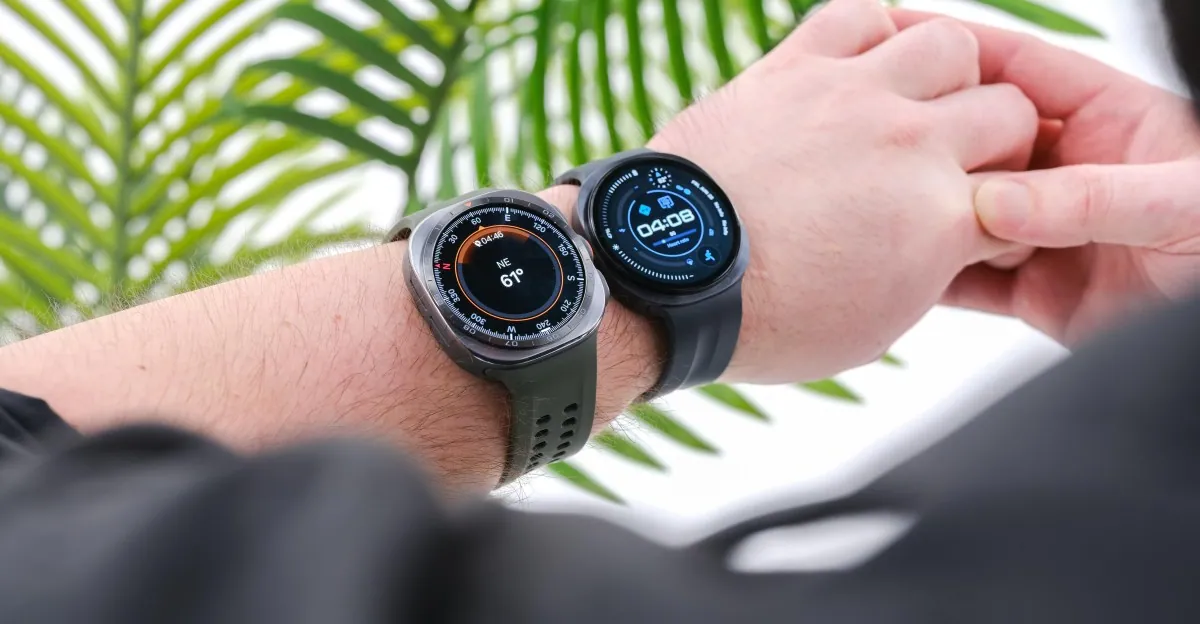
Samsung announced its latest smartwatches today, and the pitch is less about flashy new tricks than fixing what's been holding the line back: battery life and the kind of preventive health tracking that Apple, Oura, and Whoop have made table stakes.
The Galaxy Watch Ultra 2 is the bigger story of the two. Its 47mm case now holds an 800mAh battery, a 35 percent jump from the 590mAh cell in the original Ultra, which The Verge's reviewer clocked at around 70 hours of use. Despite the larger battery, the case actually shrank, coming in 12 percent thinner at 10.7mm, with a slimmer, softer strap to match. Samsung also cranked up the display to 5,000 nits, up from the Ultra's previous specs, which the company says makes it easier to read in direct sunlight. According to The Verge, that gives the Ultra 2 the brightest screen of any smartwatch on the market, paired with one of the largest batteries in the category.
The Ultra 2 is also picking up a trail-running mode clearly built to go after Garmin's turf rather than Apple's. It lets users download GPX route files for real-time GPS navigation and elevation tracking, plus estimated completion times and hydration alerts. Worth noting: those hydration alerts aren't measuring actual sweat or electrolyte loss. They're modeled estimates based on workout intensity and demographic data, not direct sensor readings. For divers, the watch adds IP69K, 10 ATM, and EN 13319 water- and dust-resistance ratings, along with a dedicated diving app built with scuba gear maker Mares that's set to arrive later this year, tracking descent speed, time at depth, and ascent pacing.
All of that comes at a cost. The Ultra 2 is now $699.99, a $50 increase over its predecessor.
The Watch 9 plays it safer
The standard Galaxy Watch 9 is a more modest update, and at $379.99 it's $30 pricier than the Watch 8. The headline change under the hood is a shift away from Samsung's own Exynos chip to Qualcomm's Snapdragon Wear Elite, a chipset Qualcomm pitched earlier this year at Mobile World Congress as built for AI-driven wearables. The move likely aims at better power efficiency and smoother AI processing, including improved performance for Google's Gemini assistant. Wear OS 7 brings a new "raise to talk" gesture that skips the wake word entirely, and Samsung says it's tuned things so a simple wrist-check to see the time won't accidentally trigger the assistant. Whether the new chip delivers a noticeable speed boost is still unclear. Some hands-on testers reportedly noticed slight lag while scrolling, though that could easily be chalked up to demo units or spotty connections rather than the hardware itself.
Battery gains on the Watch 9 are more incremental than the Ultra 2's leap. The 40mm model gets roughly a 20 percent bump to 390mAh, while the 44mm version inches up from 435mAh to 445mAh. The strap is 17 percent lighter thanks to a new "air pocket structure" that creates a small gap between the fabric and the skin, which Samsung says makes for a cooler, more comfortable fit.
Catching up on health tracking
The real focus of this year's lineup is four new preventive health features, all coming to both watches. The most significant is Vitals, which builds a personal baseline for blood oxygen, heart rate, heart rate variability, skin temperature, and respiratory rate after a week of consistent overnight wear. From there, the watch flags any morning deviations from that baseline and offers suggestions for getting back on track. It's a close match to the Vitals feature Apple introduced with watchOS 11 last year.
Samsung is also adding a Heart Health Score, a daily 0-to-100 rating based on an eight-day sleep average, moderate-to-vigorous activity levels, BMI, and vascular load, alongside a Daily Cardio Load metric that weighs training intensity against recovery using real-time heart rate data. The goal with both is to help users spot whether they're overtraining, undertraining, or hitting a healthy balance. Neither concept is new to the wearable space. Oura, Whoop, and Google's Fitbit have offered similar tools for a while now.
The one genuinely distinctive addition is Fitness Index, a radar chart that compares a user's strength, flexibility, endurance, cardio fitness, and body composition against other Samsung wearers, drawing on VO2 max, heart rate, step counts, activity time, and bioimpedance data. It doesn't grade users as good or bad. It just maps out where their strengths and weaknesses sit relative to the broader Samsung user base.
Taken together, this generation reads as Samsung closing gaps rather than opening new ground: catching up to rivals on health metrics while quietly fixing the battery complaints that have dogged its watches for years. That's a reasonable trade-off, except for the price. Samsung has been nudging its wearable prices upward for a while now, and this year's increases likely reflect broader geopolitical and supply-chain pressures as much as new hardware costs. Reasonable explanation or not, higher prices are never the part customers welcome.
Both watches are available for preorder starting today, with shipping expected to begin August 7th.