Samsung Bets on a Wider Foldable as Apple's First Fold Approaches
Leaks and Samsung's own teasers point to a shorter, squatter foldable phone debuting at Wednesday's Unpacked, a preemptive move ahead of Apple's expected entry into the category.
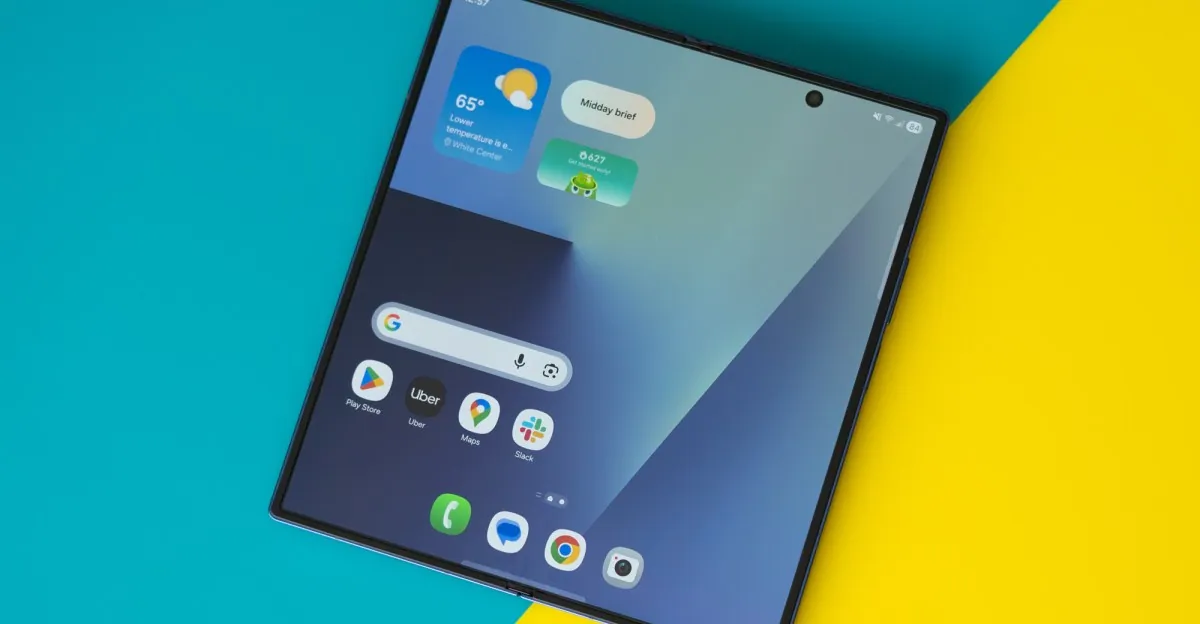
Samsung's Wednesday Unpacked event looks like its biggest in years, and not just because of the usual round of Fold and Flip updates. Alongside new versions of both phones, the company is widely expected to introduce an entirely new foldable form factor: shorter and wider than anything currently in its lineup.
It would mark the second major shake-up to Samsung's foldable lineup in under a year, following last year's Galaxy Z TriFold. For most of the category's existence, Samsung's formula was simple: a compact Flip and a larger Fold, full stop. That's no longer enough. With Apple reportedly closing in on its own first foldable iPhone, Samsung appears unwilling to sit still.
The signs of a wider foldable have been building for months. Samsung itself has teased "a new shape" for its foldables, and the invitations for this week's Unpacked show a ticket stub with the top torn away, leaving a shorter stub behind, an image that lines up neatly with the leaks. Reports on Apple's side have described a similarly squat design for its rumored foldable iPhone, suggesting both companies may be converging on the same basic shape at roughly the same time.
Not actually a new idea
A wider foldable isn't a new concept. Huawei beat everyone to this particular design this year with its passport-shaped Pura X Max, but the format goes back further than that. Google's original Pixel Fold leaned wide, as did Oppo's Find N, and Microsoft's dual-screen Surface Duo was wider still. The format largely disappeared not because it failed on its own merits, but because Samsung, as the dominant player, steered the market elsewhere, optimizing its Fold phones around slim outer screens paired with square inner displays.
That's the position Samsung has occupied for years: first-mover in foldables, and big enough to effectively set the market's direction. Rivals have chipped away at that edge recently with advances like nearly creaseless displays and better dustproofing, forcing Samsung to play catch-up in some respects. Last year's Z Fold 7 and Z Flip 7 were something of a reassertion, with the Fold 7 notably thin and the Flip 7 sporting an edge-to-edge cover screen. Samsung has continued to treat those two devices as its most complete foldables yet.
Apple changes the math
What's different now is Apple. Analysts have argued for years that Apple's arrival is the one thing that could push foldables out of niche territory and into the mainstream, and this September may be when that theory gets tested. IDC analyst Francisco Jeronimo, in a report cited by The Verge, called Apple's entry a turning point for the segment, and predicted the company could capture 34 percent of the foldable market by value in its first year alone.
That prediction cuts both ways for Samsung. A bigger, more legitimized foldable market could lift every manufacturer's sales, Samsung included. But there's an equally real chance that Apple's debut simply siphons customers away from Samsung, undercutting the dominance it's spent seven years building.
Launching a wider foldable now, ahead of Apple's expected reveal, functions as a hedge. If Apple's foldable iPhone turns out to be genuinely excellent and Samsung has nothing comparable in its own lineup, that's the worst-case scenario for the company. Getting a similar form factor to market first, or at least simultaneously, closes off that particular risk. Keeping the standard Flip and Fold around as well gives Samsung cover if buyers ultimately prefer those over anything new.
The risk of chasing Apple
Mimicking Apple's moves hasn't always worked out for Samsung. The Galaxy S25 Edge arrived months ahead of the iPhone Air and looked, at the time, like a reasonably safe bet on where the industry was headed. Sales didn't materialize, and by most accounts the Air itself has underperformed for Apple too. Samsung's other recent experiment, the Galaxy Z TriFold, lasted barely three months in the US market before effectively disappearing, and it's unclear whether a follow-up is even planned.
None of that guarantees a wider Fold will flop. But it's a reminder that betting on a form factor because a competitor might be heading there carries its own risks, separate from the risk of doing nothing.
The full picture won't be clear until Wednesday, when Samsung's actual hardware gets shown off rather than teased. Apple's response is likely still two months out, and it could be considerably longer before anyone knows whether a foldable iPhone actually reshapes the category the way IDC and others expect. What seems clear is that Samsung has decided the danger of moving first outweighs the danger of waiting to see what Apple does. Whether that bet pays off is the story to watch this fall.