Ford Puts a Power Plant Inside Its Cheap Electric Truck
The Fathom's built-in inverter could make whole-home backup power an everyday feature instead of a pricey add-on, if the hardware costs and utility paperwork don't get in the way.
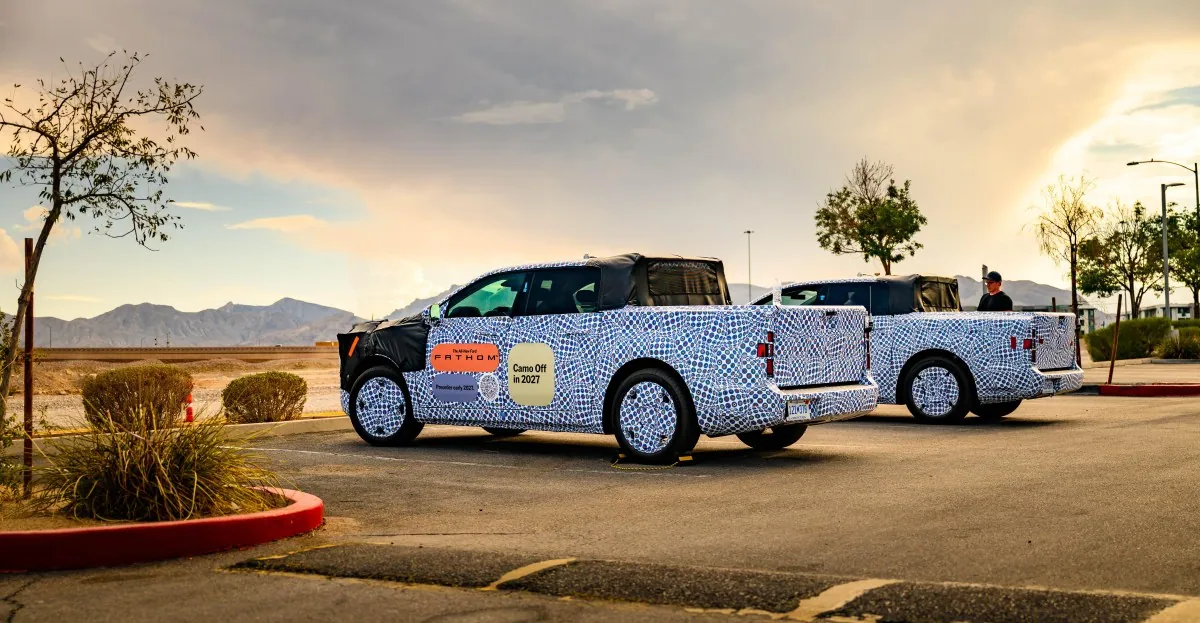
Ford is still months away from formally unveiling the Fathom, its sub-$30,000 electric pickup, but the automaker keeps dropping details to build anticipation. The latest: the Fathom will come with bidirectional charging hardware built directly into the vehicle, a move that could make home backup power dramatically cheaper and simpler than it's been on any previous Ford EV.
The feature in question is vehicle-to-home (V2H) and vehicle-to-load (V2L) charging, which lets an EV's battery power appliances, back up a house during a blackout, or even sell electricity back to the grid. Several automakers now offer some version of this, but it's typically been expensive and complicated to set up. Ford's discontinued F-150 Lightning, for instance, needed a large external inverter, a separate box that converts the truck's DC battery power into the AC power your house actually runs on, and that hardware alone could cost thousands of dollars.
The Fathom skips that external box entirely. Ford is integrating the inverter straight into the truck's onboard "E-box," letting it generate more than 10 kW of AC power on its own. That's the key change: instead of bolting on a separate, costly piece of equipment, the capability comes standard inside the vehicle itself.
Still not free, but a lot cheaper
Having the inverter built in doesn't mean backup power is automatic. Owners who want to send power back to the grid will still need a separate device, the Ford Home Power Station. Ford says it's targeting a price roughly 50 percent below the $1,310 Ford Charge Station Pro that current EV owners buy for similar functionality.
For full whole-home backup during an outage, owners will need to pair that power station with a backup panel. Today, that kind of setup commonly runs around $5,205. Ford's target for its version comes in near $3,123, about a 40 percent cut, according to the company. Ford hasn't finalized pricing on either package yet, so those numbers could still move before launch.
Even at those lower prices, there are costs Ford can't engineer away: permitting, electrician labor, and the heavy-gauge wiring needed to safely route that much power into a house. For some buyers, those line items alone could still put whole-home backup out of reach, even with cheaper hardware.
The other obstacle was never the hardware
Equipment cost is only half the problem with V2H charging. The other half is bureaucracy. Utilities have their own rules about who can feed power back onto the grid and how, and navigating that paperwork has historically been a slog for homeowners.
Ford's answer was to get ahead of it by partnering directly with five major North American utilities: Pacific Gas and Electric, American Electric Power, BC Hydro, Consumers Energy, and Exelon. Together, these companies serve millions of customers across the US and Canada. The idea, per Ford, is that whatever technical and procedural standards these utilities agree to adopt will end up setting the template the rest of the industry follows.
The agreements reportedly cover three things: simplifying paperwork for basic storm-related backup use, standardizing on common plugs and software, and making grid participation programs run automatically rather than requiring manual enrollment. If that holds, it would remove a lot of the friction that's kept V2H from becoming mainstream even among owners who can afford the hardware.
Why this truck matters to Ford
The Fathom isn't just another EV model for Ford. It's the first vehicle built on the company's new Universal EV Platform, an architecture designed to stretch aerodynamic efficiency and range while cutting production costs enough to let Ford actually turn a profit on an electric vehicle. Ford has spent over a year calling it the company's "Model T moment," language that signals just how much weight the automaker is putting on this specific launch succeeding, both as a product and as a proof of concept for its EV strategy going forward.
Pricing the truck at roughly $28,000 while also including inverter hardware that used to cost thousands extra is a bet that affordability sells electric trucks better than halo features do. Ford is trying to make basic bidirectional charging feel like a standard feature rather than a luxury option reserved for buyers willing to spend five figures on backup infrastructure.
Whether Ford hits its cost targets is still an open question. Supply chains remain tight, trade policy keeps shifting, and the company hasn't locked in final pricing on the Home Power Station or backup panel. Those variables matter more for the Fathom than for most vehicles, since the entire pitch rests on keeping costs down across the board, not just on the sticker price of the truck itself.
What happens with this one launch will say a lot about whether Ford can actually deliver an EV that's cheap to buy and genuinely useful as a backup power source, not just one or the other.