Apple Enters the Smart Display Market With the $299 HomeView
The device, open for preorder now, aims to be a shared family hub that recognizes who's talking to it and personalizes Siri accordingly.
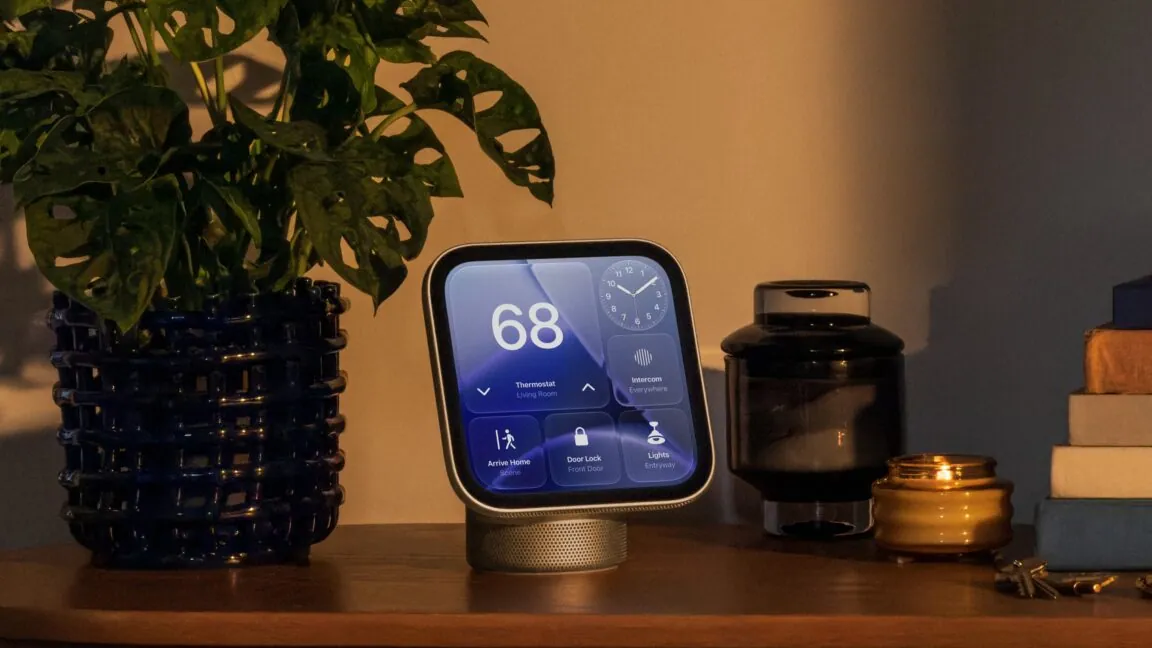
Apple opened preorders today for HomeView, a 7-inch smart display and speaker that marks the company's first real push into a product category Amazon and Google have occupied for close to a decade. It costs $299 and is built to sit on a counter or wall as a shared control point for a household, handling everything from smart home commands to video calls to a more personalized version of Siri.
The pitch is familiar if you've used an Echo Show or a Nest Hub: a touchscreen with a speaker, voice control, and camera access, meant to live in a kitchen or entryway. But HomeView's design leans on something Apple has that its rivals mostly don't, a sprawling ecosystem of devices already in people's pockets and homes, and the company is building the pitch around tying that ecosystem together rather than introducing a standalone gadget.
Up to six people in a household can be recognized by the hub, according to Apple's announcement. HomeView uses its integrated camera to identify whoever walks up and switches to that person's own profile, complete with their preferred apps and widgets. If someone connects their profile to an Apple Intelligence-capable iPhone or iPad, the hub can pull up their Messages, Calendar, Reminders, and FaceTime directly, rather than showing a generic shared interface.
Siri is the other half of the pitch. Users can simply talk to the hub to handle smart home tasks, Apple's example being something like telling Siri to close the blinds or lock the doors. But on a HomeView linked to an Apple Intelligence-enabled phone or tablet, Siri reportedly goes further, taking actions across apps and pulling in personal context, like surfacing a relevant text thread, checking a calendar conflict, or queuing up an Apple Music playlist, tailored to whichever family member is standing in front of it.
Security camera monitoring is a central feature as well. HomeView can display up to nine video feeds at once, useful for anyone running multiple HomeKit cameras around a property. With a supported iCloud+ subscription, the hub adds what Apple describes as end-to-end encrypted recognition for people, familiar faces, pets, packages, and vehicles, triggering a notification to the household the moment someone shows up at the front door. Apple is also adding automatic video descriptions for HomeKit Secure Video footage, generating a written summary of a clip so a user can get the gist without actually watching it.
Catching up, with a twist
Amazon's Echo Show has been the dominant smart display since 2017, and Google has had its own version in various forms for nearly as long. Apple sitting out that market for this long was notable given how aggressively it pushes HomeKit and Siri elsewhere. HomeView suggests the company's answer wasn't to skip the category, but to wait until it could wire the device directly into Apple Intelligence and iCloud, turning what's usually treated as a kitchen smart speaker with a screen into another node of the broader Apple ecosystem.
That approach also doubles as a retention play. The deeper features, personalized Siri actions, the iCloud+-gated camera recognition, the Apple Intelligence tie-ins, only work fully if the rest of a household is already living inside Apple's hardware and subscriptions. It's the same logic that's driven Apple Watch, AirPods, and HomeKit itself: individual products are fine on their own, but they get noticeably better once a family is bought into the whole system together.
Whether that's enough to pull households away from an existing Echo or Nest setup is the real question. Smart displays have mostly been commodity hardware, cheap, interchangeable boxes that do voice control and video calls competently and not much else. HomeView costs more than entry-level competitors, and its standout features depend on extras most casual buyers won't have by default, namely an iCloud+ subscription and an Apple Intelligence-compatible phone. For families already deep in Apple's ecosystem, that's a minor hurdle. For everyone else, HomeView is making the case that a smart display is worth paying for specifically because of what it connects to, not just what it does on the counter by itself.