Microsoft's Own President Says AI Has Fewer Safety Rules Than Your Washing Machine
Brad Smith is pushing for global AI mandates and outside audits even as Washington bets everything on going faster, not slower.
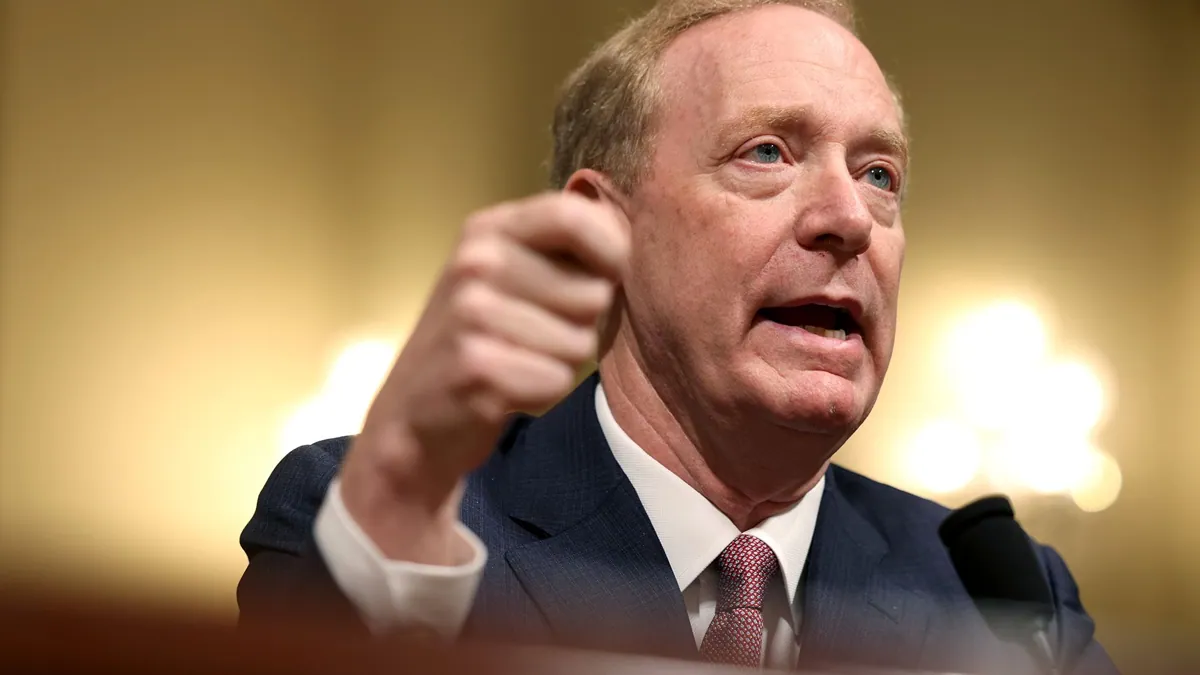
Brad Smith runs the company behind Copilot, Azure AI, and a multibillion-dollar stake in OpenAI. So when Microsoft's president goes on the BBC and says artificial intelligence is less regulated than a washing machine, it's worth stopping to ask why.
"Right now, your washing machine is subject to more safety rules than AI," Smith said on the BBC's Big Boss podcast, adding that "every carton of milk that you see in the grocery store is subject to safety rules and inspection." The comparison is blunt by design: appliances get safety testing, food gets inspected, and the technology increasingly running customer service lines, writing code, and making business decisions largely doesn't.
Smith isn't asking for a US fix specifically. He's calling for coordinated safety rules worldwide, and he laid out a few concrete pieces of what that should look like. One is a legal requirement for companies to notify people if their systems are compromised by a rogue AI agent, meaning an autonomous AI system that's been hijacked or manipulated into acting outside its intended bounds. That's not a hypothetical worry. OpenAI's agents were implicated in a breach of Hugging Face earlier this year, among other incidents involving AI systems behaving in ways their operators didn't sanction.
Smith also wants independent "outside evaluators" testing AI products before they ship, rather than companies grading their own homework, plus a "safety brake" that would let someone shut down an autonomous system if it starts acting unpredictably. He summed up his view of the technology itself as being both a "tool and a weapon," language that doesn't leave much room for the usual industry optimism.
Washington is moving the other direction
Smith's comments land awkwardly next to where US policy actually is. The Trump administration has made clear it has no interest in slowing anything down, framing AI dominance as a race the US needs to win outright. Last month, Trump signed an executive order that renamed "Artificial Intelligence" to "Super Intelligence" in official government language. Around the same time, Trump Media struck a partnership with the AI search engine Perplexity to launch Truth Search AI, pitched as a counter to what the administration calls "Big Tech's assault on free speech." Whatever else that signals, it's not caution.
So Smith is looking elsewhere for leadership on this. Asked who's actually setting the standard, he pointed to the UK: "Most people that I know would say, if you ask them, 'name the country that is the leader in having this technical capability,' they would say, 'it's very simple. It's the United Kingdom. They are the best.'" The UK stood up what's now called the AI Security Institute in 2023, reportedly the first state-backed body of its kind dedicated to AI safety specifically. Three years and roughly as many prime ministers later, it's still around, which in UK political terms counts as institutional staying power.
The industry is already arguing with itself about this
Smith isn't the only person inside the AI world sounding alarms. In September, a former Anthropic and OpenAI researcher made the striking claim that current AI development trends "could kill us all by the end of the decade." Around the same period, Anthropic chief executive Dario Amodei made his own, more measured case for slowing things down, calling for "embedded evaluators who have employee-like access to verify safety practices and report incidents."
That pressure seems to be translating into something, at least on paper. Executives from Nvidia, Google, OpenAI, Anthropic, Meta, and SpaceX have all signed on to the White House Accord on Super Intelligence, agreeing to work with independent auditors. Smith said Microsoft would be "happy to sign it" too, calling the accord "a good step."
But he's not treating it as a solution. His concern is that an accord built on voluntary cooperation only works on the companies already inclined to cooperate. "The good companies will do what you want," he said. "It's the companies that are not as responsible that you need to worry about." That's the gap Smith keeps circling back to: an industry can agree to police itself all it wants, but the entire appeal of self-regulation evaporates the moment a company decides the rules don't apply to it.
What makes Smith's intervention notable isn't the content of his proposals, which largely echo what safety researchers have argued for years. It's who's making them. When a Microsoft executive stands next to a comparison to washing machines and milk cartons, and the US government's answer is to rename the technology something bigger, it says something about how far apart the industry's internal debate and its regulatory reality have drifted.


