NASA Is Rushing to Rename AI 'Super Intelligence' Before Christmas, and Its Own Staff Are Confused
An internal rollout plan obtained by Space.com shows the agency racing to scrub "artificial intelligence" from its communications under a Trump executive order, even as scientists warn the new term doesn't mean the same thing.
NASA is in the middle of a bureaucratic sprint to erase the term "artificial intelligence" from its vocabulary, replacing it with "super intelligence" across websites, job titles, software systems, and internal communications, under a four-phase plan obtained by Space.com that runs through the end of December.
The push stems from an executive order President Trump signed on September 29, titled "Inaugurating the Era of Super Intelligence." It directs federal agencies to swap "artificial intelligence" and "AI" for "super intelligence" and "SI" in all official communications, and — notably — forbids agencies from acknowledging that a rebranding has even happened. No "SI, formerly known as AI." The White House's rationale, according to the order, is that AI capabilities have outgrown the old terminology and need language that reflects a genuinely new era of the technology. The order does not change the government's underlying definition of artificial intelligence, however, meaning existing systems get the new label without needing to do anything new.
NASA's Office of Communications and Office of the Chief Information Officer circulated an internal implementation schedule telling employees that, "effective immediately, we must use 'super intelligence' and 'SI' in all in-scope content/publications." The directive covers everything from press materials and media interviews to style guides, intra-agency websites, and IT systems tied to public communications. It applies agency-wide, including contractors and staff at the Jet Propulsion Laboratory in Southern California, which Caltech operates on NASA's behalf.
A four-phase countdown
NASA's rollout is broken into phases with hard deadlines. Phase One took effect October 9 and covered the agency's primary AI-related websites and job titles — Kevin Murphy, for instance, is now NASA's "acting chief data and super intelligence officer" rather than "chief data and artificial intelligence officer."
Phase Two targets heavily trafficked pages on nasa.gov and science.nasa.gov, along with renaming JPL's Artificial Intelligence Group website so it redirects to an SI-branded address. That phase was originally scheduled to wrap by October 30, but sources told Space.com the timeline got moved up, with changes going live October 16 — two weeks ahead of schedule.
Phase Three, due by November 30, extends to more high-traffic NASA sites and the renaming of Ask Sage, a generative AI platform used across federal agencies. NASA's own planning document flags this step as a "breaking change for APIs and other integrations," meaning software connected to these systems may stop working properly until it's updated. Phase Four, set for December 23, cleans up NASA's remaining lower-traffic sites and internal IT tools.
NASA's guidance notes that Trump's order itself sets no deadline for compliance, and that the agency's aggressive timeline reflects its own leadership's priorities rather than any mandate from the Office of Management and Budget.
Pressure from the top
NASA Administrator Jared Isaacman appears to be driving the pace. One NASA employee told Space.com, "We are getting a lot of pressure from the administrator himself to act on this." Isaacman, appointed in December 2025, has closely aligned the agency with Trump's priorities since taking the job. He attended a White House luncheon with AI executives on the same day Trump signed the order, and has since adopted the new terminology publicly.
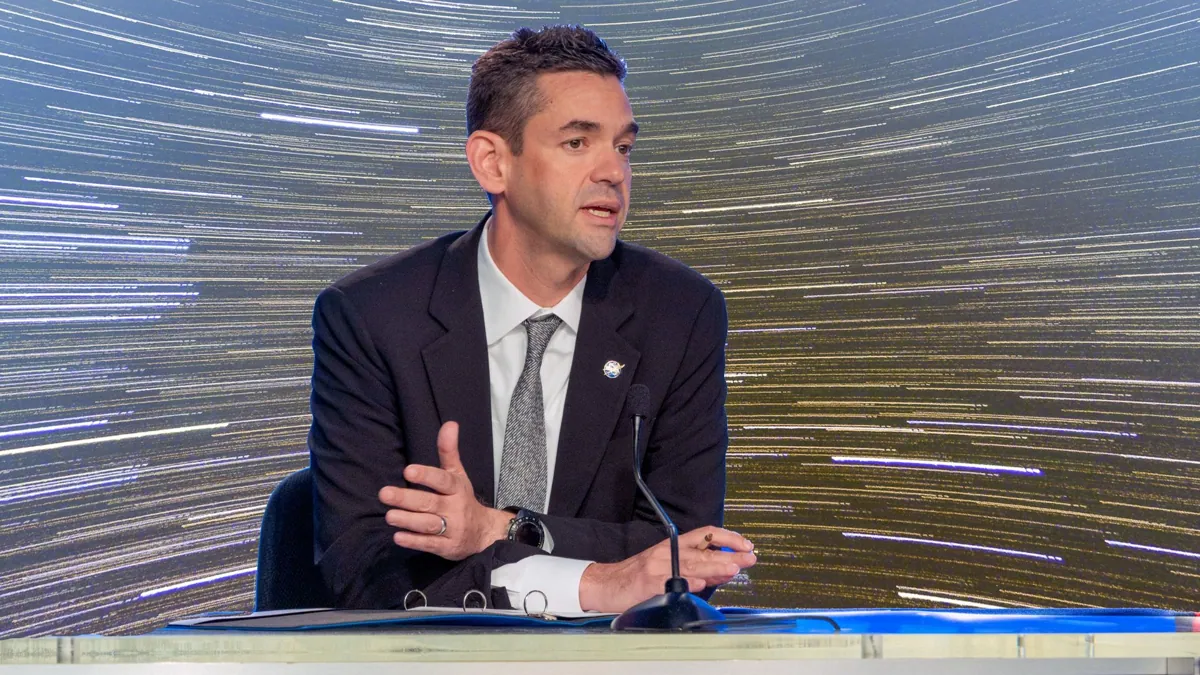
Asked about AI during an October 1 press conference for SpaceX's Crew-13 mission, Isaacman said, "I was honored to have an opportunity to join that luncheon," adding, "I made clear when it was my turn to speak … I am the space guy here," before noting that "potential super intelligence has … [can] change the course of civilizations." Isaacman's own background is in payments and private spaceflight — he founded Shift4 Payments and chartered two SpaceX missions, Inspiration4 and Polaris Dawn — rather than AI development.
Scientists worry the words don't mean the same thing
Inside the agency, the rebrand is generating friction. NASA staff have been told not to use shorthand that acknowledges the change happened at all, and related terms are shifting too — "generative AI" becomes "generative SI," and messaging is being steered away from the word "automation" toward language about how the technology "amplifies human ingenuity and unlocks new forms of creativity," echoing phrasing from Trump's order.
The trouble, according to NASA employees who spoke to Space.com, is that "super intelligence" has historically meant something different from "artificial intelligence" — a far more advanced, largely hypothetical capability that exceeds human cognition, not the machine-learning and automation tools NASA already uses. "There's concern that there's going to be a lot of confusion in the scientific community and in the general population," one employee said.
In a recording of an internal NASA communications meeting obtained by Space.com, staff raised the same concern directly to management. "We're not even supposed to use AI as a term ... it's being talked about like Voldemort or Macbeth, with people calling it 'the technology that must not be named,'" one employee said. Another added: "Super intelligence and artificial intelligence — they have two different meanings. They both are already separate things. As a science communicator … I feel like it's our responsibility to raise our hand and say, 'Hey, this is going to confuse people. This doesn't make sense.'"
To its credit, NASA appears to have left a channel open for that feedback. A meeting leader pointed staff to an anonymous internal feedback tool called "the idea box," telling them that using it to flag concerns to leadership "will not hurt." That kind of openness wasn't necessarily the norm during NASA's leadership transition earlier in Trump's second term, when the agency was run on an interim basis first by Janet Petro and then by Transportation Secretary Sean Duffy, before Isaacman's confirmation.
Some technical terms are exempt from the swap. Precise language like "machine learning," "large language models," "chatbot," and "foundation models" remains acceptable under NASA's guidance, since it's considered necessary for communicating accurately with scientific audiences. But separate rules for scientific publications and official research documents are still being written, leaving open questions about how NASA researchers will align the new terminology with universities, international space agencies, and other institutions that have no obligation to follow Trump's order.
The technology isn't changing — just the label
NASA has been expanding its use of AI for years, independent of the naming debate. Perseverance, the Mars rover, used machine learning in December 2025 to plan and execute its first autonomous drive along a route mapped out with generative AI. NASA's page documenting that milestone is now titled "Mapping Perseverance's Route With SI," though its URL still contains "AI" — for now. That link is expected to eventually redirect to a new SI-branded address, part of a broader pattern in which older web pages, videos, and podcasts get updated titles and metadata while original recordings and transcripts stay untouched.
NASA has also leaned on AI for data-heavy science. Surya, a foundation model the agency built with IBM, was trained on nine years of heliophysics data to improve space weather forecasting, and a newer NASA-IBM lunar project introduced last month uses similar tools to hunt for water ice on the moon's surface. AI is also central to how NASA plans to process the flood of data expected once the Roman Space Telescope is fully operational.
None of that technology is changing. What's changing is what NASA is allowed to call it — and, for now, whether the agency's own employees are even permitted to explain to the public why the words shifted in the first place.


