Some "Private" Claude Conversations and AI-Built Apps Turned Up on Google Search
Users who thought they were sharing with a link, not the entire internet, found their chats and AI-generated work indexed by search engines over the weekend.
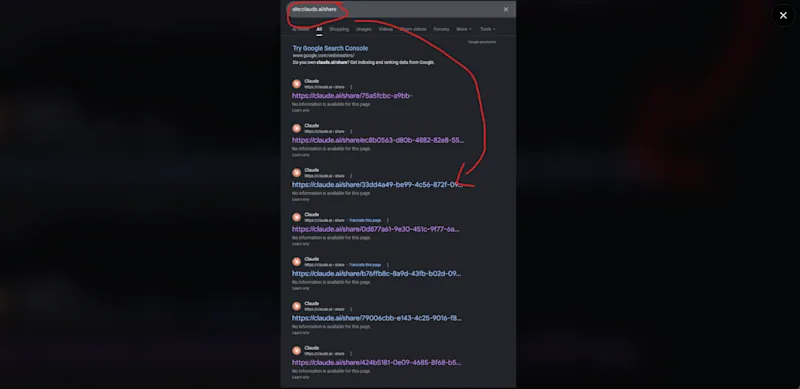
A Reddit post over the weekend set off a scramble inside Anthropic after a user discovered that conversations people had marked "shareable" on Claude were showing up in Google Search results — accessible to anyone, not just the person holding the link.
The user, posting under the handle -void1 on r/ClaudeAI on July 25, showed that a simple Google search using the query site:claude.ai/share pulled up a long list of Claude conversations that had never been meant for public browsing. The post exploded across Reddit and X, racking up thousands of upvotes and a wave of concerned replies. Commenters quickly found more than just casual chatbot exchanges: according to VentureBeat's reporting, people located shared Claude conversations touching on cryptocurrency wallet setup, legal questions, personal résumés and what appeared to be internal business discussions.
By Sunday morning, many of those original search results had vanished or become much harder to surface, a change that suggests Google, Anthropic, or the users themselves had started pulling content down. VentureBeat was not able to independently access any of the shared conversations in question.
Artifacts, not just chats, were exposed too
The more consequential discovery came a day later. On July 26, Om Patel, founder of the research firm BigIdeasDB, posted on X alleging that a related search query, site:claude.ai/public/artifacts, was surfacing Claude Artifacts — the interactive apps, dashboards, documents and other AI-generated work products Claude can build alongside a conversation. Screenshots circulating online appeared to show search results pointing to internal-looking proposal documents and other business materials.
VentureBeat independently confirmed this part of the story. Using that same search query, VentureBeat found multiple third-party Claude Artifacts appearing in Google results and accessible without any login, even though the specific URLs had never been shared with the outlet directly. VentureBeat has not verified how widespread the exposure was or whether the examples circulating on social media represent the full scope of the issue.
That distinction matters more than it might seem. A leaked chat transcript is one thing. Artifacts, by design, can be full working software, from engineering dashboards to planning documents to customer-facing prototypes. If those are being indexed the same way ordinary chat pages are, the blast radius of "shared by accident" gets a lot bigger.
Anthropic's response
Asked about the situation, an Anthropic spokesperson gave VentureBeat this statement:
"We give people control over sharing their Claude conversations publicly, and in keeping with our privacy principles, we do not share chat directories or sitemaps with search engines like Google. These shareable links are not guessable or discoverable unless people choose to share them themselves. When someone shares a conversation, they are making that content publicly accessible, and like other public web content, it may be archived by third-party services."
In plain terms, Anthropic's position is that nothing was hacked or leaked. The company says its share links use long, randomly generated URLs that can't be guessed, and that it doesn't hand search engines a directory of them. Several Reddit commenters backed up that technical point, noting that the URLs themselves are effectively unguessable. The open question, which Anthropic's statement doesn't fully resolve, is how Google found enough of these pages to index so many of them in the first place. Search engines generally find pages like this by following links posted somewhere public — a forum, a social post, another website — rather than by brute-forcing random URLs, and it's not clear exactly where that chain started here.
It's also worth being precise about what this is and isn't. Nobody broke into private Claude accounts. Every conversation and Artifact in question was explicitly set to "shareable" by a user, through a process that requires clicking through Claude's sharing settings and multiple warning dialogs. In that sense, it's structurally similar to generating a shareable Google Doc link. The real dispute is about expectations: whether users who chose "shareable" assumed that meant something closer to an unlisted YouTube video, visible only to someone with the exact link, versus a public webpage that any search engine is free to crawl and index. Once a page is accessible without a login, it's generally fair game for indexing unless the publisher actively blocks crawlers — a technical reality many users don't think about when they click "share."
Artifacts are a bigger bet than they look
The timing makes this more than a one-off embarrassment. Artifacts launched alongside Claude 3.5 Sonnet in June 2024, turning Claude from a conversational chatbot into something closer to a workspace that could spit out interactive web apps, dashboards, visualizations, documents and games in real time. VentureBeat described that launch at the time as a potential opening shot in an "interface war" among AI companies, shifting the competition from raw model quality to who builds the better collaborative workspace.
Anthropic has leaned into that bet since. Artifacts rolled out to all Claude users, and the company has said tens of millions have been created. This year, Anthropic extended the concept into Claude Code, letting engineering teams publish live HTML dashboards and interactive project workspaces straight out of coding sessions. That makes Artifacts a meaningful piece of Anthropic's enterprise pitch, not just a novelty feature for individual chatbot users. A sharing mishap involving ordinary conversations is a privacy embarrassment. A sharing mishap involving dashboards and prototypes that businesses are building their workflows around is a different category of problem.
This has happened before
Anthropic is not the first AI company to run into this exact wall. Reddit users pointed out that OpenAI faced a similar backlash after publicly shared ChatGPT conversations turned out to be discoverable through Google, raising the same question of whether a "share by link" feature should behave like an indexed webpage or an unlisted document.
Before that, Google's own Bard chatbot had a nearly identical episode in September 2023. SEO consultant Gagan Ghotra discovered that Google Search had started indexing shared Bard conversation links, and warned that users likely assumed they were sharing only with the people they intended, not the open web. Google later acknowledged the indexing wasn't intentional, said it was working to block those pages from search, and clarified that only conversations users had explicitly chosen to share were affected.
Three different companies, three versions of the same problem. The pattern suggests this isn't a one-time bug so much as a recurring mismatch between how AI companies build sharing features and how users interpret them.
What enterprises should be doing right now
For companies rolling out generative AI tools across their workforce, the gap between "accessible by link" and "discoverable by search" isn't a minor technicality. It can be the difference between an internal financial model or product roadmap staying private and it turning up in a stranger's search results.
Security-minded teams should start by auditing whatever shared Claude conversations and Artifacts already exist in their organization, deciding what should stay public and what needs to come down. Just as important is making sure employees actually understand what "share" means on each platform they use, since many people reasonably assume a link-only share is the same as something truly unlisted. Treating AI platforms with the same governance rigor applied to Google Docs, Slack, GitHub or SharePoint — including rules around sharing sensitive IP, customer data and regulated information — is a sensible baseline. For anything genuinely sensitive, keeping work inside authenticated enterprise accounts with identity-based access controls is safer than relying on public link-sharing at all. And because vendors change default settings and indexing behavior as they ship new features, it's worth periodically rechecking those defaults rather than assuming they've stayed the same.
Whether this turns out to be a narrow indexing quirk or a deeper mismatch between how Anthropic built the feature and how people actually use it, the episode is a reminder that AI tools have quietly become places where real business work happens. As more of that work, dashboards, prototypes, planning docs, lives inside chat platforms rather than traditional file systems, the fine print on a "share" button starts to matter a lot more than it used to.


