Trump Threatens New EU Tariffs Over Google Fine, Vows to Reverse Big Tech Penalties
The president says a Section 301 probe will target the bloc after Brussels hit Google with an 890 million euro fine under its Digital Markets Act.
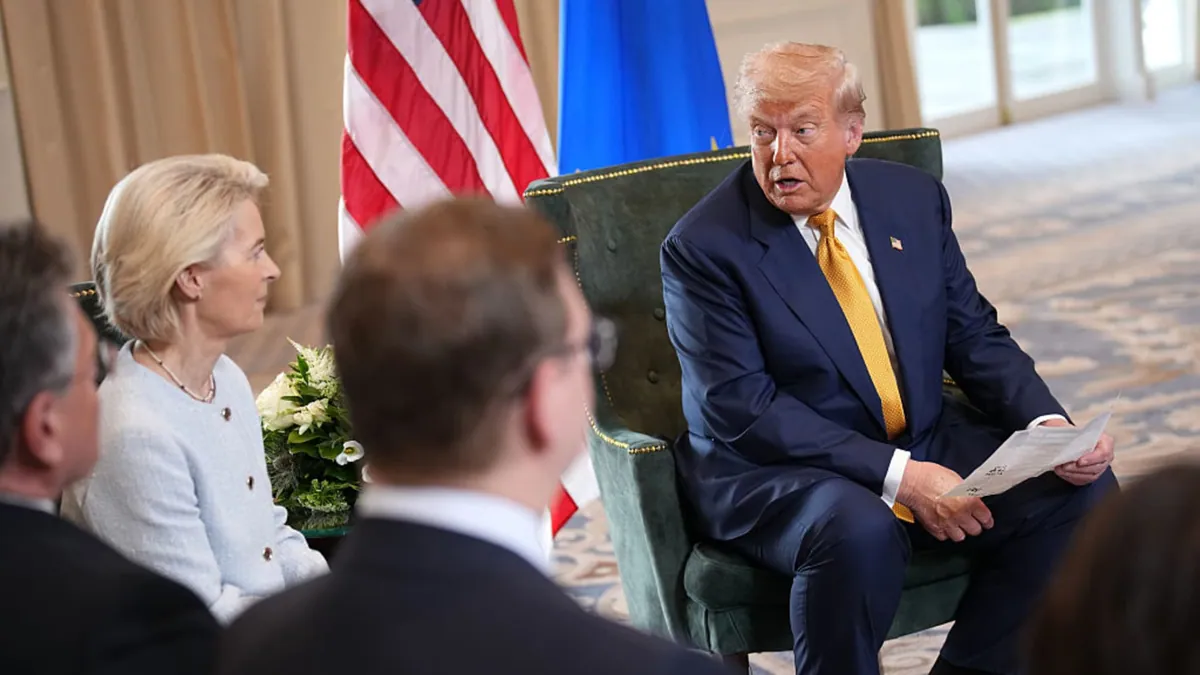
President Donald Trump said Friday his administration will open a new trade investigation into the European Union, one he expects will both unwind fines against American tech companies and clear the way for fresh tariffs on the 27-nation bloc.
The trigger was a roughly $1 billion fine the European Commission imposed on Google. In a lengthy Truth Social post, Trump accused the EU of "'ROBBING' American Companies and, in turn, the American Taxpayer," and said the bloc was "taking direct aim at GREAT American Companies!" He also brought up past EU penalties against Apple, Meta and Amazon, framing the Google fine as the latest entry in a pattern rather than an isolated case.
Trump described the penalty as having been issued "without explanation." That's not how the European Commission characterizes it. The EU's executive branch said in a press release that the fines, which total 890 million euros, stem from Google's alleged failure to comply with the Digital Markets Act, the EU law designed to rein in how dominant tech platforms operate. Regulators have used that law to scrutinize practices like whether Google's search results favor its own services over competitors', which is the specific allegation behind this fine.
Trump's response was to declare that the EU's approach "is not going to continue during the Trump Administration," adding a warning that stuck to his familiar shorthand for the trade relationship: "The United States of America is not a 'PIGGYBANK' for Europe, nor will we allow it to be!"
The mechanism: Section 301
To act on that, Trump said the U.S. will "immediately" launch an investigation under Section 301 of the Trade Act of 1974. That's the same statute that lets Washington impose tariffs when it determines a trading partner's practices are unfairly burdening U.S. commerce, and it's a tool the Trump administration has already leaned on repeatedly for other trade actions.
The timing adds context. Just hours before Trump's post, his administration had already imposed new tariffs of between 10% and 12.5% on goods from more than 80 countries, including EU member states, over allegations tied to forced labor. The Google fine, in other words, landed in the middle of an active and expanding tariff push rather than in isolation.
Trump framed the stakes bluntly. "The European Union will pay a very big price for this illegal and highly unethical conduct, which I have consistently warned them about," he wrote. He said the fines against Google should be "entirely reversed" and predicted "a substantial TARIFF to be placed on them at the earliest possible moment," closing the post with "Stay tuned!"
Why this keeps happening
The friction here isn't new, and that's the point. The EU's Digital Markets Act was written specifically to give regulators a fast, structured way to police the largest tech platforms, most of which happen to be American. Brussels has used it, along with antitrust law more broadly, to fine Google, Apple, Meta and Amazon at various points, arguing those companies wield outsized power over how European consumers and businesses access digital markets. From Washington's side, particularly under Trump, those fines look less like consumer protection and more like a revenue stream extracted from U.S. companies, and by extension, in Trump's telling, from American taxpayers.
A Section 301 investigation gives the administration a formal legal basis to respond, but it's also a process with real teeth: it's the same authority that has produced significant tariff actions in other disputes. Announcing the probe alongside a promise to reverse the EU's fines and land a "substantial" tariff signals the administration intends to treat this as leverage, not just a complaint.
What happens next depends on how the investigation proceeds and whether the EU adjusts course, softens enforcement, or holds firm on the Digital Markets Act as written. The report notes this is a developing story, and Trump's post left the size and timing of any tariff unspecified beyond the word "substantial." For now, the fine stands, the DMA stands, and the U.S. has put the EU on notice that a new front in the tariff fight is opening specifically over how Brussels treats American tech companies.


