New Jersey's Robotaxi Bill Would Require Lidar and Radar, Freezing Out Tesla
A first-of-its-kind hardware mandate pits Elon Musk's camera-only bet against the rest of the autonomous vehicle industry.
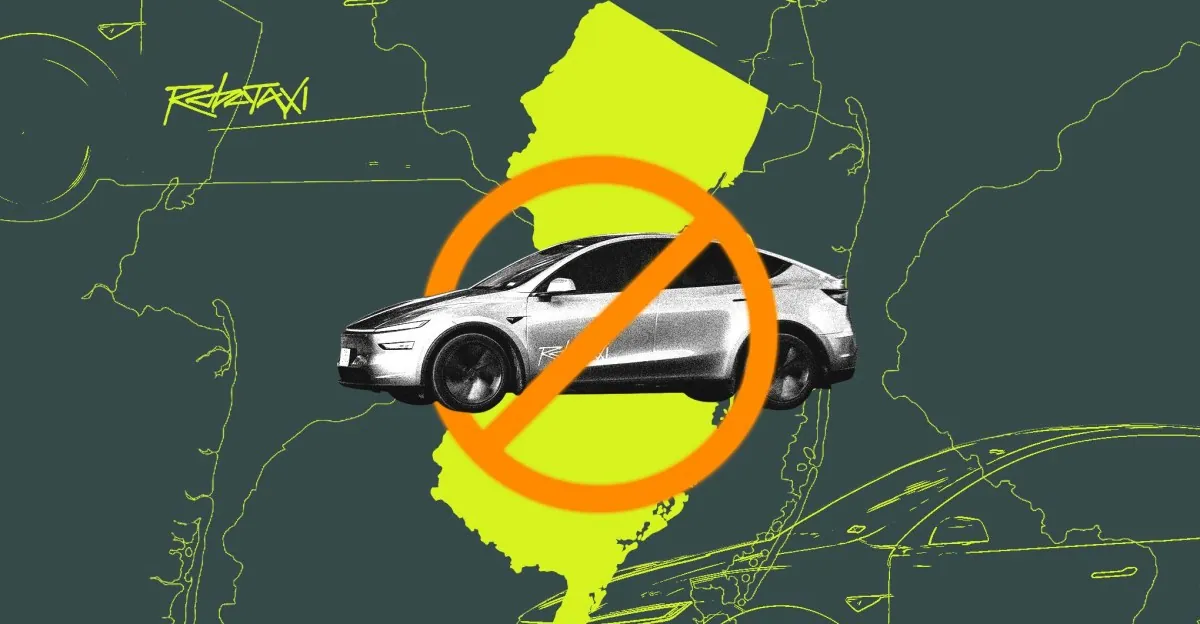
New Jersey lawmakers are moving to answer a question the autonomous vehicle industry has argued over for years: can cameras and AI alone safely drive a car with nobody behind the wheel? A bill expected to reach a vote later this year says no — and in doing so, it would effectively shut Tesla's camera-only Robotaxi system out of the state unless the company overhauls its hardware.
The legislation would require any company operating fully autonomous vehicles in New Jersey to use cameras plus two additional sensing technologies, typically lidar and radar. If it passes, New Jersey would become the first state to write that kind of hardware requirement into law, edging out a nearly identical bill still pending in New York. It's a notably different approach from how other states have handled the technology. Most regulation to date has focused on safety reporting, oversight, and job impacts — not on dictating what's actually bolted onto the car.
That distinction matters enormously for Tesla, whose entire robotaxi strategy rests on the bet that cameras paired with sufficiently advanced AI can replace human drivers without lidar or radar. Nearly every other major player in the space — Waymo, Zoox, and others — has built vehicles that stack multiple sensor types on top of each other, treating redundancy as a safety feature rather than an unnecessary expense.
The case for and against cameras alone
Democratic state Sen. Andrew Zwicker, the bill's primary sponsor, insists the legislation isn't targeted at any single company. "This is not anti-Tesla," he told The Verge. "I'm pro-New Jersey safety."
Zwicker, who also works as a physicist at the Princeton Plasma Physics Laboratory, says his views shifted after riding in a Waymo robotaxi in Phoenix. "I was amazed how quickly you get used to it," he said. He believes autonomous vehicles could eventually cut traffic deaths and expand mobility significantly. But he wants that rollout to happen carefully in the country's most densely populated state. "At this point, I don't think the evidence is sufficient that a single sensor with software can handle situations that humans can," he said. "Can we get there? Maybe. But we're not there yet."
Elon Musk has argued the opposite for years: that since humans drive using vision alone, sufficiently capable AI should be able to do the same with cameras. He's also claimed that adding sensors can actually make cars less safe, because the software then has to referee disagreements between conflicting data sources. "Lidar and radar reduce safety due to sensor contention," he wrote on X last year. "We turned off the radars in Teslas to increase safety. Cameras ftw."
The rest of the industry isn't buying it. Cameras are good at reading traffic signs, lane markings, and colors, but they struggle in bad weather, darkness, and glare. Radar handles rain and fog well and is strong at judging distance and speed. Lidar builds detailed 3D maps of a car's surroundings and excels at pinning down the shape and position of nearby objects. Companies like Waymo and Zoox layer all three together on the theory that each covers the others' blind spots.
Philip Koopman, a Carnegie Mellon engineering professor and autonomous vehicle safety expert, put it bluntly: "eyeballs are better than cameras for many reasons," and human brains, unlike current AI, actually understand what they're seeing. He thinks camera-only systems can work fine in easy conditions — clear weather, good lighting, simpler roads — but aren't ready for full-scale, round-the-clock use. "To run 24/7 across the majority of public roads in New Jersey today, it needs lidar," he said. "It's pretty clear that today camera-only technology is not up to the challenge."
What the bill would actually require
Beyond the sensor mandate, the proposal sets up a three-year pilot program for testing and deploying fully autonomous vehicles in New Jersey. Companies would need state authorization before launching a driverless commercial service, would have to report certain crashes, and would be required to log at least 50,000 miles of supervised testing in the state without a major incident before pulling the human safety driver out of the car.
Koopman, who supports the bill, thinks it could go further. He'd like to see requirements for conventional controls like steering wheels and pedals, so first responders can move a disabled vehicle — a rule that would rule out Tesla's Cybercab, which has neither. He also floated limits on how many autonomous vehicles could be on the road during the pilot period, something Zwicker said he's weighing.
Scale, Koopman argues, is where camera-only systems get tested for real. "The difference between 100 cars and 10,000 cars is night and day," he said. With only a small fleet running, rare edge cases simply don't come up often enough to expose weaknesses. He pointed to Waymo, now running more than 3,500 commercial robotaxis across 11 US metro areas, as a company that has had to adapt to unusual situations, from floodwaters to school buses, precisely because it operates at scale. Tesla, by contrast, currently has only a small number of unsupervised Robotaxis running, mostly in Texas, according to Robotaxi Tracker data — a far cry from Musk's prediction last year that Tesla would have hundreds of thousands of fully self-driving cars on the road by the end of 2026.
Lobbying, backlash, and a fight over the message
Much of the bill's language tracks recommendations from SAVE-US, a nonprofit pushing for tighter AV regulation. The group's national campaign director, Shua Sanchez, said it formed in response to Congress's failure to set national rules, leaving a patchwork of state approaches — from California's stricter oversight to what he described as Texas, Arizona, and Georgia's near-absence of regulation. "We don't have a problem with Tesla as a company," Sanchez said. "We have a problem with camera-only autonomous vehicles."
The bill has already been shaped by pressure from industry players. Waymo successfully lobbied to strip out a requirement that safety drivers stay in vehicles for the entire pilot. Uber pushed for the state to keep requiring human drivers for most rides. And according to Zwicker, Tesla has lobbied directly against the bill, with representatives arguing to lawmakers that AI has advanced enough to make extra sensors unnecessary. Zwicker isn't convinced. "I'm not convinced yet that they're ready to go," he said.
Tesla has also taken the fight public, sending a message to New Jersey owners urging them to contact lawmakers. "As written, the legislation imposes restrictions so severely that Tesla's autonomous vehicle technology couldn't legally operate in New Jersey," the message read, calling the bill a targeted ban on Tesla in the state. The campaign generated roughly 4,000 emails to Zwicker's office within a single day. "The messaging wasn't about the details of the bill," he said. "It was that Zwicker is trying to take away your Autopilot."
Zwicker pushes back on that framing. The bill only applies to fully autonomous vehicles operating under the new state pilot program, not to driver-assistance systems like Autopilot, which still require a licensed human behind the wheel.
A patchwork with no federal referee
The standoff in New Jersey underscores a larger problem: Congress has spent years debating national autonomous vehicle rules without passing anything, leaving states to improvise. Robotaxis already run commercially in California, Texas, Arizona, and Georgia under wildly different regulatory regimes. California demands extensive testing permits and public reporting but stays silent on hardware. Texas takes a lighter touch, letting companies self-certify their own readiness.
New Jersey's bill would mean AV technology there could look different from what's allowed elsewhere in the country — a tradeoff Zwicker says he's willing to accept. "The technology doesn't exist in the Northeast at all," he said. "The goal is to start now, do it safely, and build public trust."
Sanchez frames the sensor mandate not as a roadblock to innovation but as a baseline safety check. "There are absolutely brilliant people working at Tesla trying to make camera-only autonomy work," he said. "But they're trying to do it with one arm tied behind their back."
Whether New Jersey's bill passes as written, gets watered down, or stalls entirely, it's set a precedent other states are already watching — and it's forced a normally abstract engineering debate about sensors into the realm of statute, where it now has real consequences for who gets to put a driverless car on the road.


