SK Hynix's $26.5 Billion Wall Street Debut Is the Biggest Ever for a Foreign Company
The South Korean memory chipmaker's Nasdaq listing shattered records even as U.S. officials push it to build factories on American soil instead.
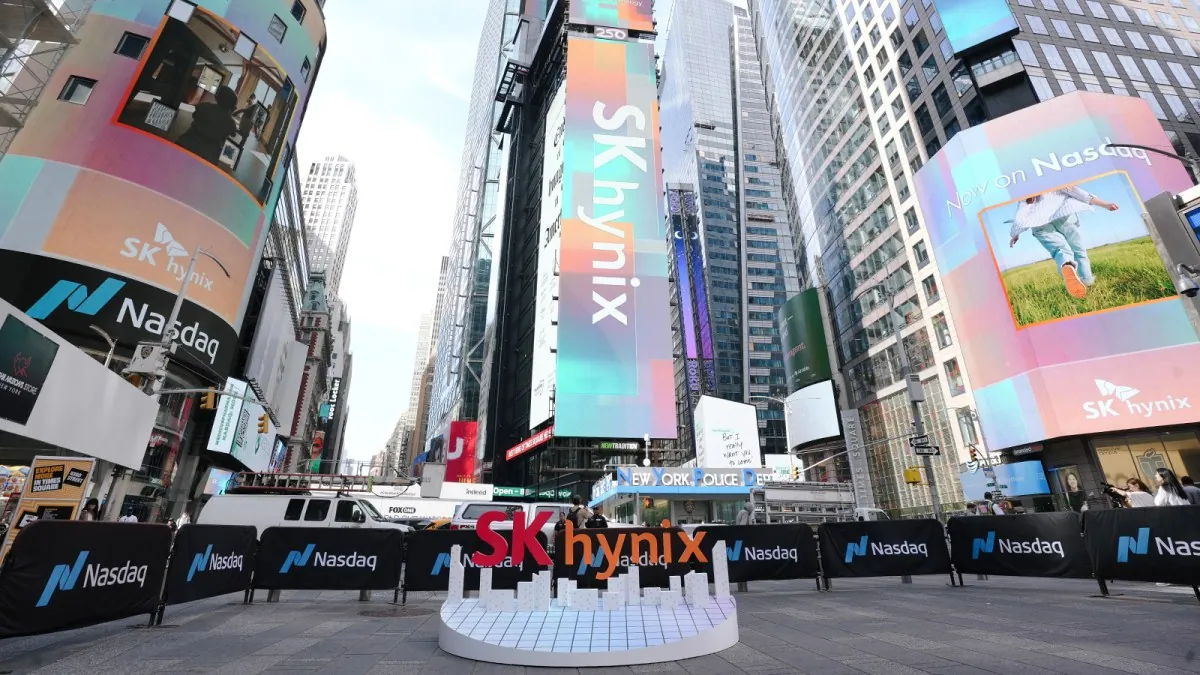
SK Hynix just pulled off the largest U.S. stock market debut ever by a foreign company, raising $26.5 billion (40 trillion Korean won) in an offering that investors could not get enough of.
The South Korean memory chip giant sold 177.9 million American depositary shares at $149 apiece, priced so U.S. buyers could get in at roughly a tenth of what the stock costs on its home exchange in Seoul. The deal eclipses Alibaba's $25 billion IPO from 2014, which had held the record for more than a decade.
SK Hynix began trading Friday, July 10, under the temporary ticker SKHYV, with the stock opening 14% above its IPO price and continuing to climb in early trading. Regular trading kicks off Monday, July 13, when the ticker switches to its permanent form, SKHY.
What makes the demand notable is that SK Hynix priced its U.S. shares at a 2.7% premium to its own three-day average back in Seoul, according to a filing with the Korea Stock Exchange. Despite that premium, orders for the offering reportedly ran more than seven times the number of shares actually available.
That kind of appetite cuts against a longstanding pattern. Korean companies typically trade at what's known as the Korea Discount, a valuation gap tied to concerns about complicated corporate governance, weak shareholder returns, regulatory unpredictability, and geopolitical risk stemming from tensions with North Korea. Investors have used that discount for years to justify paying less for Korean stocks than they would for comparable companies elsewhere.
SK Hynix appears to be an exception, and the reason comes down to one product line: high-bandwidth memory, or HBM. HBM chips sit at the center of the AI boom because they're a critical component in the GPUs that power AI data centers, and SK Hynix is one of Nvidia's primary suppliers of the technology. With AI infrastructure spending still climbing, investors are treating SK Hynix less like a typical Korean industrial stock and more like a direct play on the AI buildout.
Where the money is going
Per its filing, SK Hynix plans to funnel the IPO proceeds into three things: a new fab under construction in South Korea meant to help ease a global memory shortage caused by AI demand, a new chip packaging facility, and EUV scanners, the extreme ultraviolet lithography machines required to manufacture the most advanced chips. Notably, all three investments are happening in South Korea, not the U.S.
That detail lands at an awkward moment. On Thursday, the day before the IPO, U.S. Commerce Secretary Howard Lutnick appeared at a Micron event with a pointed message aimed at the wider chip industry. According to reporting, Lutnick said he's already in discussions with both Samsung and SK Hynix, South Korea's two other major memory players, about building new factories in the United States. The underlying goal is to loosen South Korea's grip on global memory chip production.
Micron, the lone major U.S.-based memory maker and a direct SK Hynix rival, has already answered that call. The company announced plans to invest $250 billion in new domestic manufacturing, a commitment it says will create more than 90,000 jobs and keep cutting-edge chip production based in the U.S.
A tug-of-war over where chips get made
The timing here is hard to ignore. Just as Washington is leaning on Korean chipmakers to bring factories stateside, both SK Hynix and Samsung have pledged more than $550 billion combined toward new manufacturing investment inside South Korea itself. In other words, the two companies the U.S. wants building fabs domestically just made a massive bet on building at home instead.
SK Hynix's Wall Street windfall doesn't resolve that tension so much as raise the stakes on it. The company now has fresh billions from American investors to expand its memory business, but its stated plans keep that expansion firmly on Korean soil. Whether Lutnick's overtures to SK Hynix and Samsung eventually produce new U.S. fab commitments, similar to Micron's, will be the next thing to watch as the AI chip shortage keeps squeezing supply and governments on both sides push to control where the chips actually get made.


