Nadella's Warning to Corporate America: Don't Let AI Labs Do Your Thinking For You
Microsoft's CEO says businesses that lean entirely on OpenAI, Anthropic, or any single model provider are gambling with their own survival — and his own company happens to sell the fix.
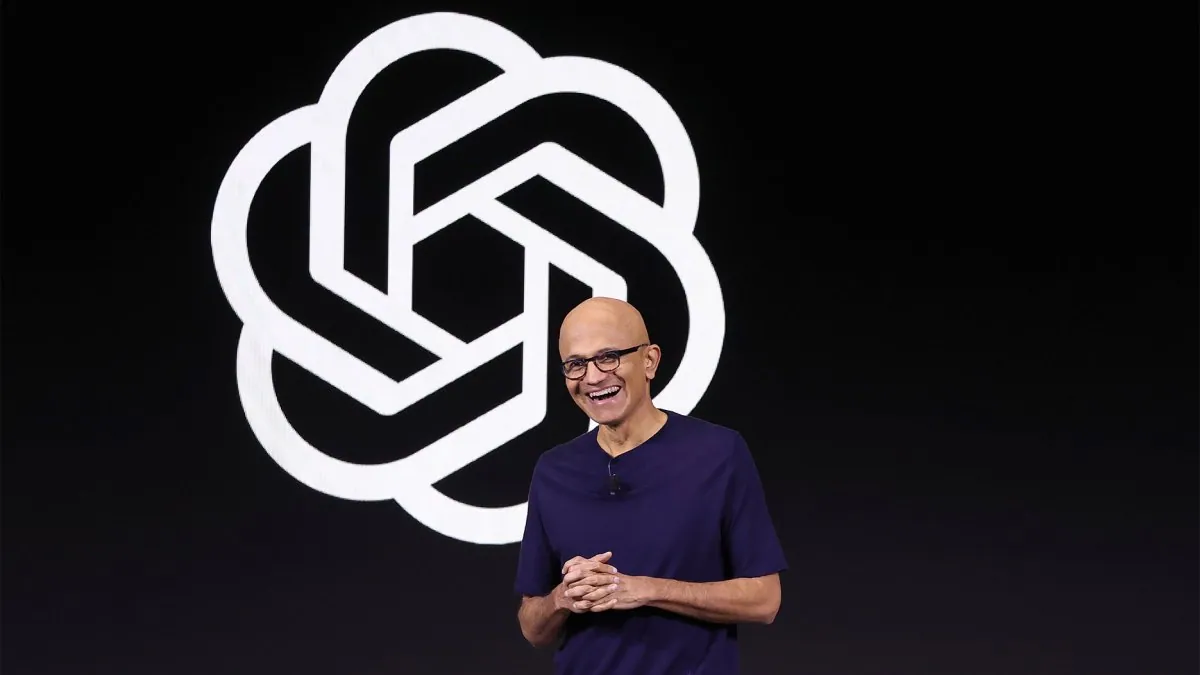
Satya Nadella has a message for corporate boardrooms, and he's repeating it with more urgency than before: hand too much control to an AI lab, and you might not have a company left to run.
The Microsoft CEO made the case Sunday on CNN's "Fareed Zakaria GPS," building on a warning he first raised earlier this month. His argument, in plain terms: businesses that route their entire operation through one AI provider's models, without keeping their own data, prompts, and tools separate, are outsourcing something they can't easily take back.
When Zakaria pressed him on what "oversharing" with an AI model actually looks like, Nadella pointed to everything a company feeds into these systems — its data, its prompts, the accumulated record of how it uses AI day to day. His fix: companies should hold onto the metadata generated every time they use a model, so they can eventually use it to train their own systems.
"Every time you use the model, all of the metadata around it is retained by you, so that you could use all of that to train perhaps your own weights or your own open, own model," Nadella said. Weights, for anyone unfamiliar with the term, are the trained parameters that make a model function — essentially its learned intelligence. Nadella's point is that companies need the raw material to eventually build that intelligence themselves, rather than permanently renting someone else's.
He didn't soften the stakes. "Any firm that doesn't have this control, I will claim will not remain a firm because you've essentially outsourced your thinking," he said.
The harness problem
Nadella zeroed in on a specific piece of the AI stack: coding harnesses, the tools that wrap around a model and let it actually write and execute code. Anthropic's Claude Code and OpenAI's ChatGPT Codex are the leading examples, and they've become one of the most popular ways enterprises put AI to work. They're also, by most accounts, a serious moneymaker for the labs that build them.
Nadella's advice runs directly counter to that popularity. He wants companies to keep the harness, along with a model's context and memory, separated from the underlying model itself, using a layer of infrastructure known as an AI gateway. Do that, he argues, and a company can mix and match models based on which one performs best for a given job, without becoming hostage to any single provider.
"By keeping the harness separate from the model and the context and memory separate from the model, you absolutely can use multiple models for what they're great at," Nadella said. "At the same time, any one model can go away, and you can still continue to be in control of your own destiny."
The obvious conflict of interest
There's a wrinkle worth sitting with here: Microsoft is one of the largest investors in both Anthropic and OpenAI, the very labs whose coding tools Nadella is telling enterprises to keep at arm's length. And Microsoft's own cloud business is increasingly in the business of selling exactly the kind of gateway infrastructure and model-agnostic tooling he's recommending. Nadella benefits either way, whether enterprises keep spending with OpenAI and Anthropic through Azure or shift toward the flexible, multi-model setups Microsoft is positioning itself to support.
That self-interest doesn't necessarily make him wrong. Enterprises really are diversifying away from single-vendor AI setups, drawn to cheaper options and to open-weight models, whose underlying code is publicly available and can be fine-tuned and run on a company's own hardware. That shift naturally creates demand for the exact management layer, and harness-agnostic coding agents, Nadella is describing.
The deeper fear: getting copied
But Nadella's warning goes beyond cost control. His underlying worry is that once a company has handed its "thinking" over to a model provider, nothing stops that provider from eventually launching a competing product built on what it learned from watching the company operate. That risk only grows as enterprises deploy AI agents with deep access to internal systems and data.
It's a fear that's been circulating in startup circles for a while now. In May, when OpenAI CEO Sam Altman offered to invest in every startup in Y Combinator's latest batch by handing out AI credits, seed investor Jason Calacanis sounded a similar alarm. "If you take these tokens, there's a non-zero chance that OpenAI will study exactly what your startup is doing, copy your idea and put your app into their free offering," he wrote at the time, calling it "the classic platform playbook."
Nadella is essentially extending that same caution from scrappy startups to enterprises with far more resources and far more to lose.
Consumers, meanwhile, are on their own
Notably, Nadella drew a hard line between businesses and individuals on this issue. When Zakaria asked how ordinary consumers should protect their own data from AI companies, Nadella didn't offer the same defensive playbook. Instead, he framed data-sharing as simply the cost of admission for free services.
"To some degree there's got to be some value exchange in the consumer space where you're getting something for free, maybe for your data. That's sort of how the advertising business model has worked," he said.
The takeaway is that Nadella sees this as a corporate survival issue, not a broader privacy crusade. Whether enterprises heed the warning, and how much of the resulting demand flows toward Microsoft's own infrastructure, is the part worth watching as companies rethink how much control they're willing to give up to their AI providers.


