Nvidia's Next-Gen AI Server Rack Pushed Back a Year, Report Says
A stubborn circuit board problem has reportedly knocked Nvidia's Kyber system off schedule, opening a rare window for rivals AMD and Google at the top of the AI hardware market.
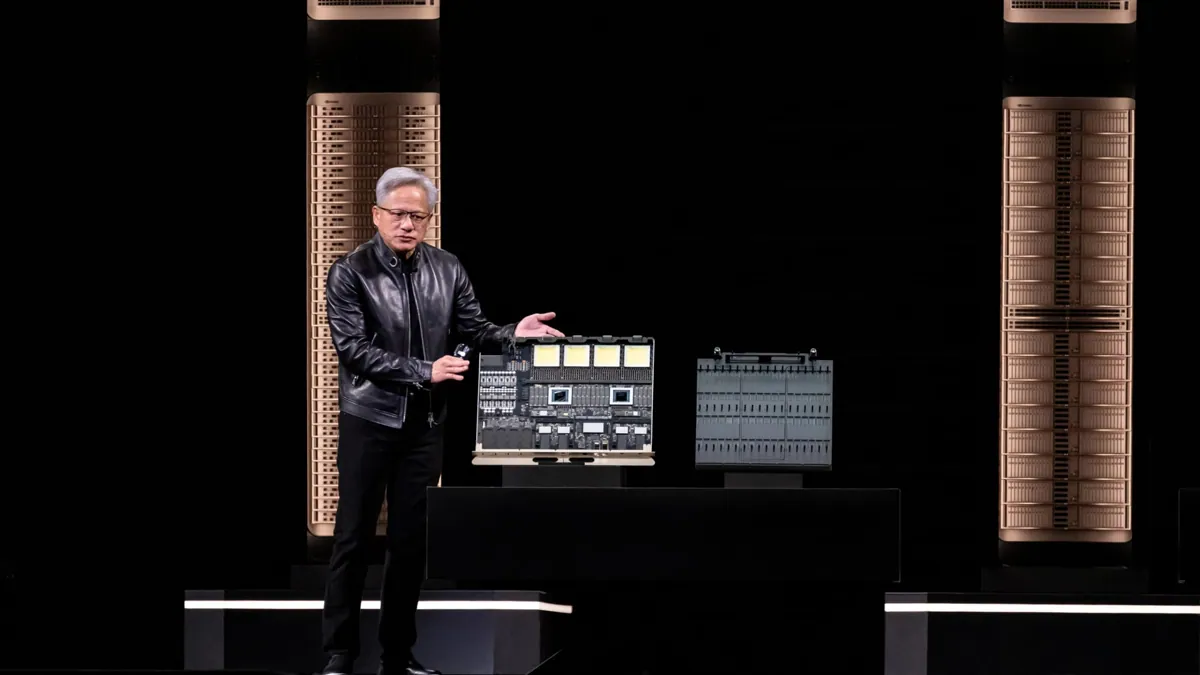
Nvidia's next big leap in AI server design won't arrive on schedule. According to research firm SemiAnalysis, the company's Kyber rack system — built to house its 2027-generation Rubin Ultra chips — has slipped from 2027 to 2028, a delay of more than a year. Nvidia disputes the report, telling reporters simply: "Our roadmap is intact." Investors didn't seem rattled either way; the stock rose about 1% on Monday.
Still, the report adds to a growing pile of evidence that Nvidia's famously aggressive product cadence is running into hard manufacturing limits.
What Kyber actually is
Kyber isn't a chip. It's the cabinet the chips live in. The design crams 144 of Nvidia's most powerful GPUs into a single server rack so they can function as one enormous computer, the kind of combined horsepower AI labs need to train and run frontier models. Unlike current racks, Kyber mounts its compute trays vertically rather than horizontally, a change meant to pack more processors closer together and cut down on latency between them. It was supposed to debut alongside Vera Rubin Ultra, Nvidia's next flagship rack-scale system, in 2027.
The holdup, per SemiAnalysis, comes down to a single component: the PCB midplane, a specialized multi-layer circuit board that connects modules throughout the system. The firm's blunt assessment: "Kyber NVL144 rack architecture has been delayed to 2028 as the PCB midplane remains challenging from a manufacturability standpoint." In other words, Nvidia's engineers designed something that's proving genuinely hard to build at scale.
It's not the only casualty. NVL576, a larger configuration that links eight racks together using optical connections, is also likely to be delayed or shipped only in limited volumes, according to the report.
The backup plan that didn't survive contact with customers
Nvidia reportedly had a stopgap in mind: bolting two of its current-generation racks together to approximate Kyber's power output while the real thing got sorted out. That plan is dead too. SemiAnalysis says cloud providers balked at the idea once they saw it. "It has since been cancelled due to heavy pushback from CSPs [cloud service providers] and hyperscalers over its odd design and heavy operational burden," the firm wrote.
With that fallback scrapped, SemiAnalysis frames the situation starkly: Nvidia currently has "no proven solution to expand the scale-up world size for Rubin Ultra." The firm argues this creates a real opening for competitors, specifically AMD and Google, whose custom in-house chips have already started peeling off business from major AI labs. A gap at the high end of the market, even a temporary one, is the kind of thing rivals wait years for.
Why this might matter less than it sounds
Not everyone reads the delay as a crisis. Paul Triolo, a partner at consultancy DGA-Albright Stonebridge Group, cautioned against overreading the news. "Should not be over analyzed as affecting the long-term criticality of Nvidia to AI data infrastructure buildouts," he said, pointing out that Nvidia "has faced these kinds of challenges before, and has worked with vendors to overcome technical issues."
Triolo also raised a practical point that tends to get lost in chip-roadmap drama: power. Electricity supply, not chip availability, is shaping up to be the real bottleneck for U.S. AI data center growth. If that's true, a slower rollout of ultra-dense systems like Kyber might not cost Nvidia much in practice. "Delays in getting to more advanced systems could just mean that the new systems are ready by the time the U.S. can work to overcome some of the critical bottlenecks on power now dogging the industry," he said.
Meanwhile, Nvidia's current lineup isn't standing still. Its present-generation Rubin systems are already in full production, with shipments to eight cloud partners — including Amazon Web Services, Microsoft Azure and Google Cloud — set to begin this fall. SemiAnalysis actually projects Nvidia's data-center compute revenue will land 20% above Wall Street's consensus estimate for the second half of fiscal 2027, delay or no delay.
The China angle
There's a wrinkle for the global chip race, too. Triolo noted that Huawei and other Chinese manufacturers stand to gain some breathing room from Nvidia's stumble. But he framed China's trajectory as increasingly its own path rather than a race to match Nvidia's architecture. "The issue is no longer really catching up, but how good will China's alternative AI stack be by 2030," he said.
For now, the delay looks less like a crack in Nvidia's dominance and more like a reminder that even the industry's biggest player is bumping against the physical limits of building hardware this dense, this fast. Whether that year-long gap becomes an opening for AMD and Google, or simply a footnote in Nvidia's next earnings call, depends on how quickly the company can solve a circuit board problem that, on paper, sounds almost mundane.


