Nvidia Wants to Sell You the CPU Too
The company that conquered AI chips with GPUs is now pushing into server processors, putting Intel and AMD's stronghold on notice.
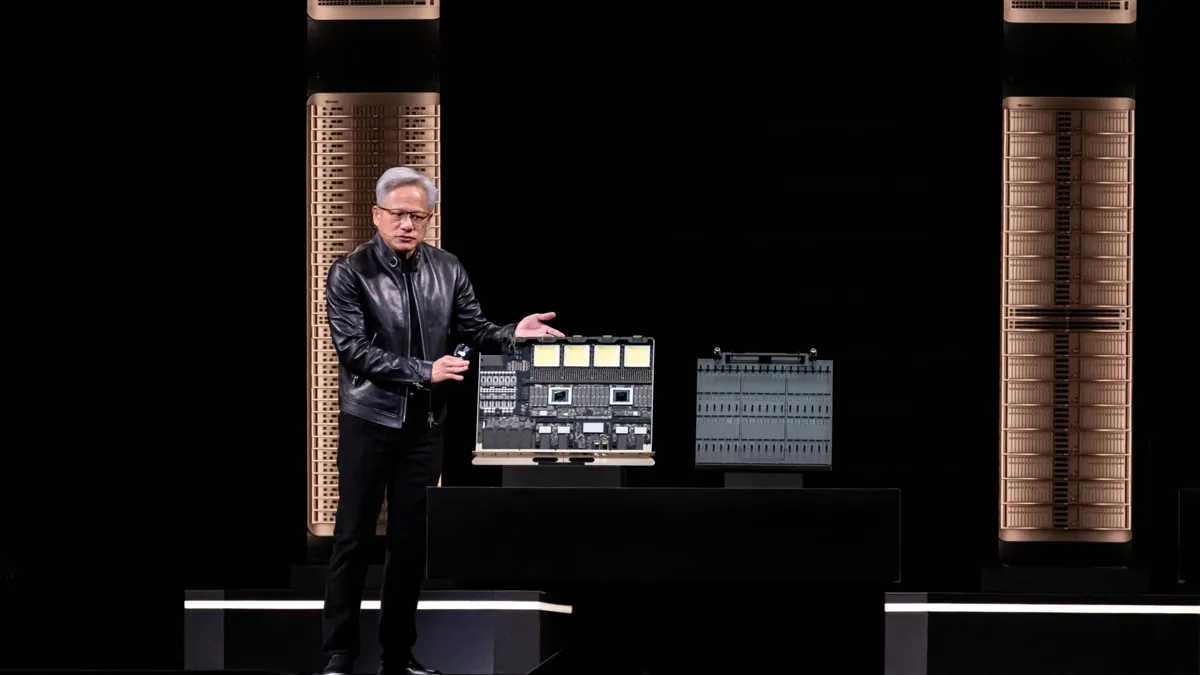
Nvidia spent the last few years becoming the most valuable company on Earth by selling the chip that powers AI: the GPU. Now it wants a piece of the other chip in every server, the CPU, and it just gave the industry its clearest look yet at how it plans to get there.
On Tuesday, Nvidia released detailed specifications and benchmarks for Vera, its data center CPU, the kind of technical information customers need to seriously evaluate a chip before buying it. Nvidia representatives said the first Vera chips already shipped to clients in June, naming OpenAI, Anthropic and SpaceX among the early recipients.
That's notable on its own. Nvidia built its empire on GPUs, the workhorse chips behind training and running AI models. CPUs are a different game, one where Intel and AMD have decades of relationships with cloud providers and hyperscalers. In this market, for once, Nvidia is the newcomer trying to break in.
Why Nvidia wants your CPU business too
The move fits a broader pattern at Nvidia: build more of the system yourself rather than just supplying one component. The company increasingly wants to sell entire racks of computing power, not standalone chips, on the theory that owning more of the stack lets engineers wring extra performance out of the GPUs that remain its real cash cow. As competition intensifies from AMD and from custom chips built by cloud giants themselves, that full-stack approach is meant to keep Nvidia's systems as the default choice for top AI labs.
There's also a shift in the underlying technology driving this. When ChatGPT launched in 2022, early AI servers paired as many as eight GPUs to a single CPU, a ratio that told you everything about where the industry's attention was. But the rise of agentic AI, systems that can operate semi-independently with minimal human oversight, has put the CPU back in the spotlight. Something has to manage those agents and keep feeding them data, and that's a CPU's job.
Wall Street has clearly noticed. AMD and Intel are two of the best-performing chip stocks of 2026, up 128% and 149% respectively, far outpacing Nvidia's 8% gain. Nvidia's own vice president of hyperscale, Ian Buck, acknowledged the shift last week, saying agents have made CPUs "much more integral," particularly when it comes to how fast a CPU can answer a single question.
The dollar figures at stake vary depending on who's counting. Nvidia has floated a $200 billion eventual valuation for the entire server CPU market. Bernstein, in an estimate earlier this year, put the current mature market closer to $37 billion for 2025. Wolfe Research, meanwhile, estimated in May that Nvidia would charge roughly $5,000 per Vera chip and ship about 1.3 million of them this year. Nvidia declined to comment on pricing.
A chip built for speed, not scale
What actually makes Vera different is a design choice. Nvidia says it's the first server CPU the company has engineered from the ground up, rather than licensing an off-the-shelf design from Arm, a shortcut that saves engineering effort but limits customization.
Intel and AMD's cloud CPUs have generally chased core count, packing in as many processing cores as possible. Nvidia went the other direction with Vera's Olympus core, prioritizing how fast each individual core runs. The company claims that focus delivers 50% better performance on AI agent workloads compared with x86 chips, the architecture that underpins both Intel and AMD's lineups.
Hannah Coutand, a Vera product marketer at Nvidia, framed the design goal around keeping GPUs busy. The chip is built for per-core speed, high memory bandwidth and low latency, she said, "so that agents can return to their GPUs as quickly as possible and keep those GPUs, which are a very expensive and a highly valuable asset in the AI factory, as highly utilized as possible."
Nvidia plans to sell Vera multiple ways: as a standalone chip, as a liquid-cooled rack linking 256 Vera chips together, in a dual-chip server configuration, and bundled with Nvidia GPUs in a combined system called Vera Rubin. The chip isn't cheap on power either, drawing between 250 and 450 watts, and it carries an unusually large amount of low-power memory, the same type found in laptops and phones, supporting up to 1.5 terabytes per chip.
Catching up to entrenched rivals
None of this guarantees Nvidia wins over cloud providers. AMD currently holds roughly a third of the server CPU market, and has been gaining ground thanks to strong relationships with hyperscalers, according to Gartner analyst Kevin Knox. Intel holds a commanding 66.8% share. "AMD's done a great job building their ecosystem around their chips," Knox said.
Nvidia's own list of Vera partners is thin so far, featuring Oracle but no other major cloud providers by name, though the company said OpenAI intends to deploy large quantities of Vera chips starting this quarter. Coutand described adoption as being in its "early innings."
Some analysts see Vera carving out a niche rather than displacing incumbents outright. Cambrian AI Research founder Karl Freund said the chip likely won't be used for ordinary server work like hosting websites, but will instead be reserved for demanding AI tasks. He also framed the strategic intent plainly: "The CPU is something they've done to kind of unhook their customers from using Intel or AMD CPUs, and they covet that revenue. What they've done is they decided to focus on a unique CPU that isn't available in the market from anyone right now."
Whether that uniqueness translates into real market share is the question Intel and AMD now have to answer. Nvidia has upended one chip market already. Vera is its opening bid to do it again in a second.


