Artemis II's Moon Launch Punched a 3,100-Mile Hole in the Atmosphere — and GPS Felt It
A new study found the SLS rocket's climb to the moon rattled the ionosphere harder than any launch on record, with enough signal distortion to nudge GPS positioning off by several meters.
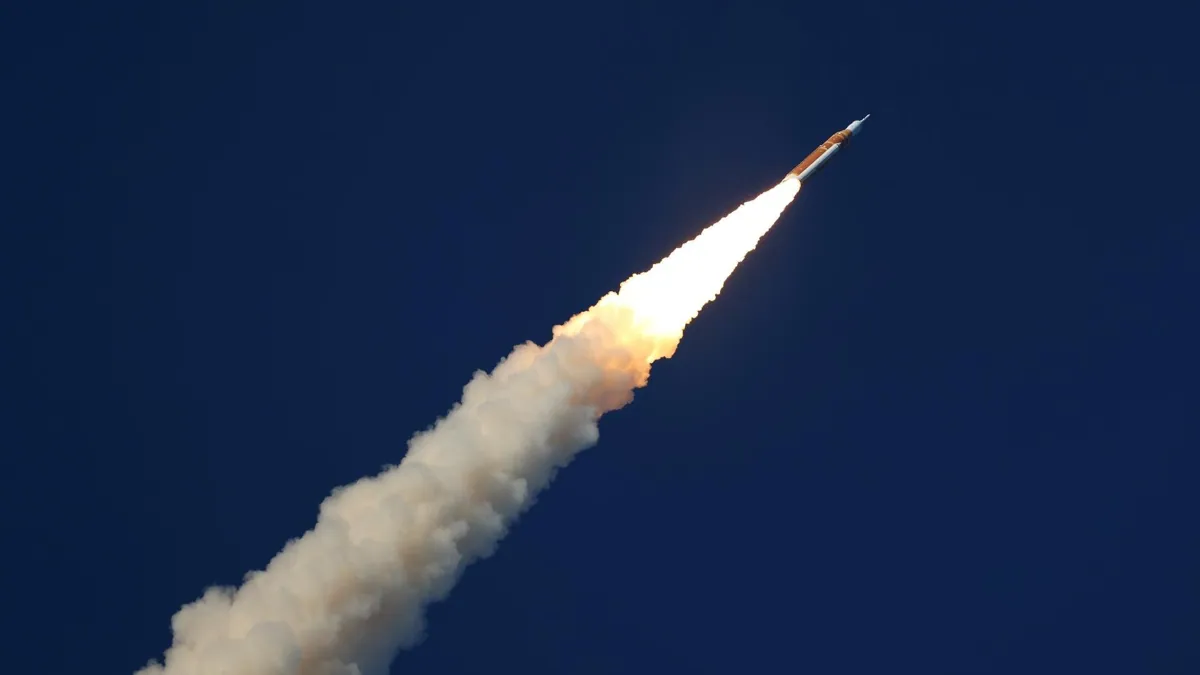
When NASA's Artemis II mission launched toward the moon in April 2026, it didn't just mark the first human return to lunar space in more than fifty years. It also tore open the upper atmosphere so forcefully that GPS signals across the United States briefly went haywire, according to a new study from researchers at National Cheng Kung University in Taiwan.
The team didn't set out to study rocket launches. They used high-precision networks of fixed, ground-based GPS receivers, the kind U.S. scientific institutions normally rely on to track the slow creep of tectonic plates before earthquakes. By timing how long GPS signals took to travel from satellites to those ground stations, the researchers reconstructed what happened to the ionosphere, the electrically charged layer of atmosphere that starts around 30 miles up, as the SLS rocket roared through it.
What they found was the most severe ionospheric disturbance ever recorded from a rocket launch. The disruption was up to ten times more intense than what followed SpaceX Starship test flights, even though Starship produces roughly twice the liftoff thrust of the SLS, according to the study.
How a rocket punches a hole in the sky
GPS works by having a receiver measure its distance from four satellites orbiting about 12,550 miles up, well above the ionosphere. Those satellite signals have to pass through that charged layer to reach the ground, and when the concentration of free electrons up there shifts suddenly, the signal arrives faster or slower than it should. That timing error translates directly into a positioning error.
Big solar storms do this too, sometimes degrading GPS accuracy for days by dumping charged particles from the sun into the atmosphere. Rocket launches cause a faster, more localized version of the same thing: a rocket flying through the upper atmosphere at supersonic speed generates a shock wave that effectively punches a hole through the ionosphere's electron density.
Artemis II left behind two of these holes. One came from the 212-foot SLS core stage during ascent. The other, more intense, came from two thruster burns of the rocket's upper stage more than an hour after liftoff, as it pushed the Orion capsule out of Earth's gravity and on toward the moon. Both disturbances stretched roughly 3,100 miles across the continent, from east to west, like oversized contrails. The upper-stage burns, happening directly inside the ionosphere at around 115 miles altitude, produced a more pronounced disturbance than even the powerful core-stage ascent.
Why a few meters matters
The ground stations detected shifts in ionospheric electron density equivalent to GPS positioning errors of several meters, according to Charles Lin, an earth science professor at National Cheng Kung University and a co-author of the study.
That might sound trivial, but modern systems that depend on precise positioning don't have much room for error. "A positioning error of a couple of meters is enough to cause an autonomous car to change lanes," Lin told Space.com. "It could have a strong impact not only on self-driving cars but also on drone positioning."
The effect is short-lived compared to a solar storm, but the timing is unpredictable from a user's perspective, and the scale here was unprecedented. Lin noted that the specific kind of disturbance seen from the upper-stage burns, generated by an orbital maneuver during an interplanetary mission rather than just a launch, hadn't been observed before. "Rocket launches from the ground to space produce that kind of effect, but we have never seen this kind of orbital maneuver in an interplanetary mission," Lin said.
More moon missions, more atmospheric noise
That's the part of the finding that points forward rather than backward. As NASA and other space agencies push toward a sustained presence on the moon, and eventually crewed missions to Mars, launches like Artemis II are set to become routine rather than rare. Lin's team argues that means the kind of space weather effects triggered by rocket passages, previously a minor curiosity, could start showing up more often in the systems people actually rely on day to day.
The study, posted as a pre-print in the journal Geophysical Research Letters, doesn't suggest GPS users need to worry about routine disruption from Artemis-scale launches happening weekly. But it does establish a new benchmark for how much a single heavy-lift mission can perturb the upper atmosphere, and a reason for researchers to keep watching what happens overhead every time a rocket this powerful heads for deep space.